

Cape Rosier woman shares an elephant love lesson
Foster parent to a baby elephant speaks on connection to the world's largest land animal
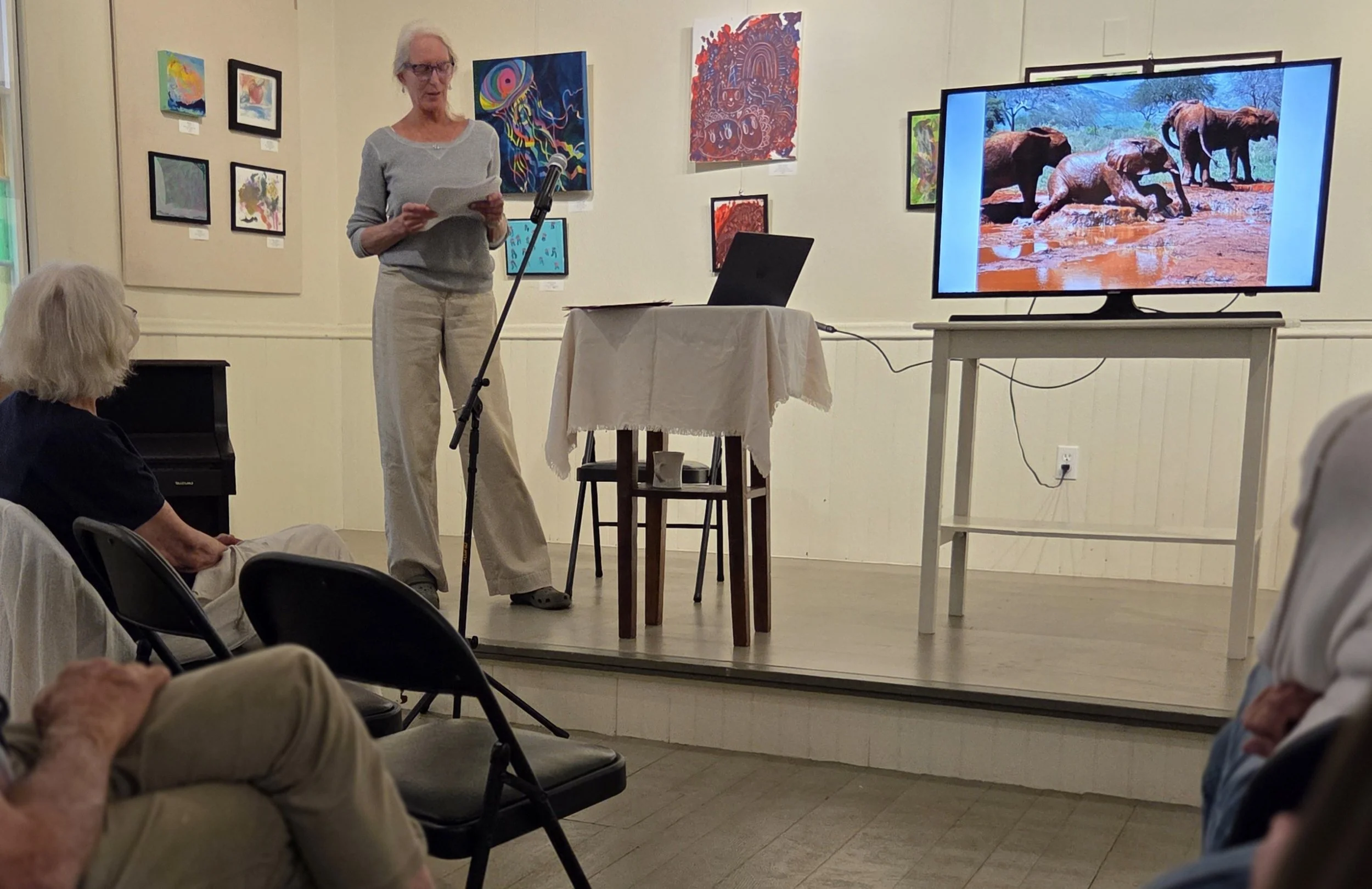
At Brooksville's Reversing Falls Sanctuary, Megan LeBoutillier narrates her trip to Kenya where she "learned about love from the elephants." Photo by John Epstein.
Aug. 26, 2026
By John Epstein
BROOKSVILLE—This past December, Cape Rosier’s Megan LeBoutillier embarked on a two-week trip to Kenya, where she visited an elephant rescue center in Nairobi, as well as sites in Kenya’s national parks where elephants are reintegrated into the wild. There, she learned an important lesson about love.
About 15 years ago, LeBoutillier decided to foster baby African elephants for $50 a month through a program set up by the David Sheldrick Wildlife Trust, a Kenya-based organization that has rescued orphaned elephants for well over 50 years. Her long-awaited tour in Kenya was offered to donors like LeBoutillier from the trust.
On Aug. 23, LeBoutillier gave a presentation to a rapt audience in the Reversing Falls Sanctuary meeting room in Brooksville. She spoke about her experience while showing stunning slides and videos. The title of her presentation: “What I Learned About Love From the Elephants.”
“My previous experience with elephants had been seeing them solitary and sad in a zoo,” she said. But her trip to Kenya opened her eyes to the emotional depths of the world’s largest land animal. “They touched my heart and made my eyes leak,” LeBoutillier said.
She then narrated a video that documented the rescue of a baby elephant that had been abandoned near a small village on the Kenyan savannah.
“It had been alone for five days and was severely dehydrated,” she said, possibly abandoned by a herd that had been chased away by villagers protecting their crops, or attacked by poachers, who hunt elephants for their ivory.
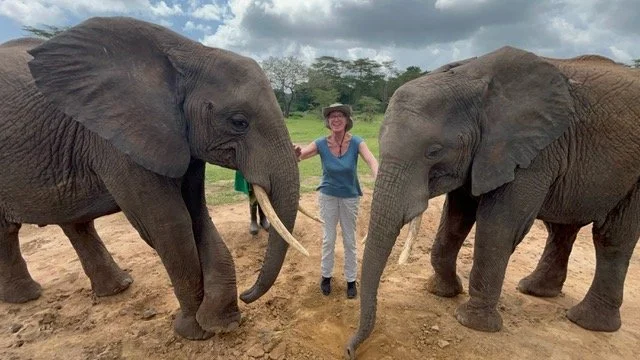
Megan LeBoutillier at Kenya's Umani Springs between two orphaned elephants who have recovered from injuries. Photo courtesy of Megan LeBoutillier.
A group of Kenyan keepers arrived by airplane to save the emaciated male calf. They wrapped him in a blanket and lifted him into an aircraft, where he was infused with fluids and taken to an elephant nursery in Nairobi. The keepers placed the sick orphan, which they named Larro, into a stable next to another elephant calf that had regained its strength. The healthier animal reached its trunk into the neighboring stall, using it to comfort the suffering baby.
Later, when Larro regained sufficient strength, the keepers introduced him to the cadre of other rescued orphans, who embraced the rescued calf with their trunks, too.
“Their trunks are amazing and very expressive,” said LeBoutillier. “They have 4,000 muscles and are used for everything, but the babies don’t quite know what to do with them at first, and they just seem to flop them around,” she said.
LeBoutillier noted that elephants also relate to their African keepers, emotionally, as family. An amazing circumstance, she said, considering all the suffering inflicted upon elephants by humans.
In a particularly harrowing video, she showed how keepers rescued a young elephant that had been stabbed with spears by villagers, who wanted revenge after an adult elephant in the baby’s herd had killed a man in their farming community. Despite risks from angry villagers, the keepers transported the severely injured creature to the rehabilitation center. There, she was given the name Mbegu and nursed back to health.
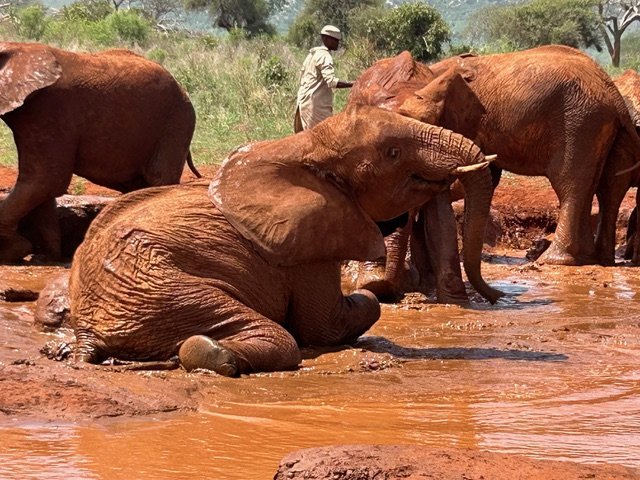
Rescued elephants playing in a mud bath. Photo courtesy of Megan LeBoutillier.
So while humans are the elephants’ worst enemy – most orphans are the result of illegal hunting – traumatized calves are still able to form deep connections with the men and women who heal them.
“I would secretly love to be a keeper,” said LeBoutillier. “They adore the elephants, and many of them are second and third generation,” she said.
LeBoutillier explained that when a baby elephant is brought to the Nairobi nursery, keepers will feed them a specially formulated milk substitute every three hours. This regimen, which mimics the feeding cycles for elephant babies in the wild, must be followed for three years.
When an orphan has recovered sufficient health at the Wildlife Trust’s Nairobi Nursery, they will be transported to one of three reintegration centers in Kenya’s vast Tsavo National Park. There, the young elephants will join older ones, who crowd around to greet the new arrivals. While they are new, they can roam around the parkland during the day under the watchful eyes of their human keepers and return at night to their enclosures to sleep. As they mature, they have the choice to come and go.
“It may take 10 years, but eventually many elephants will decide to go into the wild for good, especially the males,” LeBoutillier said. “It’s the mating instinct.”
She described how female elephants will provide milk for orphaned calves. “And orphans that have gone back to the wild to have babies will return to the park’s reintegration enclosures to show the keepers their babies,” she said.
“There are things elephants do that make me cry,” LeBoutillier said.
LeBoutillier’s presentation showed how humans can draw emotional lessons from the way elephants treat their young and respond to tenderness.
“They demonstrated love, community, courage and hope,” she said.
Two cavorting baby elephants, Lenny and Sulwe, cavorting under the watchful eyes of their parents. The calves were born in Kenya's Tsavo National Park to orphaned mothers who returned to the wild. Video courtesy of Megan LeBoutillier.
