

Some behind-the-scenes of play rehearsal include crashing a bike
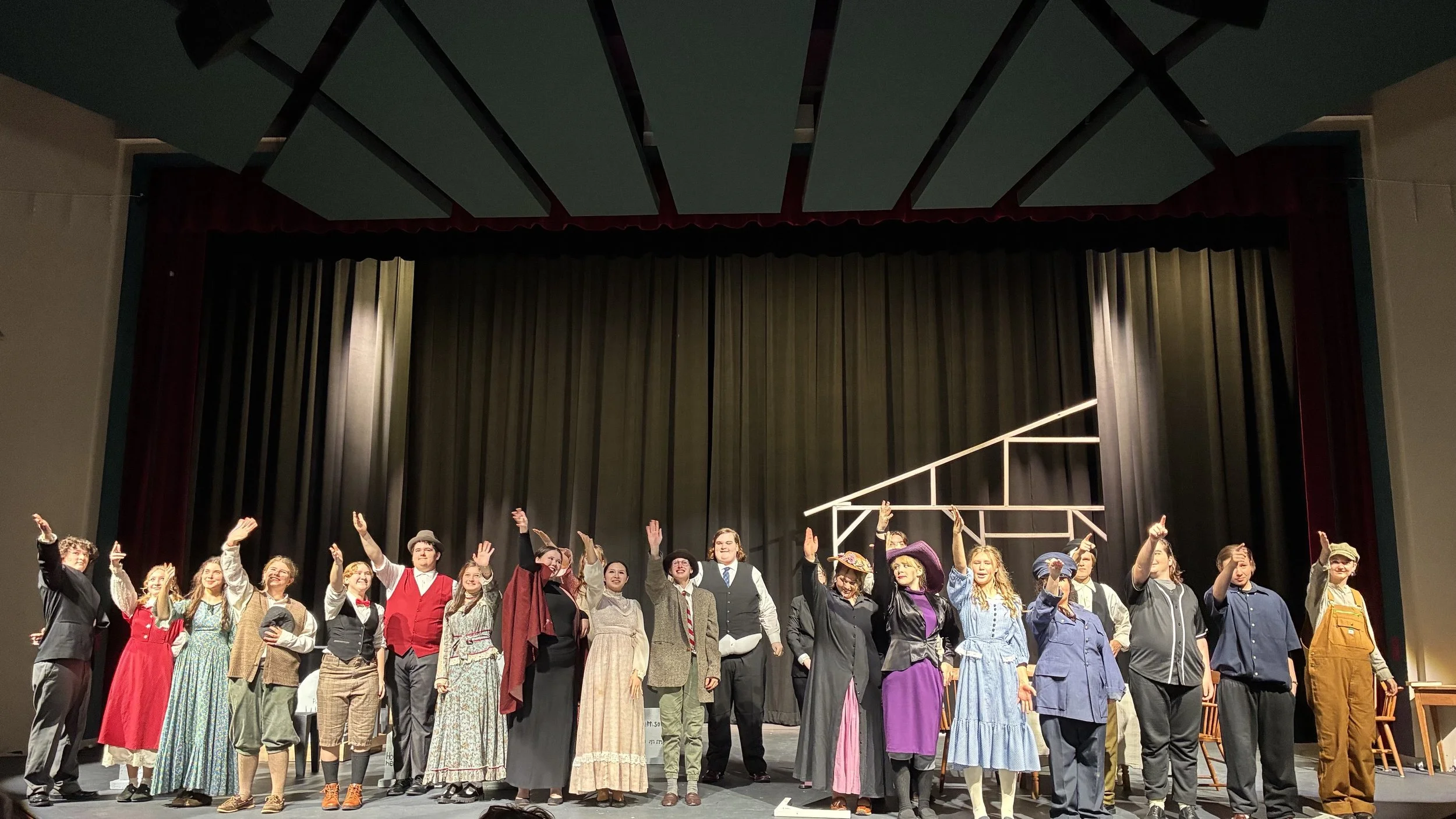
Between set design, crew and performers, roughly one-third of the student body participated in this year’s production. Photo by Tatiana Heggestad.
Nov. 9, 2026
By Tatiana Heggestad
DEER ISLE –Students from Deer Isle-Stonington High School performed Thornton Wilder’s Pulitzer Prize-winning play Our Town at the Reach Performing Arts Center on Nov. 6 and 7. The production brought students together from across the school, both onstage and behind the scenes, to tell a story about everyday life, relationships and the passage of time in a small New Hampshire town.
Set in the fictional town of Grover’s Corners, Our Town follows two neighboring families, the Webbs and the Gibbs, through three acts: “Daily Life,” “Love and Marriage,” and “Death and Eternity.” As the characters grow up, fall in love, and face loss, the play explores the significance of ordinary moments and the connections that shape a community.
John Lincoln, the play’s director, said the production offered students an opportunity to take on a different kind of theatrical challenge.
“It gave them a chance to play emotionally realistic characters after a couple years of doing plays about pirates, aliens, along with the musical Frozen,” Lincoln said.
The shift toward realism was something the students said they appreciated. Maeve Aldrich, who portrayed Emily Webb through different stages of life in the production, said her favorite part of the experience was “definitely the emotional acting, visualizing emotions, and acting as a real person, not characters.”
The production made creative use of the 400-seat Reach auditorium. Instead of confining action to the stage, the production utilized the balcony for a choir scene, and had characters entering through doors throughout the auditorium for several different scenes.
Farrah Faulkingham, who, in her first theatrical production, played paperboy Joe Crowell, even biked through the auditorium as part of the performance. It was not without its risks: During rehearsals, the ambitious entrance resulted in Faulkingham crashing the bicycle into the seats.
Behind the scenes, Lincoln’s guidance encouraged students' personal growth, making a lasting impression on many students, Faulkingham said.
“John Lincoln is the greatest person I ever met,” Faulkingham said.
The sense of community that comes with putting on a school production was a high point for participants in the production.
Quincy Lincoln, who played one of the lead roles, George Gibbs, described connection as one of the most important lessons to take away from the experience.
“Theater has always been a huge part of the school,” said Lincoln, who is the son of director John Lincoln.
“It’s a huge part of our culture, not just the school but the island. I’ve connected with people. I’m going to take away the connections with others, that the theater is great and that everyone should participate. It’s part of our culture.”
Throughout the fall, the student performers worked diligently, rehearsing for two hgours every day after school. In total, 22 students performed onstage, and approximately one-third of the school participated in some capacity. Eric Beachy’s stage design class met every day to bring the production to the stage, and Jenn Adams, the school’s music teacher, worked with students on the music for the past two months.
Our Town, with its themes of everyday life and community, reflected the students’ own experience in working together to bring the production to the stage.
