

Professor discussses hope and local action in face of climate change
Colby scientist draws a connection to climate and public health
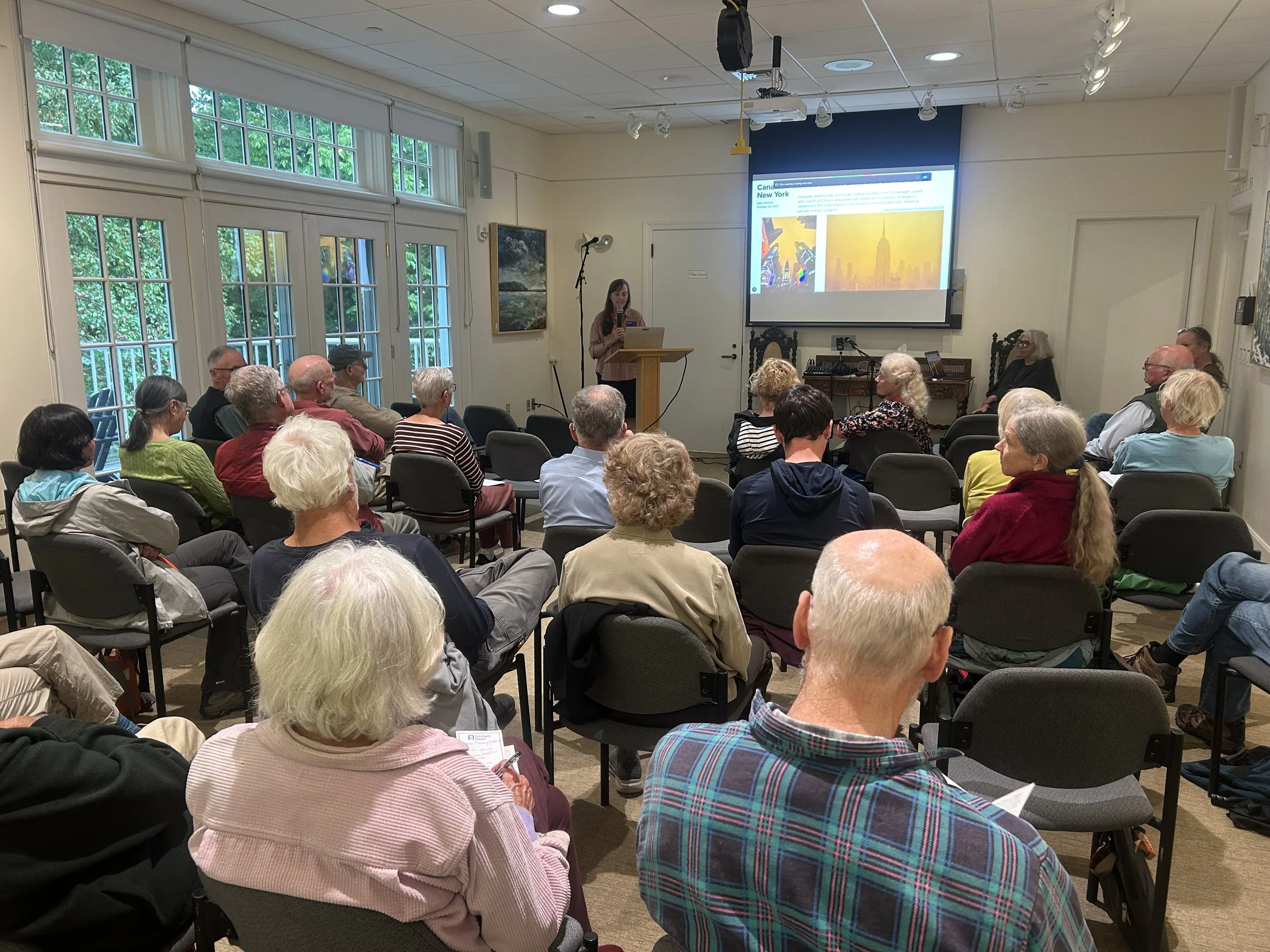
Gail L. Carlson presented to a crowded Howard Room in the Blue Hill Public Library. Photo by Maizy Weirich.
Sept. 8, 2026
By Maizy Weirich
BLUE HILL—Colby College Prof. Gail L. Carlson discussed how peninsula residents can track public health data related to climate change at a Sept. 3 presentation at the Blue Hill Public Library.
The event was hosted by the Brooklin Climate Response Committee, which was established by the town of Brooklin in 2022. The committee aims to “reduce and prepare for the ongoing effects of climate change,” according to the group’s website.
In her presentation, Carlson said that tick-borne illnesses, as well as asthma linked to worsening air quality can be symptoms of climate change in Maine. Carlson also spoke to concerns about “climate anxiety” and the consequences it can have on mental health.
Carlson suggested a resource from the Maine CDC, The Maine Tracking Network, where Mainers can become more informed on climate-relevant health matters, including local air quality readings, and the number of emergency department visits for matters related to tick-borne diseases per county.
She also mapped out the Maine Climate Council's 2024 climate plan, revised every four years, which helps guide Maine legislation. According to her presentation, the plan is focused on strengthening public health monitoring, education and prevention, as well as increasing awareness and action on the mental health impacts of climate change.
While the majority of the discussion was focused on climate change’s impact on physical health, Carlson emphasized the need to look toward an optimistic future in the face of rising climate anxiety, saying, “You have to have hope.”
“I think that’s the hugest thing that people can do, is to focus locally. Connect with people. Understand the climate impacts in your area,” she said.
One example of such local focus is the “Neighbor to Neighbor” program offered by the event’s host, the Brooklin Climate Response Committee. The program provides homeowners with tips on how to make their homes more energy-efficient. The program has generated more than 60 home visits and follow-up reports, according to their website.
Local action and empathy for those impacted by climate-related matters are key factors in personal action, according to Carlson’s presentation.
“I think we ought to have compassion for people whose physical and mental health is suffering. Whose well-being is suffering. And I feel like that’s something we all understand at a local level,” Carlson said.
