

Millions of stars show up for the Dark Sky Maine party
Other unexpected celestial guests crash Brooklin event to celebrate the night sky
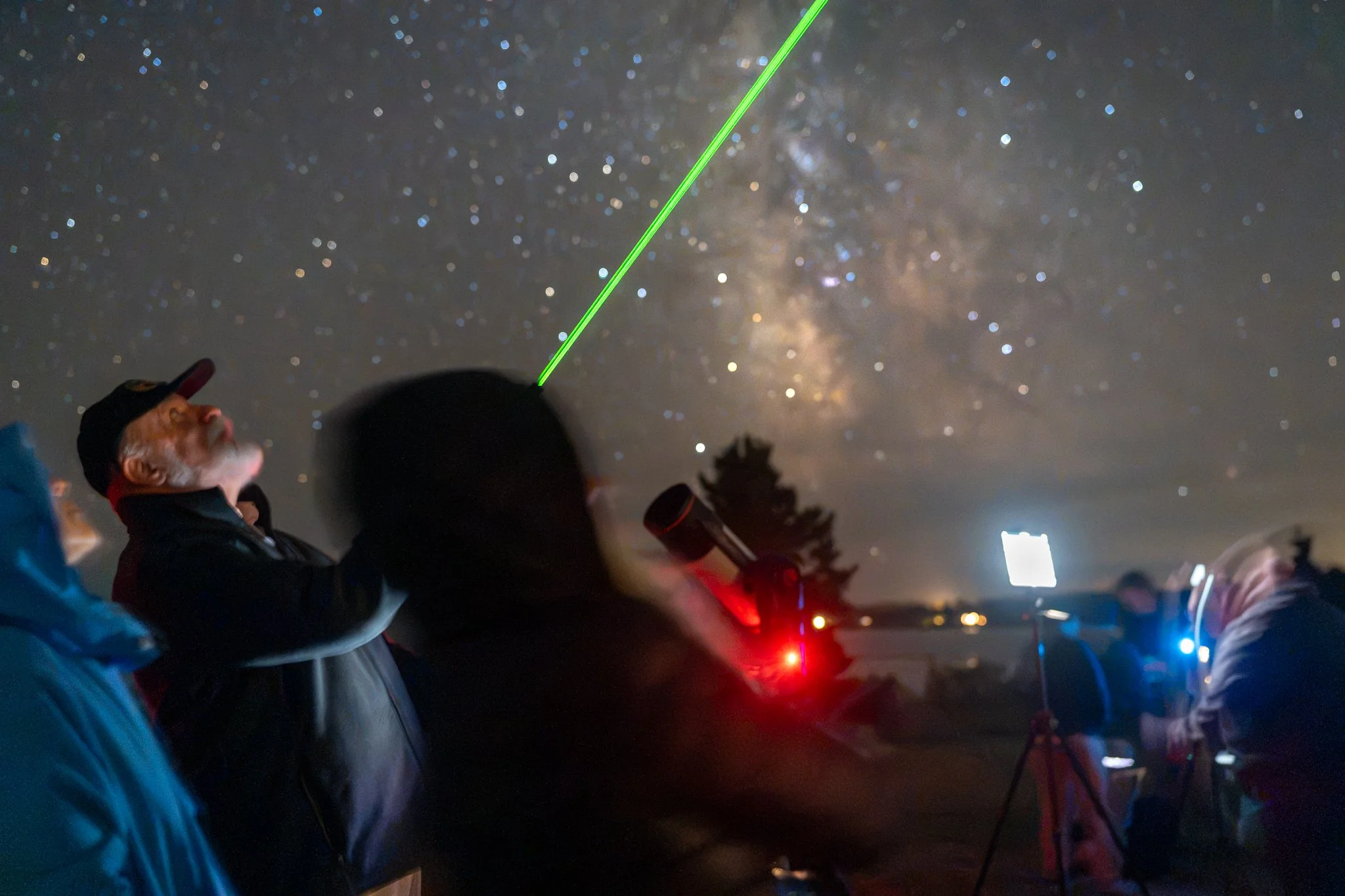
Astronomer Dwight Lanpher uses his laser pointer to help stargazers navigate the universe at the Dark Sky Star Party. Photo courtesy of Justin Miller, JMnaturescapes.
Sept. 15, 2026
By John Epstein
BROOKLIN – The heavens were perfectly aligned for the Sept. 12 star watch party at Flye Point in Brookin sponsored by Dark Sky Maine, a nonprofit that seeks to educate people about the importance of seeing the cosmos above and reducing light pollution below, so as not to obscure the universe’s visibility.
Over a hundred people gathered late Saturday afternoon on the fields behind the Lookout Inn that peered out in a southerly direction onto Herrick and Blue Hill Bays. The sky was clear, boding well for a night of stargazing with the moon still in its new phase. People lined up for slices of wood-fired pizza and listened to the Loose Cannon Jug Band.
There were interesting celestial formations before darkness fell.
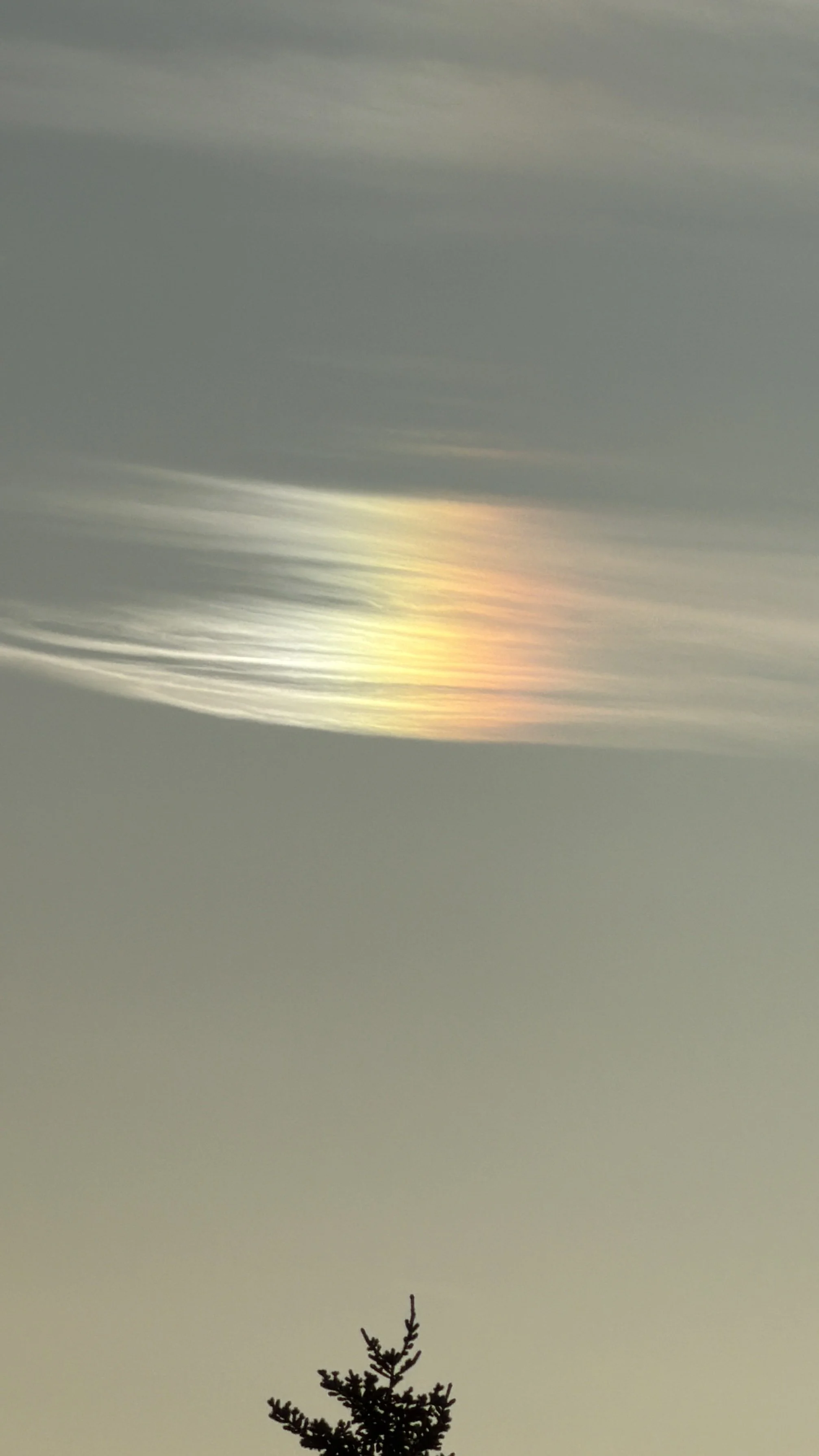
A "sun dog" glows in the western sky as viewed from Flye Point. Photo courtesy of David Clark.
“Look, a sun dog,” shouted a man, pointing to a group of wispy cirrus clouds in the western sky that glistened in the waning sunlight, revealing a full spectrum of colors.
“The clouds are high enough for there to be ice crystals in them; they act like a prism to refract the light into colors,” said Dave Clark, a retired physicist and amateur astronomer.
Clark had set up a telescope to capture images of the sun’s surface filtered through a lens which modified the glare. Ellsworth’s Alysha Soderquist and her son, Daryn, 12, each took a peek.
“That’s really cool,” Daryn said. “I saw the sunspots.”
As dusk approached, Nancy Hathaway, co-founder and president of Dark Sky Maine, briefly addressed the crowd.
“We and the animals on the planet need to see the universe,” Hathaway said. “Migrating birds, pollinating insects, rely on seeing the stars … and circadian rhythms rely on darkness.”
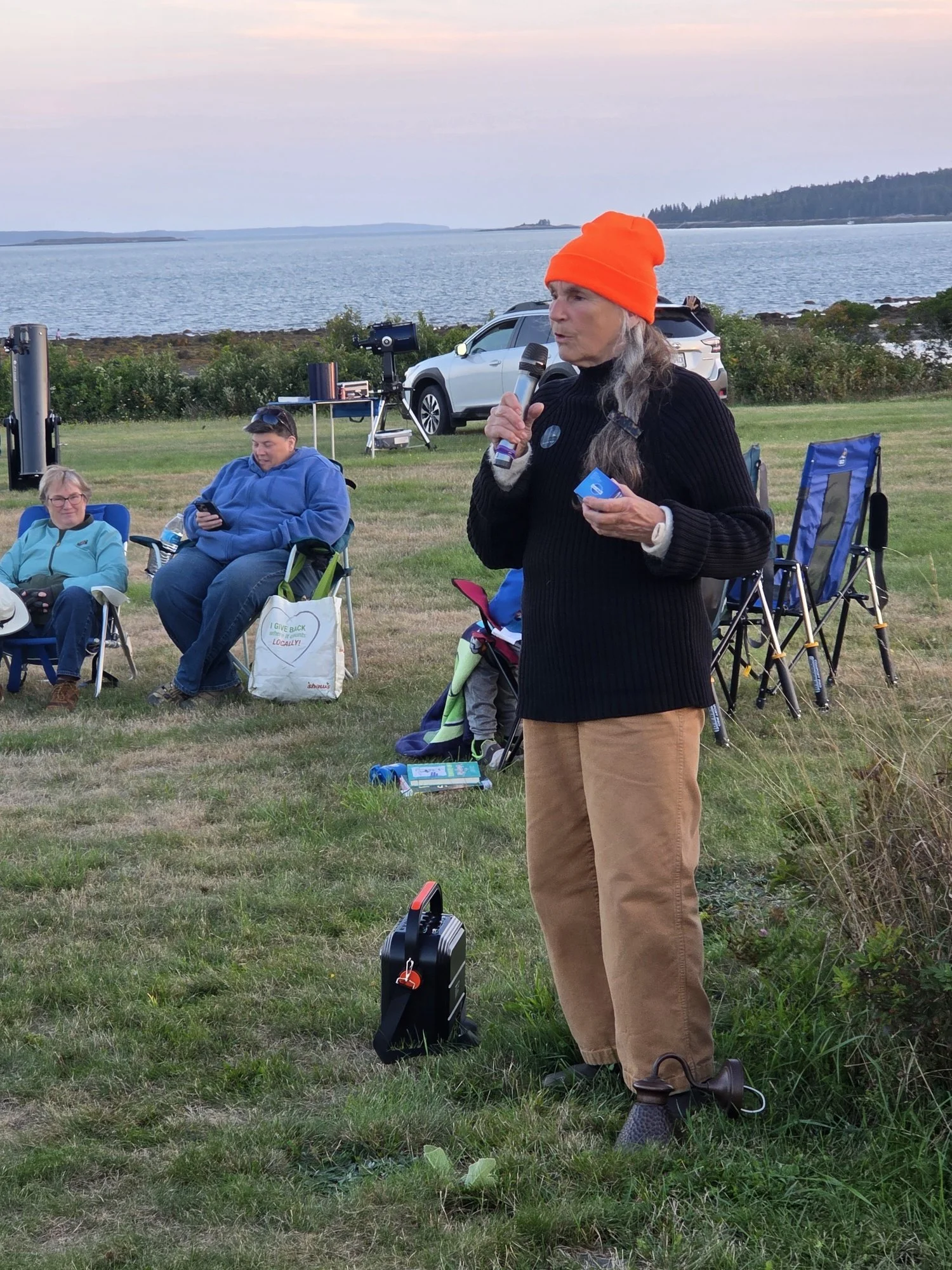
Nancy Hathaway, co-founder of Dark Sky Maine and organizer of the Dark Sky Star Party at Flye Point. Photo by John Epstein.
She urged folks to use soft, warm-white outdoor lights, no more than 2700 Kelvins, and use outdoor fixtures with shields that point down to the ground – measures that will save energy and reduce light pollution. She also mentioned the new state law, LD1934, which limits the scope of new installed lighting in public facilities beginning Oct. 1.
Hathaway then handed the portable mic to Jan Heimlich, a Dark Sky Maine board member, writer, and daughter of the man who invented the Heimlich Maneuver. She lives in Rockland and “would like to see fireflies again” in her town.
Heimlich said Rockland has adopted an ordinance mirroring one passed by Portland that requires soft lighting in new buildings that doesn’t “trespass” into a neighbor’s space.
Rob Burgess, president of the Southern Maine Astronomers Association, said, “Eighty percent of the people in the United States can’t see the Milky Way because of light pollution.”
He spoke of his concerns about the number of satellites currently being launched into the sky with no international regulation, creating “space junk.” He said company Reflect Orbital, for example, just received approval from the Federal Communication Commission to launch a satellite, equipped with a 60 by 60 foot solar mirror, to beam light down to Earth and illuminate dark areas on the planet. Burgess said there is no obvious human benefit from this project.
On another note, Burgess also explained some of the incomprehensible distances that separate humans on Earth from celestial formations.
“The Andromeda galaxy is 2.5 million light years away,” he said, “and what we are seeing is the past.”
That galaxy became visible as darkness enveloped Flye Point. Since light travels in space at 186,000 miles per second, Burgess pointed out that Andromeda is 25 trillion miles away.
“Someday it will collide with the Milky Way, but we have nothing to worry about,” he joked.
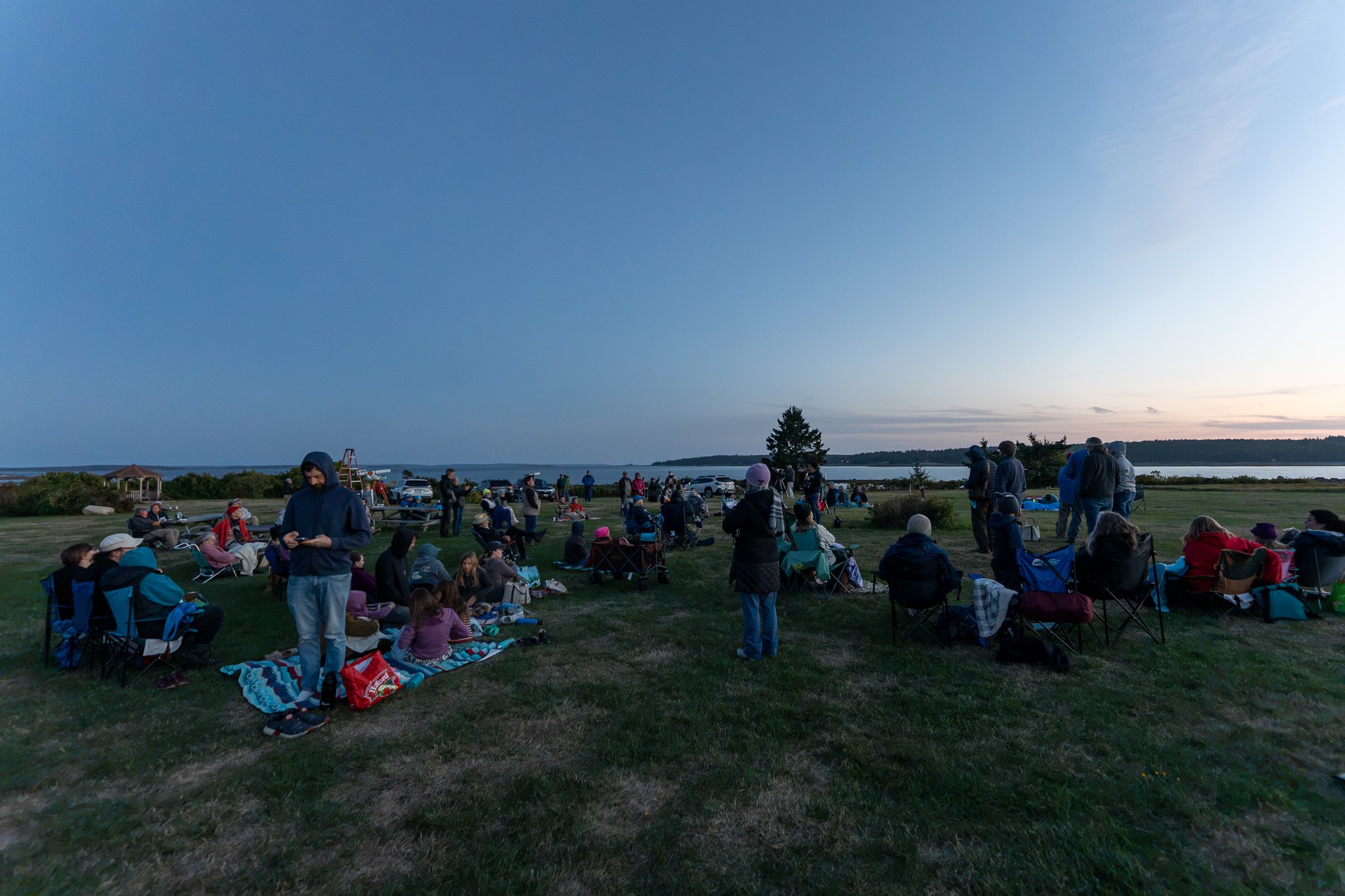
As dusk turns to darkness, folks bundle up and prepare to see the night sky at Flye Point. Photo courtesy of Justin Miller, JMnaturescapes.
As people gathered around the telescopes in the darkness of night, a man yelled, “Look, it’s the space station.” People pointed to a big, shining object, larger than any star or planet visible, that moved in an easterly direction across the sky.
“Yes, indeed, there it is,” Jon Silverman said, president of the Central Maine Astronomers Society, “it’s probably the largest light you’ll see tonight in the sky.”
With the occasional help of a laser pointer, Silverman talked about the constellations that were in the southeastern sky, including Sagittarius and Scorpio.
“We won’t see them in the sky here by winter,” he said, “we are on the edge of the Milky Way with most of the galaxy south of Earth, which is why observatories face south.”
Silverman said there are various reasons humans benefit from seeing the stars.
“There’s always been a practical application for studying the stars: They helped us navigate and know where we are…But there’s also the wonder of it all,” Silverman said. “It’s good for the psyche to see something bigger than ourselves.”
As the temperature dropped, the crowd thinned and some made their way to cars obscured in the darkness and driving home.
A few, like photographer Justin Miller, who has made dark sky pictures one of his specialties, would be at Flye Point most of this special night.
“This is what I do,” he said.
