

Erin Amadon shares what to avoid in trail design and how art and creativity play into this ‘labor of love’
Nov. 9, 2026
By Steele Hays

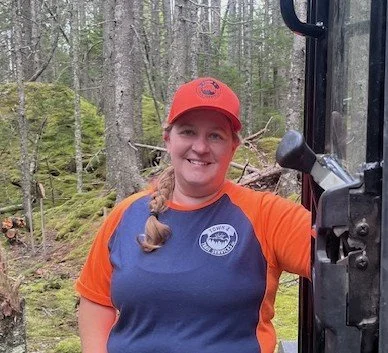
Erin Amadon is building an “all-access” section of trail to Barred Island on Deer Isle, and hopes to complete it by mid-December. Photo by Steele Hays.
Thirty years ago, while still in high school and working on a trail-building crew, Erin Amadon “fell in love with being in the woods.” Nowadays, she is driven to help others, including those with mobility challenges, have similar experiences enjoying nature and exploring trails in beautiful natural areas.
Amadon, 46, is a professional trail builder, a leader in the field, and a member of the board of the Professional TrailBuilders Association, a nonprofit trade association for the trail industry which celebrated its 50th anniversary this year.
She works alone most of the time, designing and constructing trails for organizations like Island Heritage Trust, which has contracted with Amadon to build an “all-access” section of trail to Barred Island on Deer Isle, IHT’s most popular trail. The 1,300-foot trail segment will make it possible for people who use wheelchairs or who have other mobility challenges follow the trail for a quarter mile through a mature spruce forest, where the forest floor is completely covered with a lush layer of moss.
“Science has shown us that time spent in nature is really beneficial for our health,” Amadon told The Rising Tide while taking a break from her work at Barred Island Preserve. “Maine and the rest of New England are catching up at a fast rate with the rest of the country in building access trails.”
There’s been a surge in recent years in all‑access trail development — paths designed to be usable by people of all ages and abilities. All-access trails are typically wider, have gentle grades of eight percent or less, and feature smooth graded surfaces and boardwalks over wetland areas.
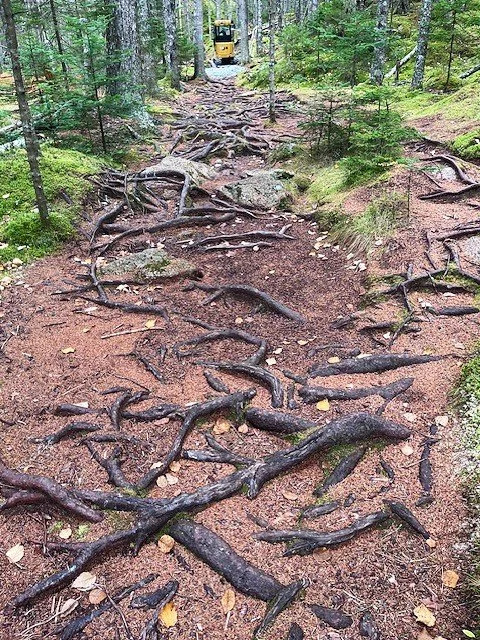
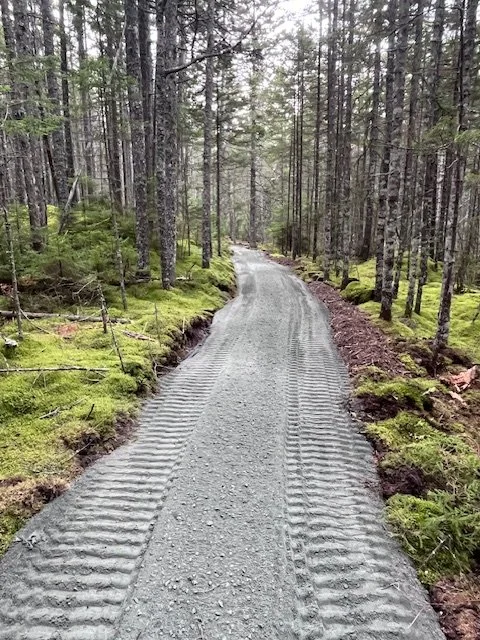
Amadon recently completed work on an all-access trail at IHT’s Lily Pond Park and has now been working on the Barred Island Trail for four weeks. She owns and operates her own fleet of specialized construction equipment: excavators, rollers, skid steers, and a Canycon brand crawler-dumper which lets her transport gravel, lumber, mulch and other materials along the trails as she builds them section by section. All of them are rugged, tracked vehicles specifically designed for trail work.
“Trail work is a little bit engineering, a little bit mathematics, a lot of physical work and a labor of love,” Amadon said.
In 2013, the U.S. Forest Service defined a set of standards for all-access trails. To meet those standards and create the best possible experience for trail users, Amadon has relocated the Barred Island trail in several sections. Much of the former trail was a virtual obstacle course of roots and rocks. The newly upgraded sections present a striking contrast. Amadon has extracted and moved many large rocks, selectively cut trees to widen the trail, and laid down and compacted a bed of crushed stone to create a smooth walking/riding surface.
She has also rerouted sections of the trail to create pleasing sight lines and views.
“That’s where art and creativity really come into it,” she said. “Because once you know how to build, you realize what you can get away with in the design phase. But that only comes with experience.”
Well-designed trails create a feeling of “being immersed in nature,” she said. That’s her goal.
One key principle of trail building is to design sustainable, durable trails that will hold up through heavy rainfall events, as well as to the wear and tear from hikers. Many trails built decades ago follow “fall lines,” which are steep paths that run straight up slopes, often along stream beds, ravines, and old animal trails, making them susceptible to erosion, according to Amadon. Alternatively, she routes trails along the contours of the land as much as possible to avoid erosion risk.
“There’s a saying: Get the water out of the trail or the trail out of the water,” she said.
Amadon is highly regarded in the trail building industry. She was featured in a video produced by the Professional TrailBuilders Association and leads training sessions at the association's national conferences. She is quoted in a 2025 National Geographic Magazine article on trail building and has worked on trail projects all over the country, and even in Argentina.
Amadon speaks about creating a “natural and organic” experience through trail design. Video courtesy of Professional TrailBuilders Association.
Being a professional trail builder in Maine is a seasonal business.
Amadon considers her building season to run from April to mid-December, depending on weather conditions. Once the ground freezes, she can often continue to work outside building boardwalk sections – raised above the ground. She travels a great deal, working on site on weekdays wherever her projects take her and heading home to Troy, Maine, near Unity on weekends. When working in the field, she often stays in a small camper.
Alex Drenga, IHT’s conservation director, said the land trust recently revised its five-year strategic plan to place a higher priority on building all-access trails.
“It’s not just about people who are born with mobility issues,” he said. “At some point in our lives, if we live long enough, we all are likely to have challenges in our mobility. Maine has an old demographic and this is about helping more people stay active and have access to the outdoors.”
The trail work at both preserves is being funded by a $250,000 grant IHT received last year from the Maine Trails Program, a state-administered program passed by the legislature in 2024. The law allows the funding of up to $30 million for trail work over the next four years. The first round of grants was awarded in 2025.
Amadon hopes to complete the Barred Island trail work by mid-December if the weather allows. If the weather does not cooperate, she’ll break for the winter and finish next spring, she said.
