

Conflict between an intact dam and a dry driveway is only resolved by a ‘beaver deceiver’
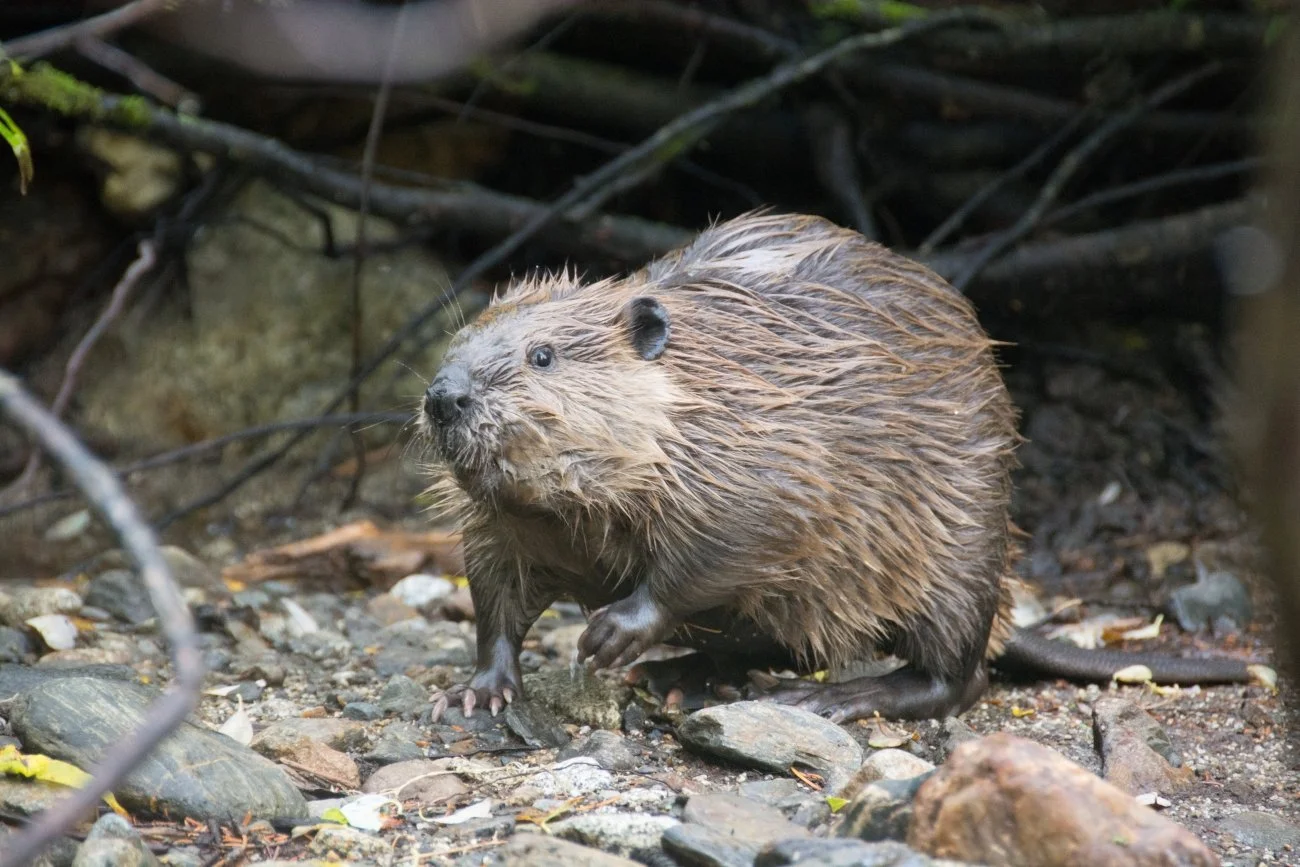
Once nearly wiped out by the fur trade, beavers have made an astonishing comeback. Photo courtesy of the U.S. Fish and Wildlife Service.
Nov. 16, 2026
By Kimberly Ridley
My friend Jon is well acquainted with the vagaries of living beside beavers. They repeatedly clogged a culvert under his dirt driveway with mud and sticks. Every time he mucked it out so his driveway wouldn’t flood, they filled it back up the same night. This went on for months.
When Jon had a caged pipe system called a “beaver deceiver” installed to stabilize the water level, he thought his troubles were over. He assumed his driveway would stay dry as the beavers went about their business in the pond. The next spring, however, the beaver pond started to rise again, threatening to inundate his driveway. When he rowed to the far side of the pond one morning, he discovered that the beavers had built a low dam plastered with a thick layer of mud.
And so began a new ritual. Every morning, Jon grabbed a shovel and stood in the stern of a small rowboat to quietly scull across the pond with a single oar. He cut sluices through the mud atop the dam to drain excess water. But the beavers returned every night to fix the leaks.
“People asked me if I was going to do this for the rest of my life,” Jon said, laughing. “I asked myself the same question.”

He was up against formidable creatures. Beavers shape the landscape more than any animal other than humans. A single beaver can chew down 200 trees a year, thanks to self-sharpening incisors fortified with iron, which tints their teeth orange.
The mere sound of running water triggers beavers to build and repair dams. These furry wetland engineers go to extraordinary lengths to construct and modify dams that maintain their pond levels at specific depths—not too deep, but deep enough to keep the entrances underwater and prevent ponds from freezing solid in winter.
They begin by laying a low foundation of sticks and branches on a stream bed and weigh it down with rocks and mud. Over this, they stack more sticks and branches, and felled trees up to 10 inches in diameter, anchoring the larger, gnawed ends in the bottom of the stream. The final step is caulking the whole shebang with plant debris and mud.
Remarkably, beavers build curved dams to withstand strong currents and straight dams across slow-moving streams. A family or colony may construct a dozen dams over the same stream, maintaining them daily and often over many generations. Beaver dams are surprisingly strong and can be massive. The largest beaver dam in the world, located in Wood Buffalo National Park in Alberta, Canada, is nearly a half-mile long and can be seen from space in satellite images.
Beaver lodges are also marvels of construction. Built from hardwoods such as aspen, willow, and cottonwood, a lodge can be as large as a living room. Each lodge houses a family and contains a cozy chamber that serves as a nursery, family room, and bedroom. The winter pantry is right outside the front door: a cache of submerged branches covered with nutritious bark. In cold climates, beavers plaster their lodges with mud, which freezes into a thick cement that protects them from coyotes and other predators.
Beavers expanded their sturdy lodge in the pond along Jon’s driveway. Even as he was frustrated trying to prevent them from flooding his road, something changed as he sculled across their pond every morning to sluice the dam.
“I don’t mean to sound woo-woo,” Jon said, “but what started out as a goddamned chore became a sort of sacred ritual. Where once I sometimes thought if someone came out and just shot them one night I’d be happy, now, I felt like these were my beavers.”
Curious, he set up a trail cam by the dam to watch the beavers at night. The footage fascinated him.
“The beavers placed heavy, waterlogged sticks so adroitly that they didn’t wash away,” Jon said. “They’re ingenious.”
A second pipe and cage system—installed underwater near the dam by beaver deceiver inventor Skip Lisle— prevented the beavers from hearing the leaks or detecting them. They continued to go about their business, and no more flooded road. Lisle created this while working as a wildlife biologist for the Penobscot Nation after earning his master’s degree at UMaine.
Click here to learn more about Beaver Deceivers.
I asked Jon why he went to all the trouble, where some folks might just have the beavers trapped and removed or worse, killed. His reply was simple.
“It’s impossible not to respect them,” he said.
Indeed. Once nearly wiped out by the fur trade, beavers have made an astonishing comeback. Their numbers have grown from an estimated 100,000 in 1900 to upwards of 15 million today. In that time, we’ve learned a great deal about them—and their role in maintaining and even restoring ecosystems. While living their lives, they create verdant wetlands that clean and store water, mitigate floods and droughts, and provide habitat for a host of birds, fish, amphibians, reptiles, insects and mammals.
Under this month’s Beaver Moon—the best viewing will be at dusk on Nov. 23 and 24—our furry neighbors are at their busiest, stocking their pantries, winterizing the lodge, and repairing dams. Visiting Jon’s pond to watch them, I think about how beavers contend with many of the same challenges we humans face, from managing water to creating sustainable communities. They demonstrate that it’s possible to not only make a landscape more beautiful, but also enrich it, creating a home for many other creatures. As Ben Goldfarb wrote in Eager: The Surprising, Secret Life of Beavers and Why They Matter, “What looks to us like disorder is more properly described as complexity, a profusion of life-supporting habitats that benefit nearly everything that crawls, walks, flies, and swims in North America.”
Maine native Kimberly Ridley is the award-winning author of six creative nonfiction books about the natural world for children and adults, including The Secret Pool and Wild Design: Nature’s Architects. Her essays and articles have appeared in numerous publications including Down East Magazine, The Christian Science Monitor, and The Boston Globe. She lives in Brooklin with the painter Tom Curry and their cat Andy. www.kimberlyridley.org
