

My Wild Neighbors: The bird that can grow its brain
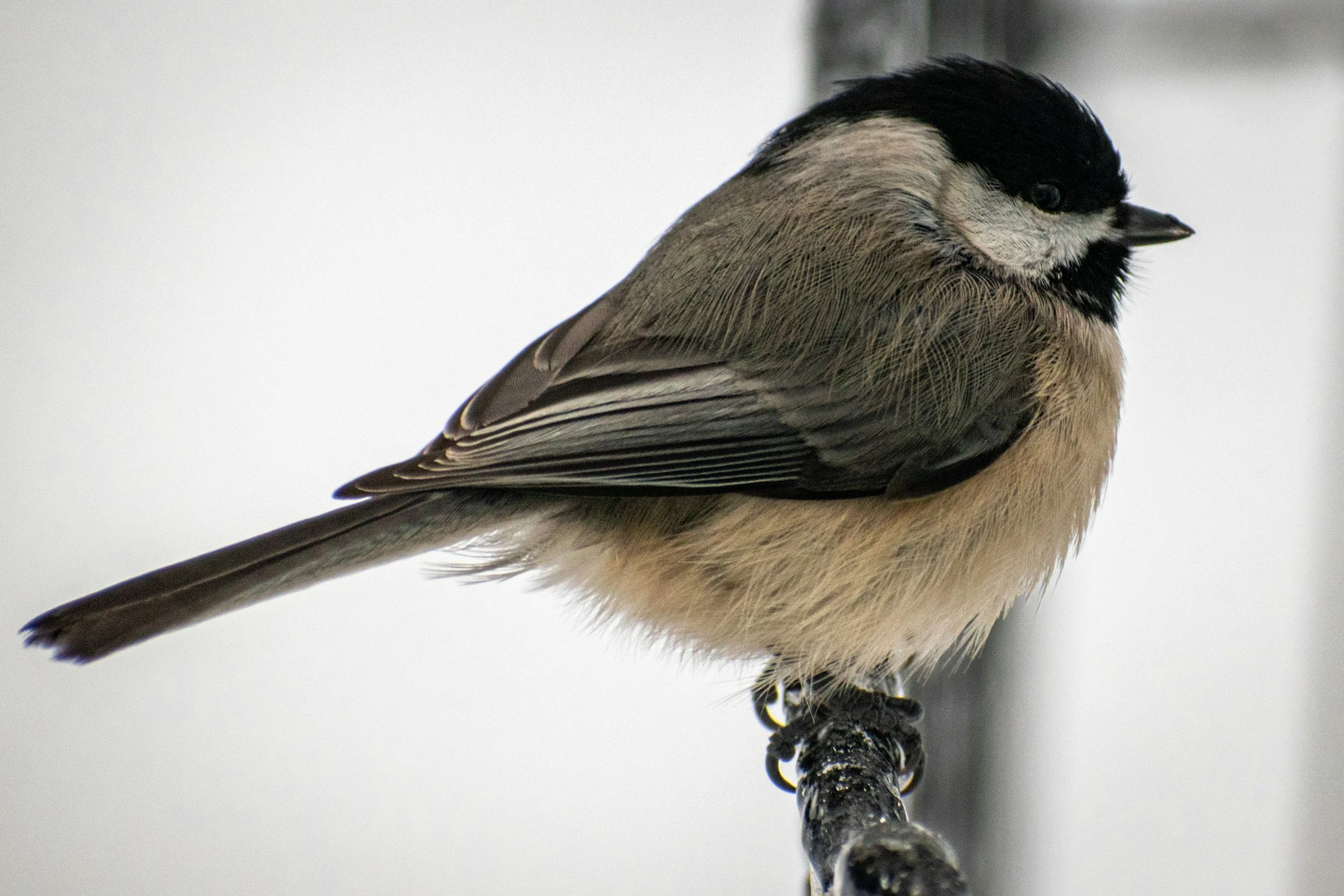
What is this little bird thinking? A lot, it turns out. Photo courtesy of Unsplash.
By Kimberly Ridley
One frost-glittered morning, I glanced out my study window to spot a chickadee stashing a sunflower seed under a roof shingle. It made me wonder how these adorable puffballs remember where they’ve hidden all those seeds—and how they survive Maine’s long winters. On deadline for an article and never one to pass up a chance to procrastinate, I did some research. Let’s put it this way: calling someone “birdbrain” could well be a compliment.
It turns out that chickadees grow new brain cells in autumn to help them remember all winter long where they’ve hidden hundreds to thousands of seeds and other food items such as frozen insects. The chickadee’s hippocampus, a brain structure involved in spatial memory, grows about 30 percent in fall. It shrinks back down to normal size in spring when food is abundant.
Researchers further delving into this bird’s astonishing memory recently made a fascinating discovery: Each time a chickadee caches a bit of food, neurons in its hippocampus fire in a unique pattern similar to a barcode for an item in the supermarket. When a chickadee returns to a particular spot to fetch a seed, the same pattern lights up in its brain.
An amazing memory isn’t the chickadee’s only remarkable adaptation for weathering winter. On subzero nights, this tiny bird can gradually lower its body temperature by more than 15 degrees, voluntarily going into hypothermia to conserve energy. This metabolic feat, combined with a dense down jacket and a snug roost in a tiny tree cavity helps chickadees survive temperatures as low as 40 below zero!
These spunky survivors also are well-equipped to deal with sharp-shinned hawks and other predators. Chickadees possess one of the most sophisticated communication systems among the world’s land animals. When they detect a hawk or shrike flying overhead, they give high-pitched “seet” calls to warn their flockmates. If chickadees spy a predator lurking in the ’hood, they utter alarm calls consisting of multiple “dees” after the “chicka.” The more “dees” the greater the threat.
I’ve witnessed the chickadees’ neighborhood watch in action. I was filling the feeders one winter afternoon when their rapid-fire dees spilled down from the spruce woods at the edge of the yard. When I scanned the trees with binoculars, a barred owl stared back at me from a spruce near the feeder. It was likely hunting for a red squirrel or mouse, but the chickadees wanted the owl out of the yard. Suddenly, they mobbed the owl, coming within a few inches of its head. They harangued it for a good 15 minutes until it finally gave up and glided off into the woods.
As if they weren’t busy enough just trying to survive, chickadees start singing in January. Their soft “fee-bee’s” and “hey sweetie's” enliven the frosty air like a premonition of spring. Several months later, typically in May, they get down to the business of nesting, constructing a thick, cozy cup of sphagnum, plant down, and other fibers lined with fur.
I’ve been lucky to have chickadees as next door neighbors for years. Every spring, I marvel, watching the parents constantly zip back and forth to the nest with caterpillars in their beaks at all times of day. To raise one brood, writes entomologist Douglas Tallamy, author of Bringing Nature Home and Nature’s Best Hope, a chickadee family will consume between 6,000 and 9,000 caterpillars. Multiply one chickadee family by who knows how many, and you have an elegant method of natural pest control (mind you, not all caterpillars are pests).
Long before scientists began discovering the wonders of these extraordinary little survivors, the Maine state legislature named the chickadee our state bird in 1927. What a fitting choice. Chickadees are clearly brilliant, hardy, and resourceful, like so many Mainers I know. Honestly, I can’t think of a bird I admire more—especially when I’ve forgotten where I’ve left the car keys.

Maine Native Kimberly Ridley is the award-winning author of six creative nonfiction books about the natural world for children and adults, including The Secret Pool and Wild Design: Nature’s Architects. Her essays and articles have appeared in numerous publications including Down East Magazine, The Christian Science Monitor, and The Boston Globe. She lives in Brooklin with the painter Tom Curry and their cat Andy. www.kimberlyridley.org
