

My Wild Neighbors: Drifters
Lion’s mane jellyfish can be six feet across with 120-foot tentacles. Here’s how you treat a sting.
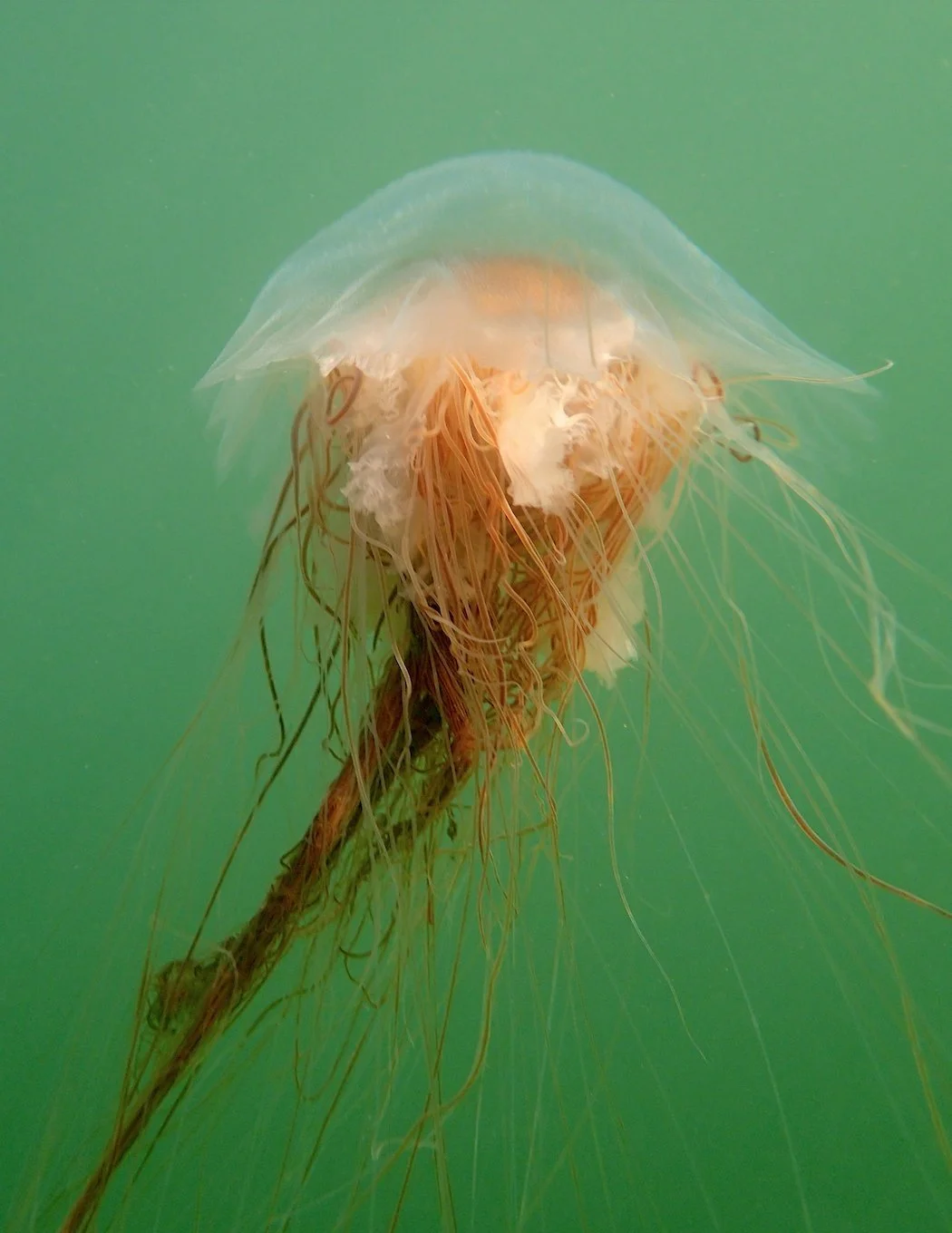
A lion’s mane jellyfish. Photo by Zoe Weil.
By Kimberly Ridley
A massive lion’s mane jellyfish made the news last June when it washed up on Lincolnville Beach. Nearly five feet across, the crimson and pink creature looked like a ginormous jello mold that had exploded. Some online viewers thought AI had generated photos of the jellyfish, but it was the real deal. The pink fringe turned out to be millions of lion’s mane larvae—which made me think twice about swimming in Penobscot Bay this summer.
Native to the Gulf of Maine, lion’s manes are the world’s largest known jellyfish. Some grow to more than six feet in diameter with hundreds of hair-like tentacles up to 120 feet long. I’m thankful that most of the lion’s manes I’ve seen along our shores are no bigger than dinner plates.
The three other gelatinous creatures you’re most likely to encounter in our waters are moon jellies, white cross jellies, and comb jellies. Like lion’s manes, saucer-sized moon jellies and white cross jellies are cnidaria, pronounced ny-DAIR-ee-uh, from the Greek word cnidos, which means stinging nettle. These are water-dwelling invertebrates related to sea anemones and coral. Comb jellies are ctenophores, very distant cousins of jellyfish (more on them later).
Delicate and (mostly) short-lived, sea jellies are some of the most ancient animals on earth. They’ve stuck with the same basic body plans for more than 500 million years, surviving several cataclysms including the one that wiped out the dinosaurs. The entire time, they’ve managed quite nicely without brains, hearts, or other fancy organs.


Our local jellyfish, like all of their kin, sport bell-shaped bodies trailing tentacles studded with stinging cells called nematocysts. When something brushes against a jellyfish’s tentacles—the zooplankton and small fish they eat, or your arms or legs—nematocysts burst and release harpoon-like barbs filled with venom. You’d not feel a white cross jelly’s sting, and a moon jelly’s sting is relatively mild. The lion’s mane sting, however, leaves painful welts.
If you have the misfortune of getting stung by a lion’s mane, don’t pee on the welts! Urine can actually make the pain worse. Websites including the Cleveland Clinic recommend first rinsing the stings with seawater (not fresh water) and removing as many tentacles as possible with tweezers, followed by soaking the affected area in the hottest water you can stand for 20 to 45 minutes and then applying hydrocortisone cream. Though rare, an allergic reaction means a trip to the ER.
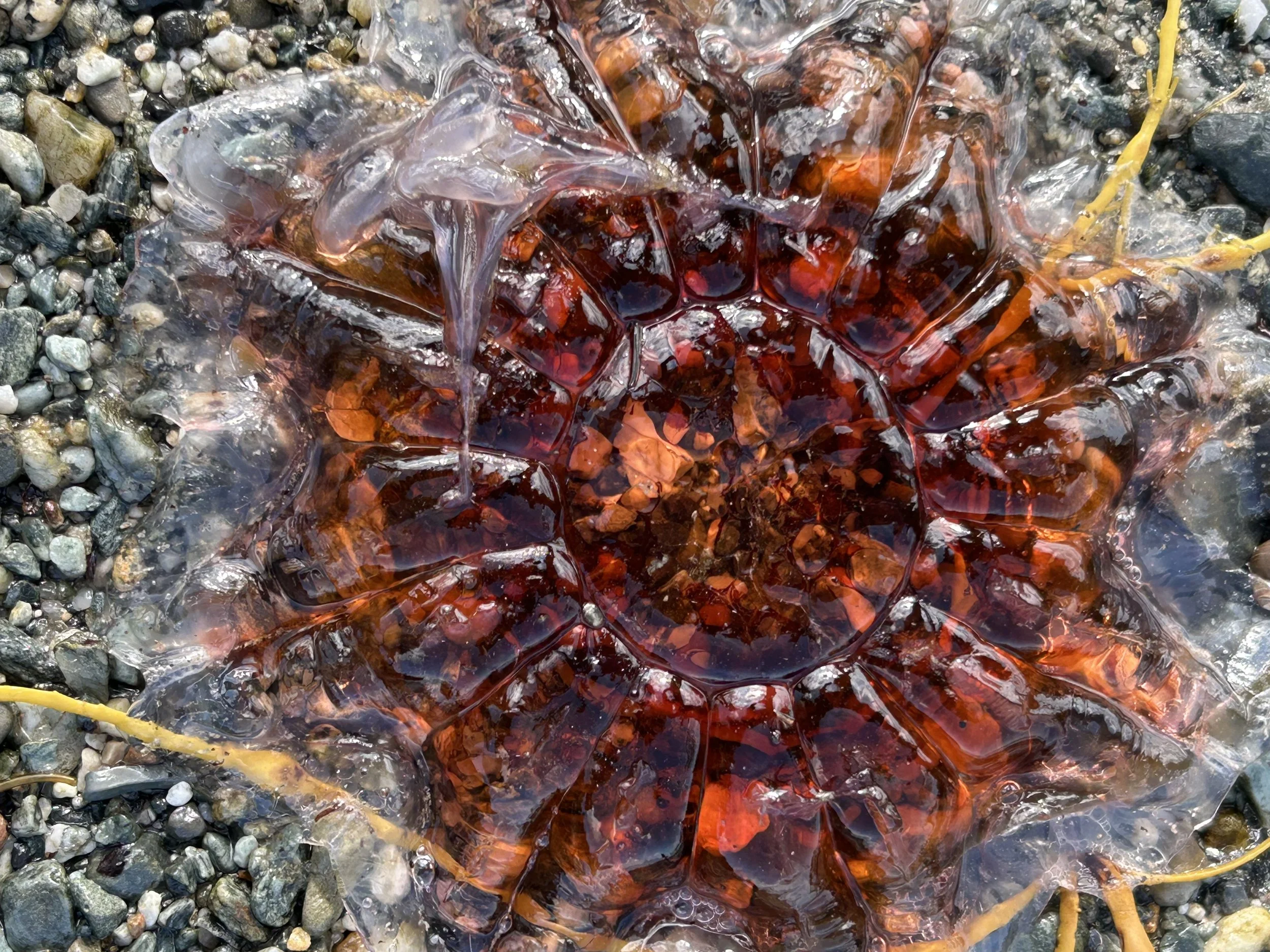
A lion’s mane jellyfish on the shore at Harriman Point in Brooklin. Photo by Kimberly Ridley.
I recently counted more than a dozen lion’s manes washed up on Harriman Point in Brooklin (none was bigger than a dinner plate, thankfully). Wondering if jellyfish populations were on the rise, I contacted Dr. Nick Record, senior research scientist at the Bigelow Marine Laboratory of Ocean Sciences in East Boothbay, who’s been studying jellyfish patterns in the Gulf of Maine since 2012.
“We’re examining new evidence suggesting that jellyfish are becoming more common in the Gulf of Maine,” said Record, who is developing a jellyfish forecast for the region based on data that includes sightings reported by community observers.
What’s driving a possible rise in jellyfish here is a mystery. I had assumed that rapidly warming water—the Gulf of Maine is heating up faster than 99 percent of other bodies of water worldwide—plays a major role since jellyfish reproduce and grow faster in warmer water. But that doesn’t hold true here.
“The long term increase in jellyfish populations started well before the rapid warming that we’ve seen in the Gulf of Maine,” Record says.
What about other factors linked with jellyfish blooms elsewhere, including low oxygen caused by nutrient runoff, overdevelopment of underwater structures that give jellyfish polyps more places to attach and grow, and depleted fisheries?
“None of these quite fit the bill for coastal Maine,” Record said. “So stay tuned.”
In the meantime, Record and his colleagues continue to collect and analyze data. You can report sightings of jellyfish and comb jellies to jellyfish@bigelow.org or complete a form at jellyfish.bigelow.org.
While jellyfish deploy venom to capture prey, comb jellies have a different trick up their tentacles: glue. Cells on their tentacles produce a sticky substance that traps zooplankton drifting by. They then reel their sticky “fishing lines” right into their mouths.
The first time I saw a comb jelly, I thought I was hallucinating. Swimming off Great Spruce Head Island, I noticed tiny filaments of rainbow flickering just under the surface of the water. The sun must have been at precisely the right angle to strike the comb jelly’s cilia. These tiny paddle-like hairs, which they use for swimming, refracted the light into rainbows. It looked like an animated antique Christmas ornament. Mesmerized, I watched the transparent, thumb-long creature until a cloud blotted out the sun.
I became obsessed with comb jellies a few years later while doing research for my children’s book, Extreme Survivors: Animals That Time Forgot, which explores 10 of the most ancient animals on earth. Like jellyfish, comb jellies were among the first animals to evolve skin, muscles and nerves. Most fascinating: their nervous system, a simple net of neurons, is unlike that of any other animal. When scientists removed the neural nets of comb jellies in the lab, the gelatinous creatures grew new ones. Learning how they do this might someday point to new treatments for Alzheimer’s and other brain diseases.
Comb jellies have at least two other claims to fame. They may well be the first animal to evolve an anus, an innovation that allowed digestive tracts, and therefore larger animals, to evolve. In addition, they’re more than 600 million years old, most likely making them the most ancient creatures on Earth, a distinction that scientists had previously assigned to sponges for more than a century.
The stunning success of comb jellies and jellyfish might seem to be a paradox given their short lives. Most live only weeks or months in the wild. The one exception is the appropriately named “immortal jellyfish,” which may have discovered the secret to longevity. The adult immortal jellyfish, which lives in temperate and tropical waters worldwide, can revert back to its juvenile form—and then grow back into adults, switching forms again and again.
All jellyfish and comb jellies are masters of reproduction. Comb jellies are hermaphrodites who constantly pump out gametes when food is abundant. Fast-growing larvae resemble tiny adults. Jellyfish spawn seasonally and employ both sexual and asexual reproduction. Fertilized eggs hatch into polyps who settle on the sea floor. When conditions are right, their bodies divide into segmented layers that resemble stacks of pancakes. Each layer pops off into a mini medusa, the adult form of jellyfish. A single polyp can release thousands of medusas in its lifetime. When a colony of polyps do this at once, massive jellyfish blooms occur.
Huge blooms of jellyfish have caused headaches in some parts of the world. One massive bloom clogged coolant intake pipes at a nuclear power plant in Sweden, which forced a temporary closure. In other parts of the world, jellyfish blooms have hoovered up plankton that fish depend on, filled fishing nets, and stung swimmers.
Still, these ancient creatures are vital to the health of our oceans. They’re food for some species of sea turtles and likely play other important ecological roles yet to be discovered.
When I see a jellyfish, I always pause, dazzled by their otherworldly beauty and gobsmacked to lay eyes on creatures who have survived unimaginable odds. Perhaps they are the ultimate survivors with much still to teach us.
“I think it's fascinating that jellyfish appear to have changed so little in hundreds of millions of years, through global mass extinction events and extreme climates,” Record said. “It makes me think that there's a deep, fundamental connection between jellyfish and ocean resilience.”
Maine native Kimberly Ridley is the award-winning author of six creative nonfiction books about the natural world for children and adults, including The Secret Pool and Wild Design: Nature’s Architects. Her essays and articles have appeared in numerous publications including Down East Magazine, The Christian Science Monitor, and The Boston Globe. She lives in Brooklin with the painter Tom Curry and their cat Andy. www.kimberlyridley.org
