

Doctor advocates for a different approach to primary care
Lucy McBride, MD, discusses a holistic approach to health and steps to empower patients
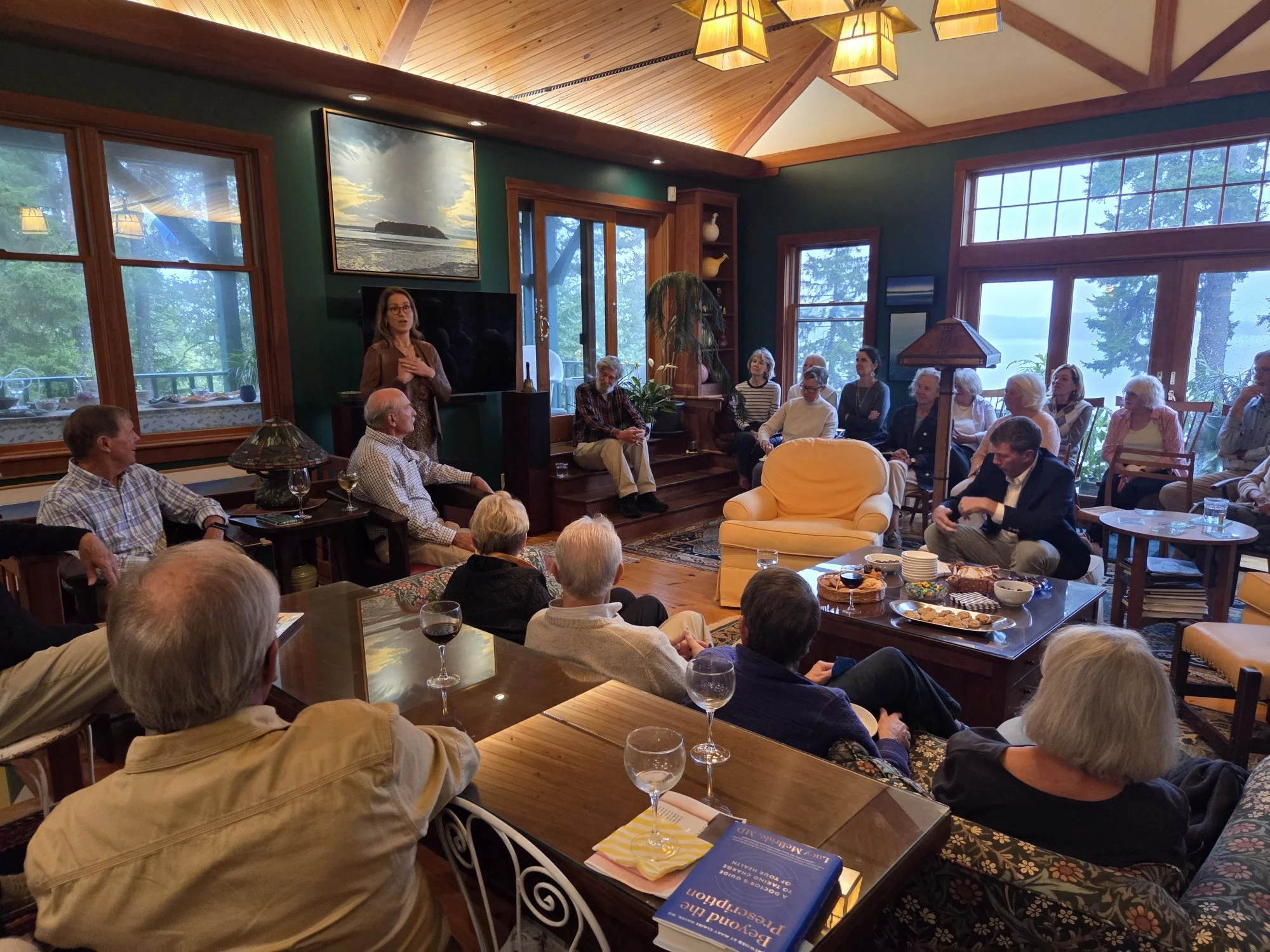
Lucy McBride, MD, a primary care physician based in Washington, DC, discusses her new book, Beyond the Prescription, at a gathering hosted by Brooksville's Kathy Bonk and Marc Tucker. Photo by John Epstein.
Sept. 9, 2026
By John Epstein
BROOKSVILLE—Some 40 people, many connected to the healthcare professions, gathered on Sept. 3 at the Brooksville home of Kathy Bonk and Marc Tucker to hear a talk by Lucy McBride, a primary doctor with an innovative practice in Washington, DC.
The Harvard-trained doctor, who has been in practice for 25 years, discussed her recently published book, Beyond the Prescription. According to the book's website, it provides advice “for navigating your health in real life, without perfectionism, pseudoscience, or shame,” as well as how to become an "empowered patient.”
“I decided to go into primary care medicine because I wanted to be the first point of contact for people seeking medical care,” McBride said.
During her medical school training and then a residency at Johns Hopkins Hospital, McBride enjoyed connecting with people and trying to understand their experience with illness.
“I realized that the current health care system, all too often, treats patients like a set of transactions or a set of diagnosis codes and body parts instead of as a whole person,” she said.
McBride said that it takes time to build trust with a patient and to understand the conditions of a person’s life – like childhood traumas, marital problems and work stresses – that might lead to health issues. She believes that these are variables primary care physicians need to know.
For her, the most important event was not when she wrote a prescription for a patient, “but when the patient paid attention to their health.”
McBride decided to chart a different path for primary care. She said she set up a practice that is not tied to an insurance reimbursement system where medical providers have little time with their patients and minimal space for holistic inquiry. Instead, her patients — for an annual fee that’s less than $3,000 per year, according to Kathy Bonk — receive a careful, hands-on physical examination and complete a lengthy personal history questionnaire that covers personal biography, living situation, health data, food and drink habits, and mental health.
McBride, who is available for as-needed consultations throughout the year, also serves as a health care referral hub for her patients, should they need specialized medical care or surgery.
While living in Washington, DC, Tucker, a government adviser on the economics of education, and Bonk, a communications specialist and political activist, both became her patients. Tucker said his first visit involved a two-hour interview.
“We were lucky,” Tucker said.
Bonk was emotional about her good fortune to be treated by McBride.
“She was the doctor who carefully examined my body and discovered the beginning stages of breast cancer, which probably saved my life,” Bonk said.
McBride fully acknowledged that the care she provides is not affordable. She explained that she wrote her book to help those who just get 15 minutes to meet with their primary care provider, and to “squeeze the juice” out of that time by asking better questions about their symptoms, medications, and alternative treatment options.
Nancy Murdock, who described herself as “a patient,” said she agreed with McBride’s holistic approach to medicine.
“We are not lab tests,” she said.
McBride said, “More than 100 million Americans face obstacles in acquiring primary care due to provider shortages in their community.”
She said that the nation as a whole needs 27,000 more primary care doctors and attributes this deficiency, in part, to federal limits on funding primary care at medical schools. She also blames the fact that medical students who choose primary care as a practice face an average debt of $250,000, but earn 40 to 90 percent less than physicians who become specialty practitioners or surgeons.
McBride also pointed out that doctors are suffering burnout, causing many to retire early because administrative tasks largely related to electronic health care documentation take up almost three-quarters of their time.
Additionally, the electronic data does not get cross-referenced across medical systems, so there’s no central strategy for treating patients, McBride said. Scott Thurston, a retired cardiovascular heart surgeon, commented that he found HIPAA (Health Insurance Portability and Accountability Act) to be “a pain in the a**” because it limited a hospital from getting information from another health care provider without providing releases in circumstances where a patient needed immediate emergency treatment.
Doug Cowan, a retired radiologist, praised McBride’s book “for empowering patients to be proactive about what health care means to them,” but he said that limitations on insurance payments pushed doctors to think too much about reimbursements. Similarly, Ted Clayton, an accountant who was on the board of Blue Hill Hospital, said it is “a system driven by reimbursement, where doctors and patients feel powerless.”
McBride stated that the United States spends more per capita on health care than European countries, where the citizens have longer life expectancies. She believes that the rise of America’s $4.4 trillion wellness products and services industry is an unhealthy offshoot of the many problems with the U.S. health care system.
Does the doctor have a prescription?
“The system is certainly ripe for a popular movement,” McBride said. “And people should vote for candidates on the local or national level who understand this issue.”
