

Local artist’s mural marks state museum reopening after six years
Blue Hill resident completes floor-to-ceiling mural at the Maine State Museum
Oct. 28, 2026
By Steele Hays
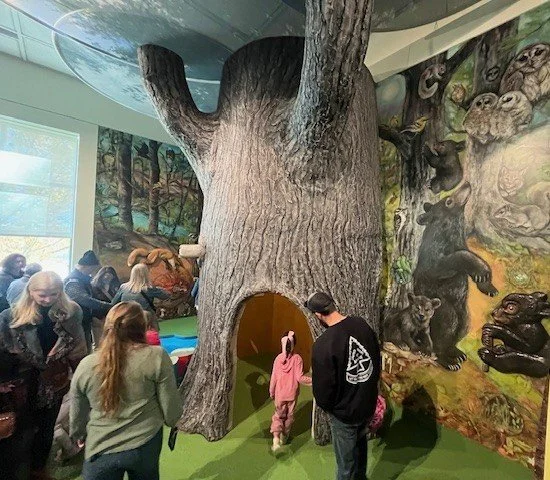
The trunk of a tree where children can go underneath, as part of Rebekah Raye's mural at the Maine State Museum. Photo by Steele Hays.
AUGUSTA – After six years of renovations and upgrades, the Maine State Museum in Augusta held a grand opening on Oct. 24 to show off its new design and exhibits – including a children’s learning center display featuring floor-to-ceiling interactive murals created by artist Rebekah Raye of Blue Hill.
After surging through the doors, scores of children swarmed the display, which features a huge hollow white pine tree flanked by Raye’s murals depicting dozens of Maine forest animals.
“To me, it’s the most beautiful thing in this museum,” Gay Grant said, a member of the Museum Commission. “We cannot praise this enough. It’s like a giant picture book children can walk into. Governor Mills saw this and was blown away by it.”
Raye and more than 20 of her relatives, friends and Blue Hill neighbors attended the opening, as did Mills and many other state officials. Over 600 members of the public entered the museum within the first hour after the doors were opened.
“I am thrilled beyond belief to see all of it installed,” Raye said. “It’s more than I thought it was going to be. This is the biggest piece I’ve ever done.”
Raye worked intensively on the murals for two and a half years.

Rebekah Raye wears a jacket that is a print of her mural. She poses with the carved flying squirrel that depicts her, the artist, on the animal’s tail. Photo by Steele Hays.
Joanna Torow, the museum’s chief educator, knew Raye from previous collaborations and asked her to take on the mural project, funded by a $30,000 grant paid for by private donations.
“I am ecstatic about the way it’s turned out,” Torow said. “I wanted someone who could relate to children and I knew she could do that.”
The murals were designed and painted by Raye, who did extensive research on the wildlife she chose to depict: bears, deer, flying squirrels, owls, raccoons, bobcats, squirrels, foxes, eagles, salamanders, and more – all representative of the fauna of Maine’s white pine forests, the focus of the exhibit.
The mural is not just two-dimensional. It features several three-dimensional, painted wood sculptures of animals like a jumping fox, a bear cub, and a flying squirrel. Raye chose her own unique way to “sign” the mural, carving a tiny figure of a woman lying on her stomach working on a painting while riding on the flying squirrel’s tail. There are other interactive elements as well, including several hinged swinging doors that open to reveal hidden animal images. Children were busy opening every door as they explored the exhibit.
The grand opening marked the end of the museum's six-year hiatus. It closed its doors in 2020 after its heating and cooling system failed and needed replacement. Workers quickly discovered other problems—including that the building had significant levels of asbestos that had become airborne and dangerous.
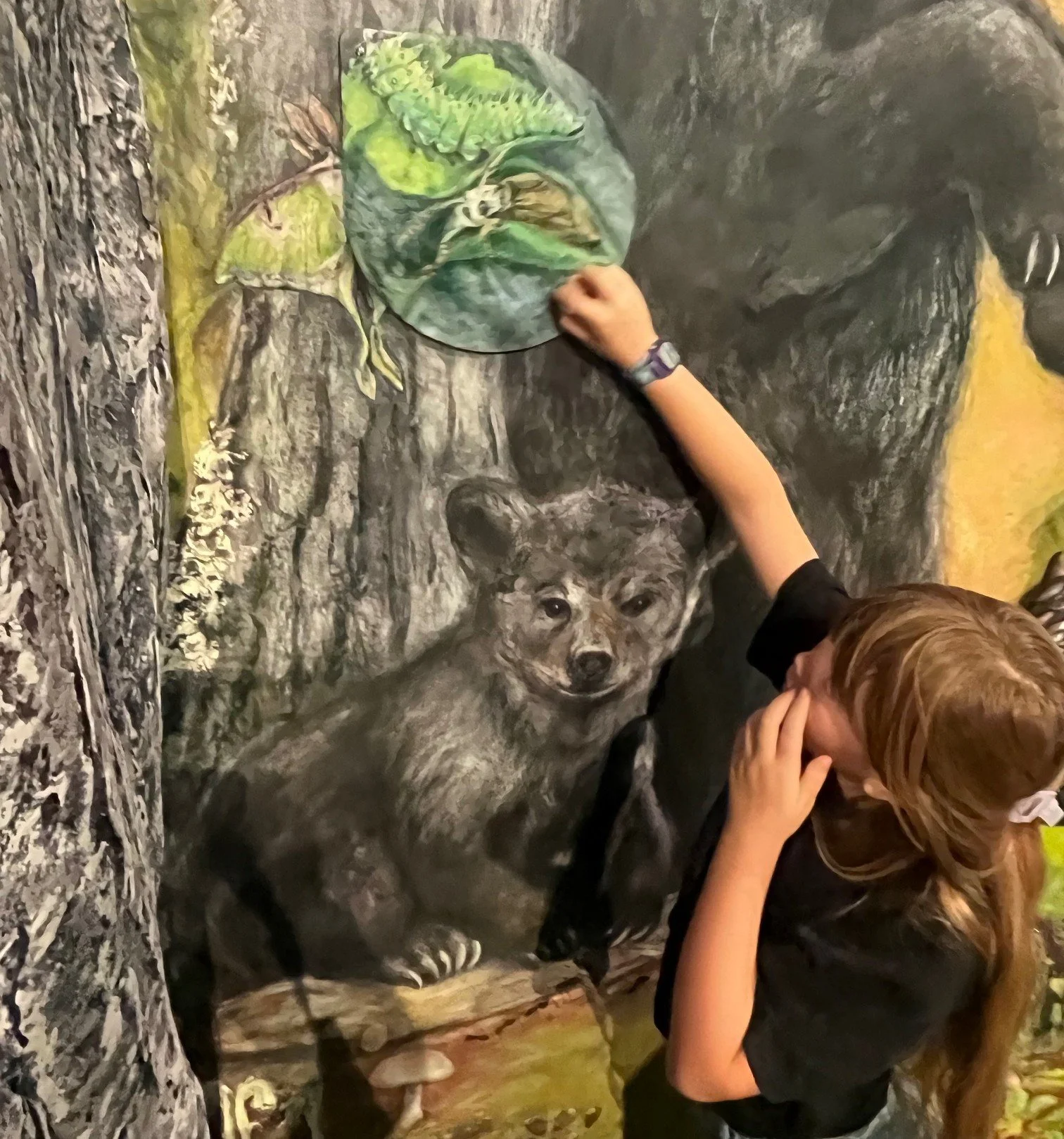
A child revealing a hidden picture within the mural. Photo by Steele Hays.
The building, which is also occupied by the State Library and State Archives, had to be completely gutted and renovated, but that gave state officials a chance to redesign and update the exhibits as well as the electrical, plumbing and HVAC systems. Just removing the contents took two years. The library collections filled 38,000 book carts, enough to stretch more than seven miles. The museum has more than 800,000 objects in its collections, and its contents were distributed to 12 different storage locations around the Augusta area.
The museum opened two of its four floors on Oct. 24, while two additional floors are still under development and scheduled for opening in 2027.
Raye’s mural is not the only museum exhibit connected to the Blue Hill Peninsula and environs. Hanging from the ceiling in an adjacent exhibit hall is the skeleton of a 45-foot-long humpback whale named Vector and a 25-foot whale calf. The bone taxidermy was done by Dan DenDanto, a senior scientist at Allied Whale on Mount Desert Island. Vector was well known by whale watching crews and scientists and was frequently seen in the waters around Bar Harbor. Vector died off Cape Cod, but its carcass was recovered and brought to shore.
There is also a display on the Revolutionary War ship Defense, a 16-gun privateer which was part of the Americans’ Penobscot Expedition sent to capture the British fort at Castine in 1779. The Defense was scuttled by its crew to avoid falling into the hands of the British. The ship’s wreckage was discovered in Penobscot Bay in 1972 by students and staff of Maine Maritime Academy and later excavated. A number of artifacts from the Defense are on display.
Admission to the State Museum is free through the end of December.
