

WHEEL WATCH: Gramp Robbins vs. the Styrofoam pot buoys
“A classic stubborn-old-man-meets-new-technology situation” — or is it?
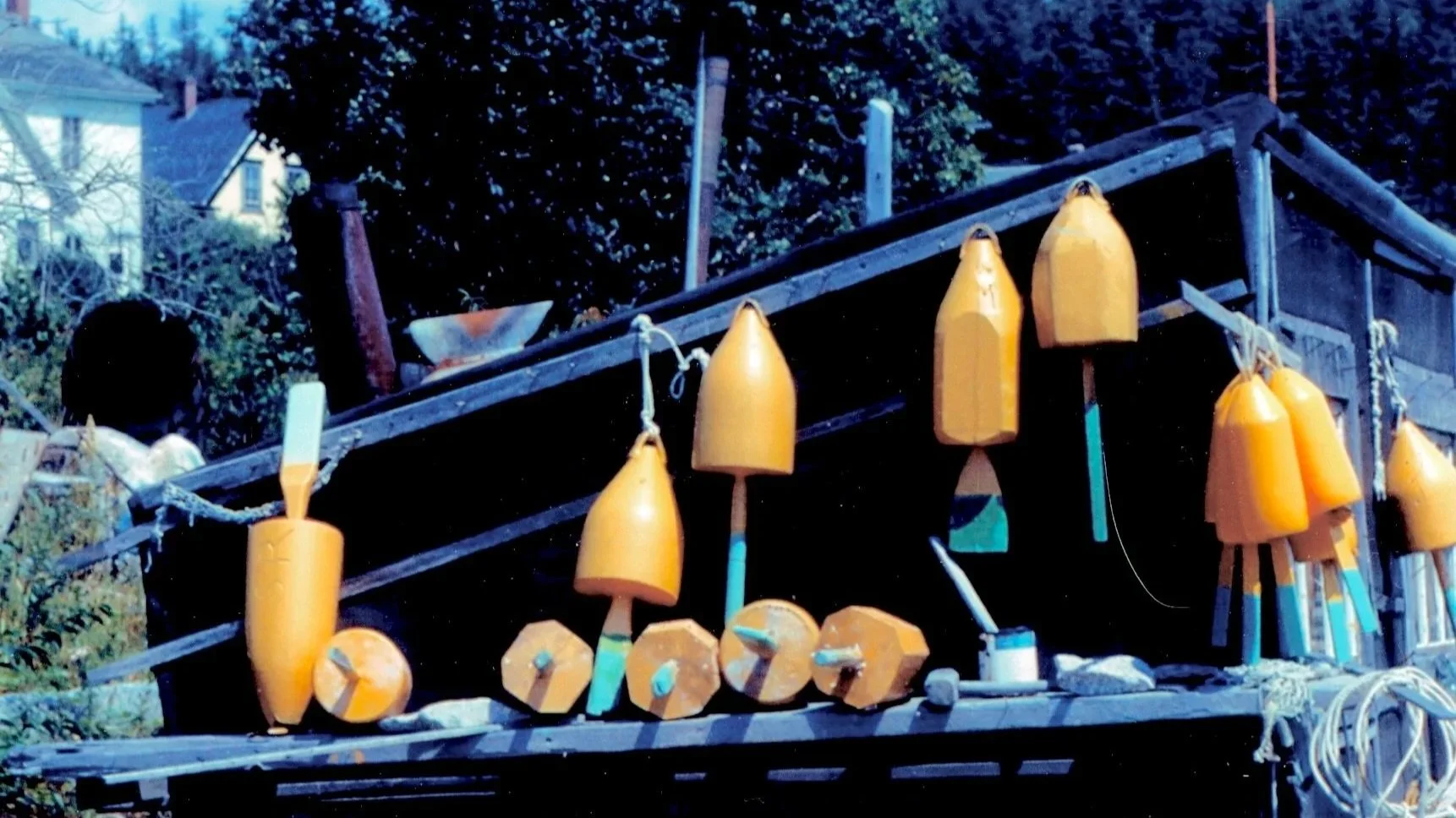
A late 1960s/early 70s photo of some of Pa’s buoys on the west end of his old shop on the wharf he shared with Uncle James Robbins in Moose Island Cove. Photo courtesy of Anne Page/Steve Snowden.

Brian Robbins.
May 4, 2026
By Brian Robbins
When I was a kid, hanging out with Pa on the wharf that he and Uncle James shared at the head of Moose Island Cove, one of my chores in the spring would be helping to scrape and paint pot buoys.
My earliest memories are from when everything was still wood: heavy, clunky wooden buoys (some sawn, some carved) with either a hole bored in the nose or a strip of tread off an old tire nailed to the snout to tie into. I’d poke and gouge at them with a paint scraper and then daub on Pa’s buoy colors – bead yellow with Newport green spindles.
I can’t remember when Pa first tried the new-at-the-time lightweight Styrofoam buoys, but I’m pretty sure it was the summer of 1969 when my brother Stevie bought a bunch of them. He had returned home to go lobstering after several years on research ships down at the South Pole – a story for another day – as well as a short stint on a bomb carrier.
(Between the two, Stevie much preferred Antarctica.)
My brother and his wife, Brucine, had returned to the Island to get back to what he’d wanted to do since he was a little kid: go lobstering full-time.
The years of shipping had given him a little nest egg to work with – enough to head up to Campobello Island and order a wooden 37-footer from boat builder Morris Fletcher.
But it was going to take a while to have that Campobello boat built; in the meantime, Stevie’s plan was to start building up a gang of wooden lobster traps and tend them out of a wooden outboard the first summer he was back home.
Those first new traps were standard fare for the time: half-round 3-footers, each rigged with nylon heads hand-knit by Nanny and Gramp Robbins (Pa’s folks).
Gramp was getting up in years by then (there was some question about how old he was exactly; the Robbins side of our family was never burdened by factual accuracy – especially if it hindered the telling of a good story), but he still had some lobster traps in the water, which he hauled by hand out of a peapod.
“I started out in a peapod 80 years” – or however many Gramp would claim, depending on the day – “ago and now I’ve ended up back in one.” Whatever: it was the only way Nanny was going to let him go lobstering. For the first couple of summers after he sold his long-time full-sized boat (with an inboard gas engine and spray hood), Gramp hauled out of an outboard. The sight of him roaring into Moose Island Cove, standing up in the stern with the throttle pinned on that old Evinrude and one eye squinted to avoid the sparks and hot ash flying off the end of the Camel he was grinning around terrified the womenfolk in the family.
He was given the ultimatum of oars or dry land.
Gramp chose oars.
Anyway, those new traps my brother was building needed rigging – rope, toggles, and buoys. And where he was starting from scratch, Stevie figured he’d go with some brand-new Styrofoam buoys.
I remember the day he first approached Gramp about replacing a few of his oldest, water-logged wooden buoys with lightweight plastic ones.
“Bri and I will paint a few up with your colors,” said Stevie.
“Nope,” said Gramp, flicking the wheel on his Ronson lighter to burn a twine end on a bait pocket he’d just knit.
“Why not? They’re light and –”
“Don’t bother,” said Gramp, pinching off the burning end with a well-calloused thumb and forefinger. “Don’t want ‘em.”
“But you might –”
“I don’t want that mess aboard my boat.”
Stevie started to weaken (Gramp was one of the few who could do that to him), but tried one more time: “How about if we just painted up a couple and –”
“If you tie one of those things onto one of my traps, I’ll cut it off,” said Gramp. He gave the Ronson a quick slap of the wrist to click the cover closed; the conversation ended with that click.
I know, I know – this reads like a classic stubborn-old-man-meets-new-technology situation, but it turned out Gramp had a perfectly good reason for feeling the way he did. He just didn’t admit to it until after he’d come ashore for good.
At the time of the buoy conversation, Gramp’s eyesight was still pretty good – as far as seeing things off in the distance went. Up close? Not so great. (He had magnifiers he wore for reading and knitting heads and bait pockets – although he could probably do that with his eyes closed.)
His hearing was awful. Stevie’d taken him for hearing aids, but Gramp refused to wear them, claiming he could hear anybody he really wanted to ... which made Nanny really mad.
So, Gramp had a system that worked when he was out in the peapod hauling traps – and he wasn’t going to change it.
He’d sight up a pot buoy from a distance over his shoulder, line up the bow of the peapod, then dig in with the oars as he faced aft. Even in his later years, Gramp was a good rower, staying on course nicely as he bore down on the buoy.
There was no need to keep stopping to glance over his shoulder; Gramp would just keep rowing until he heard – and felt – the old wooden pot buoy ‘wump’ into the bow of the peapod ... then ship his oars and reach over the side to grab the buoy.
Simple as that.
You see where this is going, right?
One of those new Styrofoam buoys sure wasn’t going to make much of a ‘wump’ against the peapod.
Sometimes you just have to stick with what works.
—Robbins, who grew up in Stonington and now lives in Nobleboro, writes his monthly column “Wheel Watch” for The Rising Tide.