

My Wild Neighbors: Bobolink high jinks have makings of spicy Netflix series
Bobolinks travel upwards of 12,500 miles every year between Argentina and northern United States
By Kimberly Ridley
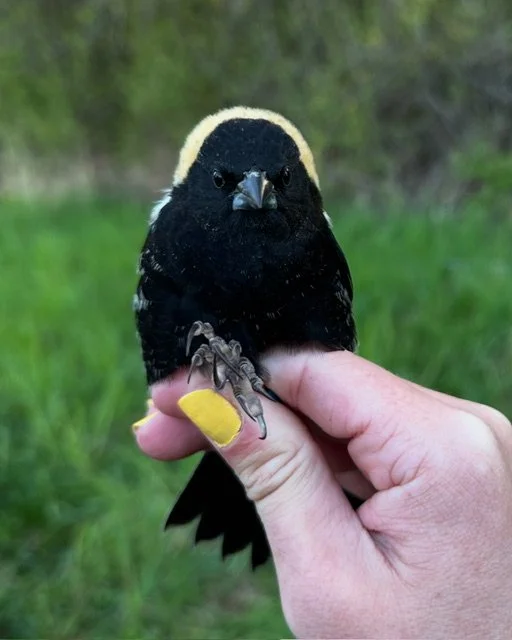
A male bobolink’s song is a “series of electronic sounding burbles and chirps.” Photo courtesy of Noah Perlut.
On clear nights in May with a light southwest breeze, millions of songbirds fly north in the dark. They orient with an inner magnetic compass and steer by the stars. Great waves of warblers and orioles, indigo buntings and scarlet tanagers and many other species surge high overhead while we sleep. I love to picture them spilling down from the sky just before dawn to feed and rest.
More than 100 species of migratory birds nest in Maine, traveling from as far away as South America. Bobolinks have one of the longest migrations, flying upwards of 12,500 miles round-trip every year from Argentina to nest in large fields and tall grasslands across the northern United States and Canada. Some bobolinks log enough miles in their decade-long life to circle the equator five times.
I always pause along the edges of fields to listen for bobolinks on my morning walk in May and June. The male’s song, a series of electronic sounding burbles and chirps, reminds me of the Star Wars robot R2-D2. Once I’ve heard a male bobolink, I scan with binoculars until I spot him: a dashing black songbird with a blonde mullet and white patches on his back and wings. The males are often described as looking like they’re wearing a tuxedo backwards. Females resemble large, slender sparrows with golden faces and bellies and brown-streaked backs and crowns.
Female bobolinks, I recently learned, have distinctive vocalizations. For example, they give a specific “come-hither” call, a series of high, descending notes, when they’re ready to mate.
“All the male bobolinks in a field know when a female is fertile,” says ornithologist Noah Perlut, professor of environmental studies at the University of New England, who’s been studying these birds for twenty-five years. He adds that males who already have mates sometimes fly to other fields up to seven miles away to listen for and mate with another fertile female—and then zip back home.
Bobolink high jinks have the makings of a spicy Netflix series. In a single breeding season, males often mate with multiple females, and females will sometimes mate with more than one male. Each clutch of up to seven eggs laid in a well-hidden nest on the ground likely represents several fathers. There’s a lot going on in our daisy-spangled fields.
Few people know more about the secret lives of bobolinks than Perlut. He and his colleagues have banded more than 14,000 bobolinks and savannah sparrows over the past quarter century in the same study fields in Vermont and New York. Bobolink Odyssey, his long-term study of the bobolink’s life cycle, is yielding new insights into the behavior, genetics, and migration of these extraordinary birds.
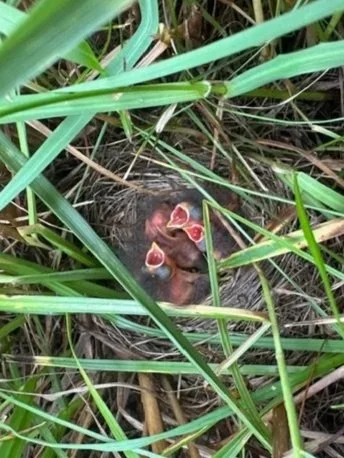
Bobolinks nests are well-hidden and can contain up to seven eggs. Photo courtesy of Noah Perlut.
Perlut made an astonishing discovery after fitting bobolinks with lightweight geolocators: Some of these birds fly nonstop over open ocean for three days from the Delmarva Peninsula to Colombia or Venezuela on their fall migrations. In other words, they don’t eat, drink, or rest for seventy-two hours.
Despite the bobolinks’ gobsmacking feats of endurance and survival, these birds are in steep decline. We’ve lost more than half of the world’s bobolinks in the past 50 years according to the U.S. Committee of the North American Bird Conservation Initiative’s 2025 State of the Birds Report. Known as “rice birds,” they’ve been shot as pests in agricultural fields in the southern United States and in South America where they gather in huge flocks. In Jamaica, bobolinks are hunted and consumed as “butter birds.”
The biggest problem, however, is the loss of large meadows and hayfields that bobolinks depend on for breeding habitat. The good news is that landowners can help with simple changes to managing their fields. Those who have large fields that they don’t farm can simply mow as late in the season as possible, beginning in late July after bobolink chicks have fledged. The other crucial step is removing grass and vegetation from a field after it’s mowed.
“Let’s say you cut your field in September,” Perlut says. “If you leave the grass, it suppresses growth in the spring. But if you remove it, the fields green up faster and bobolinks will select those fields earlier for breeding habitat.”
For dairy farmers, who must mow fields for high protein fodder, Perlut advises mowing as early in May as possible, and then delaying the second harvest for sixty-five days rather than forty days. He notes that this approach has been tested and successful for years with farmers in Vermont. Another strategy for farmers with large fields, Perlut adds, is to mow the edges, where bobolinks don’t nest, and wait to mow the centers of fields where the birds do nest later in July after the chicks have fledged.
Bobolinks will return any day now. They will enliven our fields with beauty and song. They and their chicks will feed on insect and caterpillar pests, helping to protect grasslands and crops. They will bring gifts that are beyond measure.
“It’s an absolute wonder that an animal that weighs as much as two strawberries could fly from Maine to Argentina year after year,” Perlut says. “The fact that this tiny organism is coming back to land we’re stewarding—isn’t that something we should be in awe of and appreciate?”
Yes, indeed.
For more on the marvels of bird migration, Ridley suggests readers check out Cornell’s birdcast.org. For opportunities to meet our avian summer neighbors, check out Island Heritage Trust’s Wings, Waves and Woods Festival, the Acadia Birding Festival, and Downeast Audubon’s great bird walks and talks.
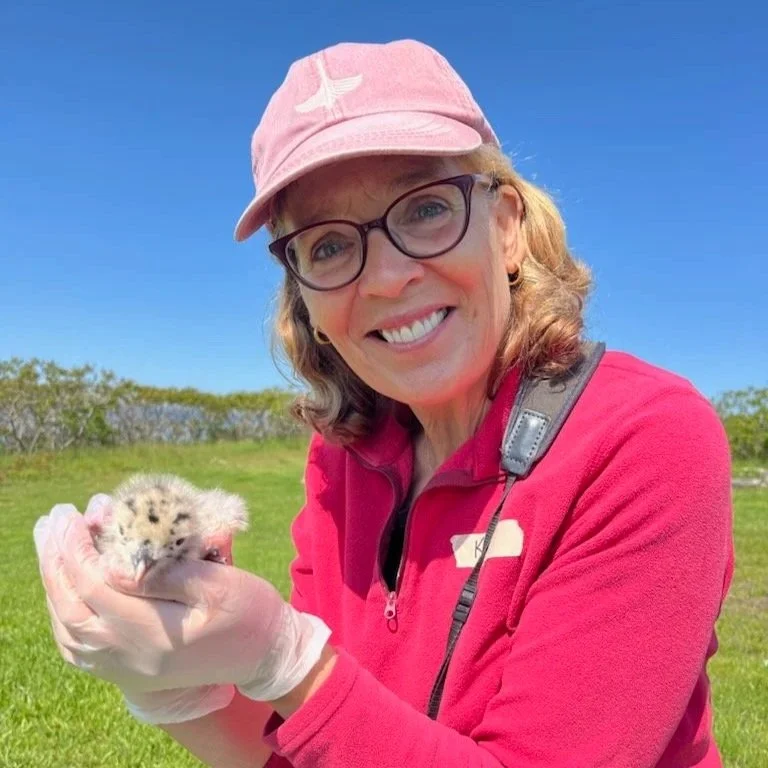
Maine native Kimberly Ridley is the award-winning author of six creative nonfiction books about the natural world for children and adults, including The Secret Pool and Wild Design: Nature’s Architects. Her essays and articles have appeared in numerous publications including Down East Magazine, The Christian Science Monitor, and The Boston Globe. She lives in Brooklin with the painter Tom Curry and their cat Andy. www.kimberlyridley.org