

WHEEL WATCH: I was not meant to be underwater
A close call on a deep-sea sub, saved by a pilot as cool as Chuck Yeager
Sept. 22, 2026
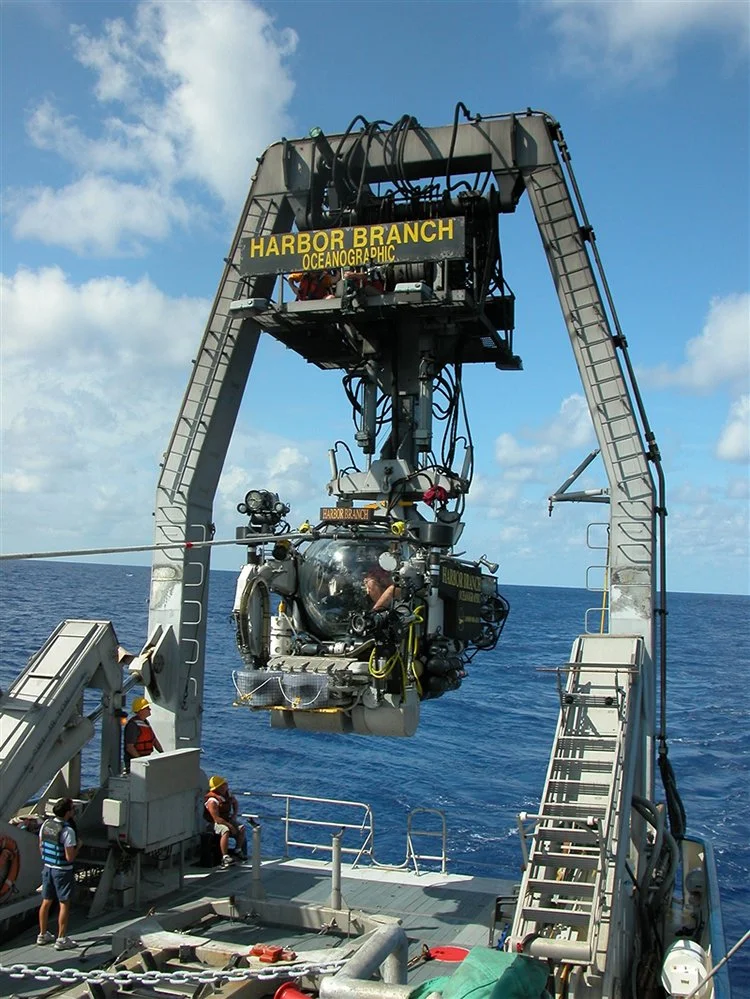
The Johnson Sea Link hangs from the massive A-frame in the stern of the research vessel Seward Johnson in preparation for launch. Photo courtesy of Liz Baird.
By Brian Robbins
My relationship with bodies of water has been pretty clearly defined my whole life.
I like to be on them, aboard something that floats.
I’m okay with being in them bodily for short periods of time.
But being submerged? Nope.
Before you start with the old “How would you know if you’ve never tried?” argument, let me tell you about my two experiences with submersion.
To be fair, the first was only by proxy, but I experienced it at a formative age ... and I’m pretty sure the scars are still there.
Did you ever watch the television program Sea Hunt, starring Lloyd Bridges? The original series lasted four seasons (1958 – 1961); seeing’s how I was born in ’58, I’m pretty sure my weekly viewings of the adventures of former Navy frogman Mike Nelson (Bridges’ character) were during the show’s syndicated reruns. That would have meant watching Sea Hunt on one of the three Bangor-based stations we could pick up from our house in Stonington: channel 2, 5, or (when the weather was right and the antenna was facing just so) 7.
The premise was a simple one: Mike Nelson had parlayed his talents into a post-Navy career as a freelance scuba diver, roaming the ocean in his stalwart vessel Argonaut and saving the day weekly – managing to outwit the bad guys (there were always bad guys ... or sharks) while retrieving wayward nuclear missiles or saving the lives of folks who had managed to get in all sorts of underwater predicaments.
The thing was, almost every episode featured a scene where Lloyd Bridges’ character would encounter some sort of issue with his oxygen supply while underwater: one of the bad guys (or a shark) would cut/bite his air hose in half; he’d get an air tank hopelessly tangled in the rigging of a sunken pirate ship and have to abandon it; or whatever task he’d tackled would take way too long and he’d simply run out of air.
Then would come the weekly holding-the-breath scene where Mike Nelson would have to wrap up whatever he was doing to save the day and make his way to the surface – slowly, of course, to avoid decompression sickness (the dreaded “bends”).
Totally caught up in the excitement of the moment, I would attempt to hold my breath as long as Lloyd Bridges appeared to on our old Emerson black-and-white. I never thought about the show being anything other than real-time; I never thought about scenes being shot in multiple takes or any of that; and I definitely thought that poor old Lloyd was holding his breath during the commercial break that inevitably came as he was starting to head for the surface ... adding maybe two minutes to every oxygen-starved situation.
Needless to say, Lloyd/Mike always made it to the surface in time – with enough strength left to subdue the driver of the bad guys’ getaway boat if need be ... or another shark.
Me? I was never able to hold my breath that long. At the very least, I’d turn all red and, about the time I thought my lungs were going to explode, break into a gasping wheeze while flailing my arms as if I was still trying to get to the surface.

At the worst, I’d actually black out – that’s right: actually faint from holding my breath so long – the only good part being it would usually happen during the commercial break, and I would regain consciousness before the show resumed.
Some weeks Lloyd/Mike would lose his air twice during an episode. I’d be a mess by bedtime.
You can see how those weekly sessions at a young age imprinted negative feelings about being underwater that remain with me to this day.
The only time I was able to overcome my fear (sort of) long enough for an actual undersea experience of my own was the time I went for a ride in the Johnson Sea Link to the bottom of an area of the Gulf of Maine that was somewhere between 110 and 120 fathoms deep.
This was during the early 1980s, when we were offshore lobstering. (I know we had the 54’ steel Stacie Vea, so it had to be after she was launched in 1981, replacing my brother Stevie’s 44’ Shirley & Freeman we’d started fishing offshore with.)
There were two summers in a row back then when we were involved in a lobster-tagging project off outside. The mothership was the research ship Seward Johnson - 170’ long, as I remember. She was owned by Harbor Branch Oceanographic Institute in Fort Pierce, Florida; I’m remembering that biologists from Woods Hole Oceanographic Institution in Massachusetts were onboard to carry out the mission.
During the tagging sessions, the Seward Johnson would meet up with us in the evenings after a day of hauling lobster trap trawls: we would crate up the day’s catch, set the crates adrift tied on a buoy line, and they would retrieve and haul them aboard. Those lobsters would be tagged and released – the idea being that eventually they would be recaught and their new locations reported, giving the scientists an idea of their migratory movements on the ocean bottom.
It was over 40 years or so ago, but I’m remembering each meet-up session lasting a couple of days; we’d haul through the gear in that area and, bidding the tagging crew farewell, head elsewhere to carry on with our trip.
The Seward Johnson also served as the base for the Johnson Sea Link, a mini-sub that I remember being a little over 20’ long with a large see-through acrylic bubble in the front where the pilot and a passenger would sit. The Sea Link made dives during the days they were in the area to observe the ocean bottom we were fishing and get an idea of the lobsters’ preferred habitat.
The first year we were involved in the tagging project, my brother Stevie went down in the Sea Link (I think Steve Snowden – “good ol’ Snyder,” we called him – might have gone, as well). The second year, my brother wasn’t with us for whatever reason; I was running the Stacie Vea with Snyder, Charlie “Hogg” Pickering, and Petey Spear as crew.
We’d hauled all of our trap trawls in the area and made the final transfer of crates to the Seward Johnson. I’d just entered the course on the autopilot for our lobster gear in the lower portion of Crowell Basin when the head scientist from the Woods Hole crew called on the VHF radio, asking if I’d like to make a dive in the Johnson Sea Link.
I don’t know why I said yes ... but I did. We went up alongside the Seward Johnson and I climbed aboard, along with Petey Spear. (As mentioned, Snyder had gone on the dive with my brother the previous year; Hogg’s response when he was asked if he’d go is unprintable in a family publication.) We were shown aboard the Sea Link. I’d be sitting up forward with the pilot; Petey would be in a separate compartment back aft. Snyder and Hogg would be standing by aboard the Stacie Vea.
The Woods Hole team reported that the Sea Link had actually dived on one of the trawls we’d hauled and set back earlier that day, but couldn’t locate the traps on the bottom. That was weird, as I had seen both ends of the 44-trap trawl they were talking about on our radar just before leaving the Stacie Vea.
Not to worry, though: the Sea Link’s pilot had an idea.
First, let me say: the fellow operating the submersible was everything I’ve always imagined Chuck Yeager (the legendary test pilot) to be: cool as a cuke and sharp as a tack; friendly, but in an all-business way. He inspired confidence, for sure.
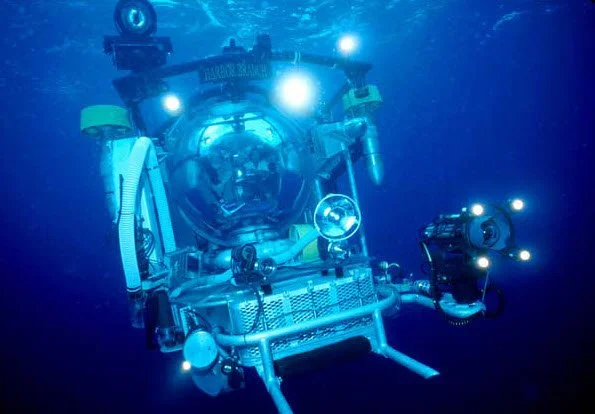
The Johnson Sea Link at work during a dive. Photo courtesy of Harbor Branch Oceanographic Institute
His plan was – once they’d plunked us into the water with the A-frame on the stern of the Seward Johnson and we’d scooted clear of the ship’s fantail before it slammed back down – to use the Sea Link’s mechanical arm to loosely shinny down the rope of the trap trawl’s endline. There was no way we could miss the cement trap anchoring the end on bottom, right? Brilliant.
So down we went, slow and steady ... and when we reached bottom, sure enough: there was the trap we’d had on the rail of the Stacie Vea earlier that day.
Pretty cool.
I don’t recall exactly, but I know the area where the lobster-tagging project took place wasn’t the deepest gear we had at the time.
I’m remembering trawls in 160 to 180 fathoms down in the lower portion of Crowell Basin – and gear deeper than that in Georges Basin. (I have a memory of a grey line 214 fathoms down etched out on the old Furuno depth recorder.) As mentioned earlier, I think where we went down in the Johnson Sea Link was maybe 110 or 120 fathoms deep. I’m not positive, but I can tell you these things, for sure:
It was over my head.
And I couldn’t have swum to the surface.
I’d learned that much from all those episodes of Sea Hunt.
Anyway, the neat shinny down the endline had put us right where we wanted to be.
The Sea Link’s pilot went to open the fingers of the mechanical arm to release the endline – and the hard-running tide on bottom (who knew?) immediately flipped the rope around the arm, snagging us in place.
Not cool at all.
I’m remembering at least one of us saying, “Oh, shit.” Maybe it was just me; I can’t say for sure.
But good ol’ cuke-cool Chuck Yeager (I’m sorry I can’t remember the man’s real name, as he saved our lives) never broke a sweat as he worked the controls on the mechanical arm for a few minutes, eventually flipping the offending endline clear and setting us free.
The sad part is, I can’t tell you much about the rest of the dive – I was pretty preoccupied with pondering things such as mortality, the afterlife, and how long it was going to take the Johnson Sea Link to return to the surface.
Which we did eventually (without further incident) and then reboarded the Stacie Vea ... something that floated.
I was pretty happy about that.
—Brian Robbins grew up in Stonington and now lives in Nobleboro, where he writes his monthly column “Wheel Watch” for The Rising Tide.
