

WHEEL WATCH: Froze solid

Brian Robbins.
By Brian Robbins
I’m of an age – 68 in a couple of days as I write this – where I grew up hearing the stories told first-hand of hellacious winters past when folks could walk (or ride in horse-drawn sleighs – or, later, motorized somethings) from Stonington to Isle au Haut.
I never saw it that bad myself, but my first couple decades’ worth of winters growing up in Stonington were definitely colder for more extended periods of time than the average of late.
As a little kid, I remember things freezing in with no one getting out to fish (a lot of them scalloping, along with some shrimpers and lobstermen with gear on the outer bottom), often for weeks at a time.
I have a clear memory of Gramp Robbins – Freeman to the rest of the world, who lived with my grandmother Vivian in a little house overlooking Moose Island Cove – saying to me during one of those extended cold snaps when my father hadn’t been able to make a cent for weeks, “Don’t you worry, Bri – I know it’s been tough times, but your father’s got all that money he made seining buried in Crisco cans out back of your house. He can always dig one up if it gets real bad.”
I’ll admit, it did make me feel better to hear that, although after a few years, I realized Gramp was lying (which he would do – usually for the sake of a good story, which you couldn’t fault him for). There were two things obviously wrong with what he was telling me. For starters, my father (who I called “Pa”) went herring seining for years and never made an abundance of money doing it. I remember him saying, “Why would anybody go all the way to that Las Vegas place to lose money when you could go herring seining and at least be out on the water?”
Along with that was the fact that the little house on Clam City Road where my brother Stevie and I grew up sat on what was basically a granite ledge with not a whole lot of dirt around it. Even if there had been some Crisco cans chock full of seining money to bury, you would have been hard pressed to get very deep with a spade around our house.
But, Crisco cans or no Crisco cans, we got by during those winters when things were froze solid. Maybe we didn’t have much, but we had enough. (And if you’re not familiar with the taste of government cheese, then you’ve missed something.)
The worries of the iced-in times were one thing; it was when the ice let go that all hell often broke loose. There’d be a warming spell – and maybe some southerly winds making up from out in the bay, stirring up the waters beneath the frozen harbor and then it would come around nor’west – and there’d be a call from my Uncle James, who had his own view of Moose Island Cove: “Better get over here; the ice is starting to go.”
Try to imagine that thick saltwater ice, somewhat busted up by the sea that had come in off the bay, now being pushed out on an outgoing tide and a nor’west breeze – dense, heavy jigsaw pieces, grinding and chawing at anything in their path. What they couldn’t get by or get through, they’d drag – and that included all those boats that had been sitting silently on their moorings through the freeze. Sometimes mooring pennants would chafe or part under the strain; sometimes mooring rocks (hellishly heavy blocks of granite) would uproot and drag. Boats would be piled into one another; sometimes one would be forced out onto the ice and lay over on its side, in danger of filling and sinking.
It was a mess. There were things Pa and the other fishermen could do, and then there were things that only the Great Spirits could make happen or prevent.
It was part of winter fishing. If you had a boat in the water and you were trying to feed the family, it was part of what you had to put up with.
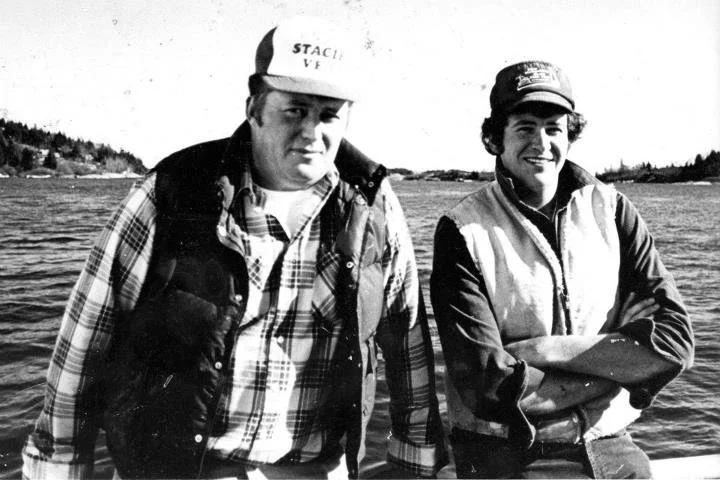
Brian Robbins, right, with his brother, Stevie, a legendary Stonington fisherman who was one of the first to fish for offshore lobsters. The two brothers grew up in Clam City in Stonington. Photo courtesy of Brian Robbins.
By the time I was old enough to be a part of things, we’d still have periods of the harbor freezing, but it wasn’t as bad as the old days. With Pa and Stevie, I learned about breaking a path through ice with a skiff – first while rowing, and then with an outboard (easier, yes, but make sure you have extra shear pins for when a chunk of ice sucks into the propeller).
Constant rocking from side to side. Let the hull ride up some onto the ice ahead and rock even harder, until it gives way underneath and allows you to go ahead a few more feet – unless that particular cake won’t let go. Then you need to back off and pick another spot to bite into and rock some more. And repeat and repeat and repeat and repeat and repeat.
I remember Stevie and I making our way out to his old Campobello-built lobster boat (the predecessor to the 44’ Shirley & Freeman and the 54’ Stacie Vea that we eventually went offshore lobstering with) in Moose Island Cove. It had been a slow, hard crawl, crunching our way from the wharf at Billings Diesel out to the mooring in the wooden skiff he had at the time. We were both wheezing and coughing – the northerly wind felt as if it was icing over the insides of your lungs when you tried to take a breath.
Gasping for air, we finally got alongside the boat, hoping that the kerosene heater down forward had stayed lit and the old 4-53 Detroit Diesel would start so we could warm things up a little.
We’d no more than crawled in over the side and touched our boots to the deck when Stevie made a grunting noise, looking back the way we’d come: the path we’d chowdered out was all but invisible already as the ice shifted, pushed by the wind and tide.
It was going to be a long slog back in.
That was winter.
—Robbins, who grew up in Stonington and now lives in Nobleboro, writes his monthly column “Wheel Watch” for The Rising Tide.
