

WHEEL WATCH: The colorful chaos of Stonington Lobster Boat Races
In the 1980s, Brian Robbins’ summers ‘revolved’ around the classic island event

July 7, 2026
By Brian Robbins
“We were just off the western end of Mark Island when the nitrous oxide kicked in …”
Sounds like the opening sentence of a Hunter S. Thompson novel, doesn’t it? Fear And Loathing In Downeast Maine or something like that, right?
Well, the truth is (and we’re talking 30 years or so ago here, so there has to be some sort of statute of limitations to this), I was on hand for an experiment involving nitrous oxide and a 6V-53TI Detroit Diesel.
I, in fact, was the button man.
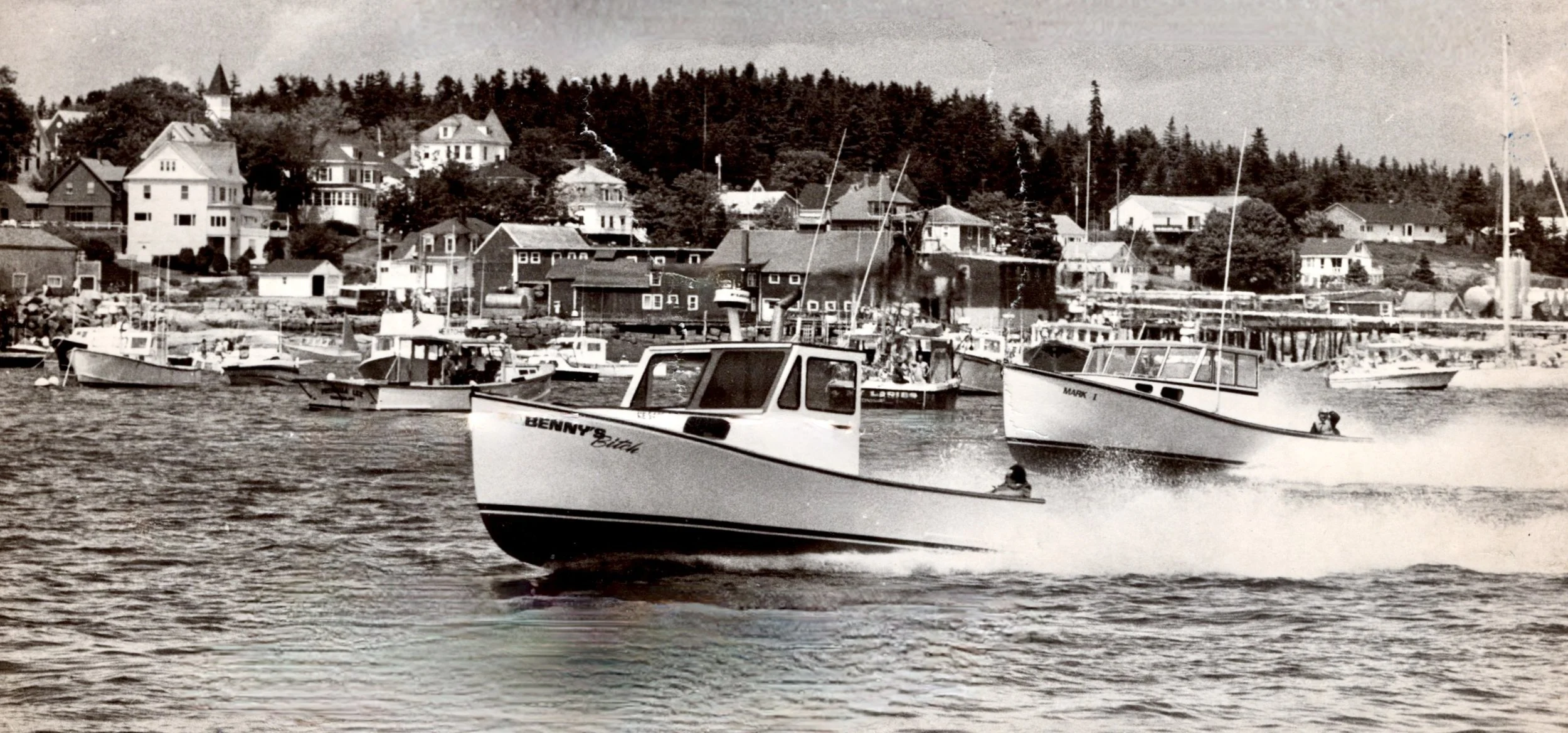
Benny Beal leads Leeland Peabody down the race course at Stonington. Photo courtesy of Brian Robbins.
But let me explain ...
Back in the late 1980s and 1990s, my summers revolved around the Maine lobster boat races: besides doing coverage for Commercial Fisheries News (CFN), I helped organize uniform classes and a point system for the circuit; I was on the Stonington race committee; and I did the announcing for several locations.
People were great to me along the coast, and I was often allowed peeks behind the curtain to what racers had up their sleeve for speed tricks—folks trusting that I would never leak info to their competitors. And I didn’t.
For the first several seasons I was writing about the races, veteran fisherman Benny Beal from Jonesport had the boat to beat on the Maine lobster boat racing circuit: a diesel-powered 28-footer named Benny’s Bitch. (I know, I know ... I would always refer to it as “Benny’s boat” whenever talking about the races in front of my kids.)
There were a number of boats who challenged Benny during those years, but nobody worked any harder to beat him than Leeland Peabody and his 33’ Mark I from down in Cutler.
Leeland’s 33-footer was a well-used quahog dragger when he bought her; he had Little River Boat Shop strip the rugged Young Brothers hull down to the bilges and completely rebuild her, plunking a 400-horsepower 6V-53 Detroit Diesel onto the engine beds.
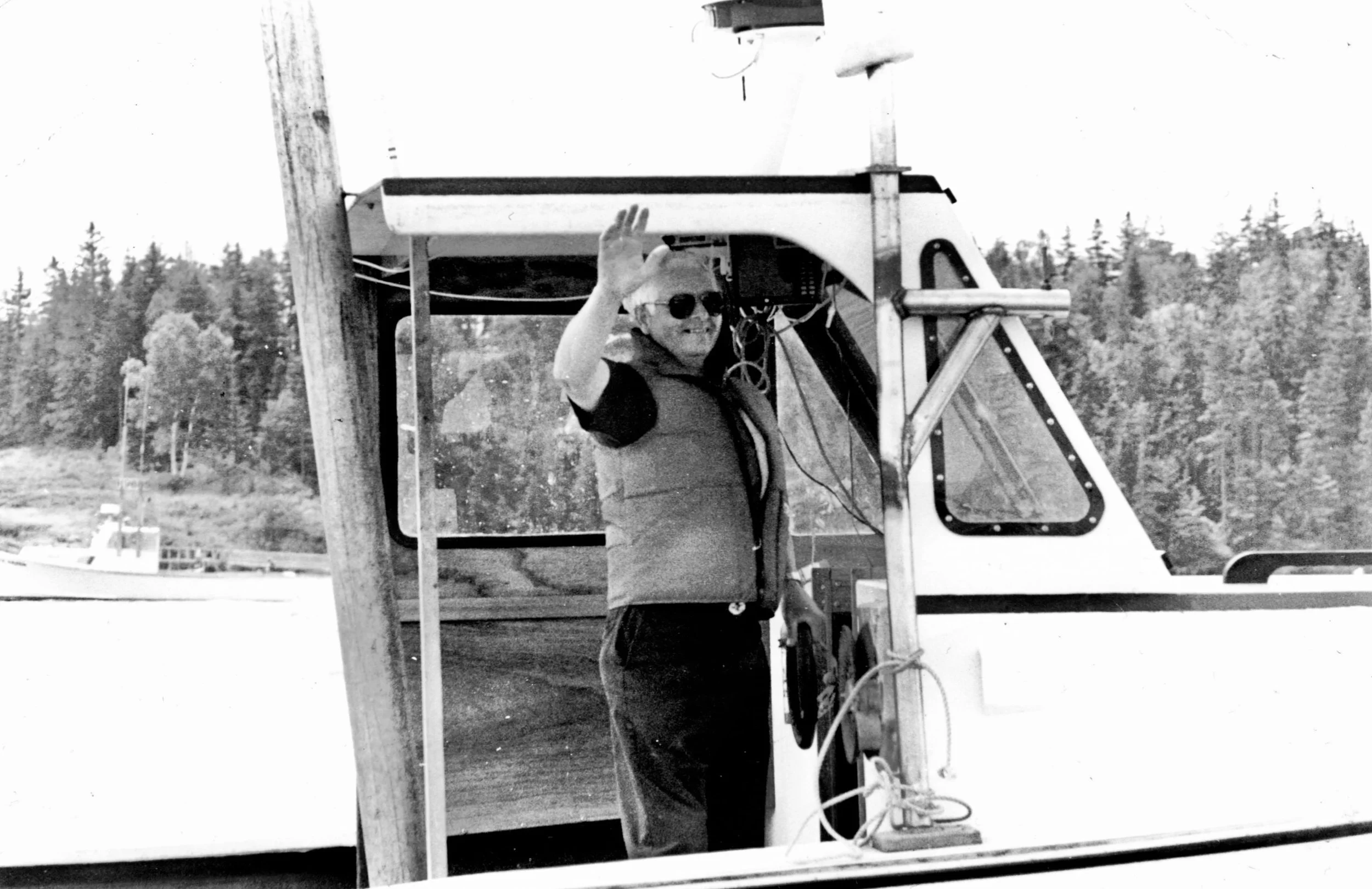
Benny Beal at the helm. The veteran fisherman—a pioneer of offshore lobstering—and racer passed away in 2022, having spent the majority of his 90 years on or around the ocean. Photo courtesy of Brian Robbins.
Leeland could’ve had a lightweight hull built from scratch, but he was bound and determined to prove that an honest-and-true workboat could be competitive on the race course.
The Mark I made her debut at the 1991 season opener at Boothbay Harbor: Benny Beal was the day’s overall winner, but Leeland made him work for it.
The gauntlet had been thrown down.
For the next several seasons, there was a standard scenario on race day: Leeland and Benny would each win their respective class races, setting up a showdown between the two in the diesel free-for-all; they’d rip across the finish line in the day’s big finale with the Mark I’s bow right on Benny’s Bitch’s aft quarter; and before the sun went down that evening, Leeland would be telling me, “I know what to do to beat him next time …”
And in the meantime, Benny would’ve said something to me along the lines of, “Leeland’s got her going awful good—I had to run a little harder today.”
I wouldn’t say anything to Benny about Leeland’s next tweak, of course—and I certainly never told Leeland that Benny still had a little throttle left. I just let it all play out and wrote my race features for CFN.
I was on hand when Leeland experimented with lifting rails; he tried different rudder designs; I remember the manufacturers of a bottom coating called “Sea Slide” showing up to give the Mark I’s hull some extra slickness; and I remember a set of military-spec fuel injectors that were scary.
And then came the period when Leeland tried (and perfected) injecting propane into the air intake of his engine. He happened to read an article in a magazine aimed at campers and RV enthusiasts describing a “hill climb assist” in certain diesel-powered rigs, tapping into the onboard propane source for the cookstove or whatever for an extra boost on steep inclines.
Eventually, a lot of competitors employed the propane trick (with varying results), but Leeland was the first I knew of – before it became illegal—and he had it down to a science, giving the Mark I’s engine a good kick in the pants at full throttle.
But it was nothing like the time he tried the nitrous oxide.
I remember Leeland calling me at the old CFN office in downtown Stonington a couple days ahead of that weekend’s race.
“When you get out of work, come over to Billings Diesel,” he said. “I want you to take a ride with me.”
Sounded good to me—I’m always up for a boat ride.
Yeah, well …
As we idled out into the western bay off Stonington, Leeland showed me a bright blue tank of nitrous oxide down in the Mark I’s lazarette, plumbed up to his engine’s air intake by a long length of braided stainless-steel hose.
I can’t remember if propane was against the rules at that point, but nitrous oxide?
It was as illegal as it gets—for either diesel or gas-powered boats. And remember: my role as a journalist was one thing; I was also very involved with the politics of the race circuit.
“Leeland ...” I stood there, staring at the blue bottle and shaking my head.
“I just want to try it to see what it does,” said Leeland.
“Yeah, but …”
“I promise: we’ll just try it once and then I’ll take it off the boat.”
My protests got weaker and weaker. The truth? Heck, I wanted to see what it would do, too.
Of course, I wasn’t there just to go for a ride: I had a job to do. I was sitting on the stern of the Mark I with a little plywood box with the nitrous feed line running in and out of it—and a button to push.
“Wait until I hit the throttle before you give it any nitrous,” said Leeland. “I’ll give you the signal and you hit the button.”
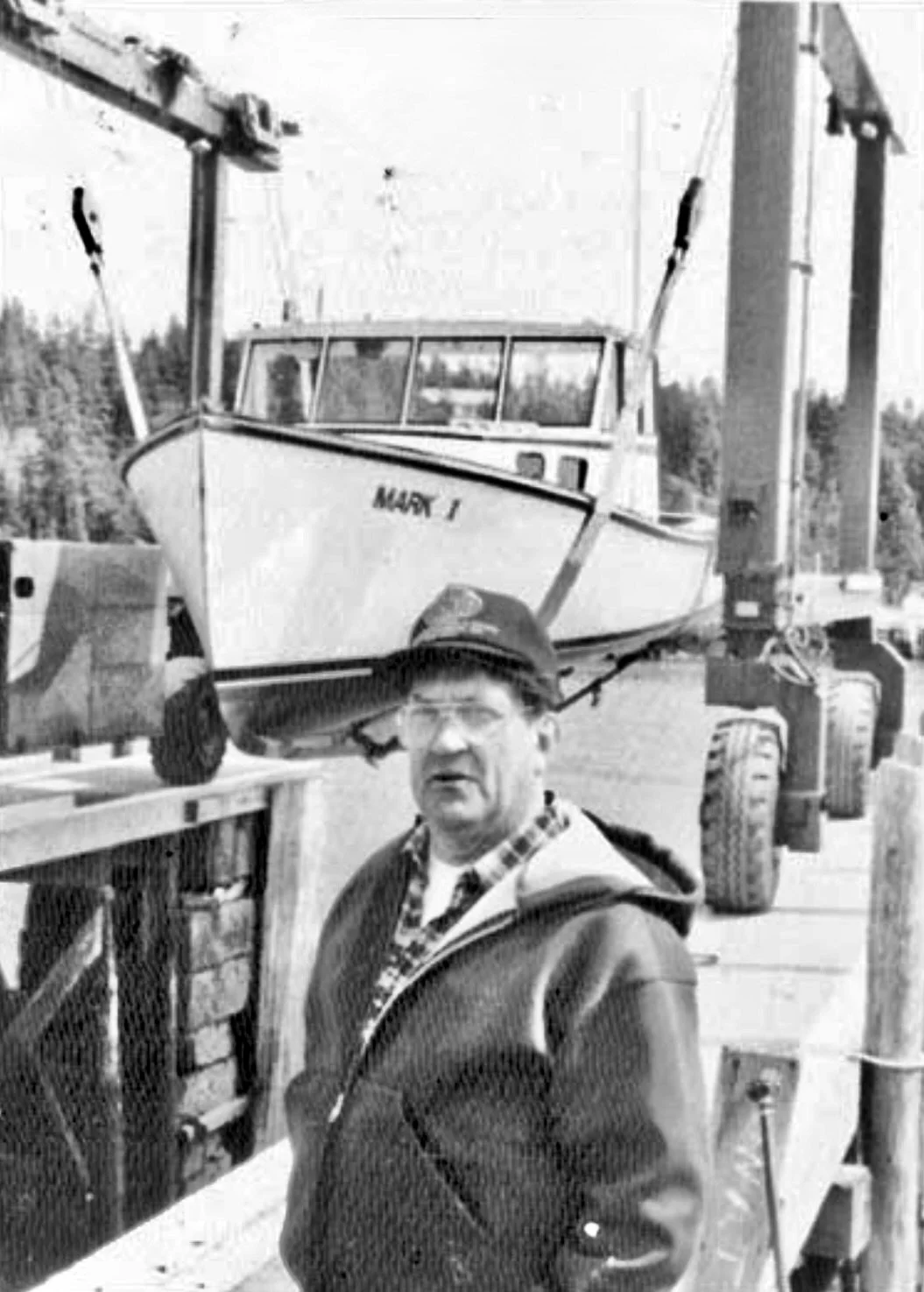
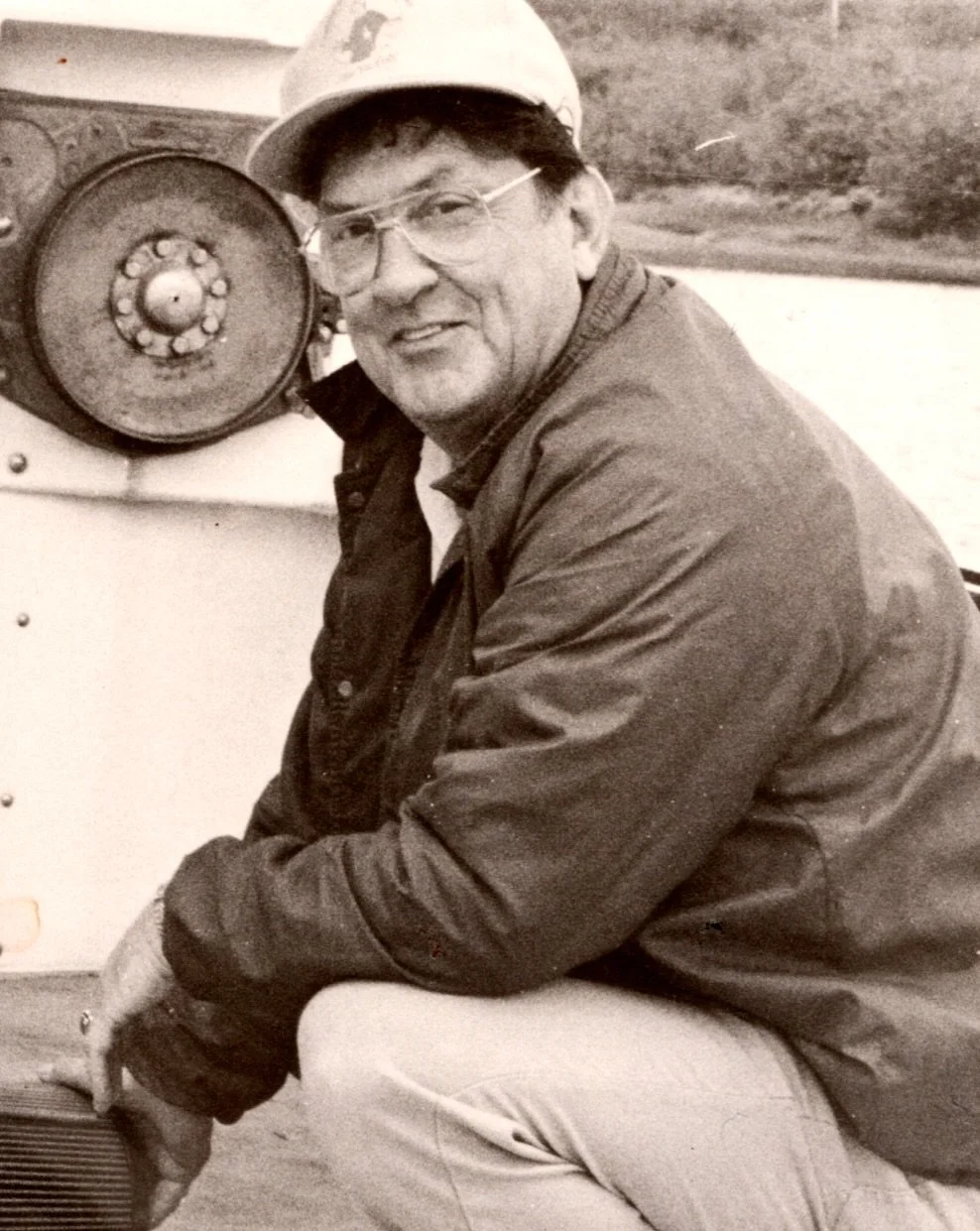
Leeland Peabody and the 33’ Mark I, hanging in the straps at Billings Diesel, left. Leeland and his wife Debbie moved to Arkansas back in the mid-90s, but he’d always stayed in touch—and loved talking old race stories. He passed in 2024 at the age of 84. Photos courtesy of Brian Robbins.
On our first pass, Leeland looked back at me and nodded as she topped out around 2850 RPM; I hit the button and…nothing.
Leeland waved his arm, thinking I hadn’t been watching him. I hit it again. Still nothing.
Leeland slacked the throttle back. “Did you press the button?” he yelled.
“Yes, I pressed the button!”
“Well … this time, hold it down when I give you the signal,” he said.
Leeland nailed the throttle and the diesel let loose with that fierce scream she had. The Mark I was ripping out by Mark Island when he nodded to me; I pressed the button down and held it … and waited … and … WHAM!
I can’t tell you how long I’d been holding the button before anything happened. It seemed like forever, but I’m sure it was only a few seconds … however long it took for the nitrous to run from the bottle through that neat-looking braided stainless hose to my control box and then shoot forward to the air intake on the engine.
But once it did, all hell broke loose.
The Mark I’s diesel would fetch against the governor at 3100 RPM; Leeland said afterwards that that’s where the tach needle landed when the nitrous kicked in, without a care in the world about the propeller on the other end of the shaft. The 33-footer leaped—and I mean leaped—with a wildness neither of us had ever felt in the normally-stable hull, cocking up on one haunch. And that poor Detroit Diesel sounded like it was coming off the beds.
I let go of the button as Leeland yanked the throttle back. (He had heart trouble, by the way—I’d seen him pop a nitroglycerin pill more than once on race day.) He brought the Mark I down to an idle, threw her out of gear, and then stood there, pale-faced and staring at me with his headful of black hair standing up like a rooster’s comb.
Neither of us spoke for a few moments. And then Leeland said, “Holy shit.”
It took about 10 minutes to unhook all that stuff when we got into the wharf.
And I can promise you it never made a reappearance.
—Brian Robbins grew up in Stonington and now lives in Nobleboro, where he writes his monthly column “Wheel Watch” for The Rising Tide.