

WHEEL WATCH: The legends who built the Shirley and Freeman
The men behind a ‘one-of-her-kind lobster boat’—that may or may not have lost its roof in a violent storm
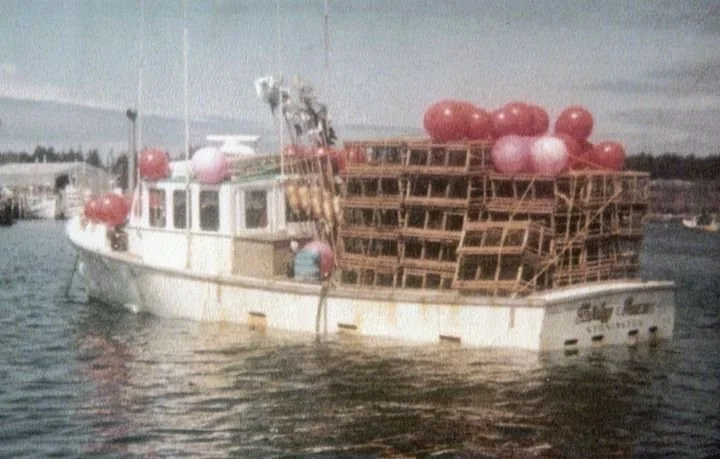
The Shirley & Freeman on her mooring off Billings Diesel in Stonington, loaded with 88 four-foot wooden lobster traps (four trawls’ worth) and all the rigging. “It would be an 18-hour steam out to where we’d be setting them,” Robbins said. Photo courtesy of Stanley “Cappy” Sargent.
Oct. 13, 2026
By Brian Robbins
The recent passing of John “Jock” Williams – founder of Mt. Desert’s John M. Williams Boat Company – both saddened and reminded me of how lucky we were to cross paths with the folks that we did during the building of my brother Stevie’s 44’ offshore lobster boat Shirley & Freeman back in the 1970s.
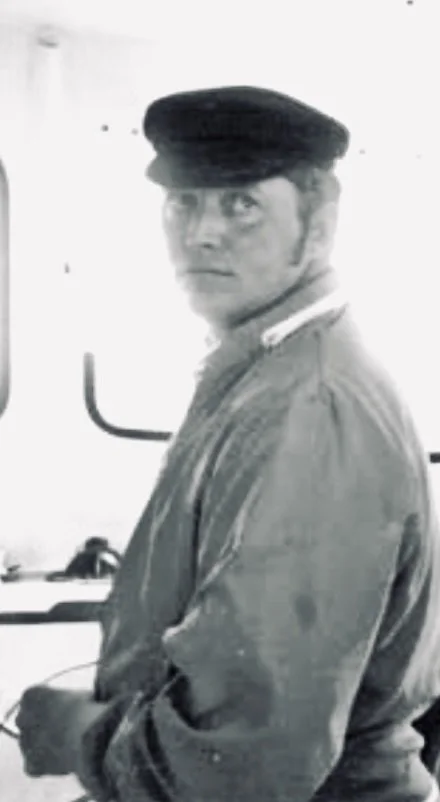
Robbins’ brother Stevie at the helm on launch day. Photo courtesy of Brucine and Stacie Robbins.
Stevie had a vision and he was blessed with a drive that was matched only by his integrity: he might have been inspired to try his hand at lobstering offshore by stories of the accomplishments of others (Bob Brown, Charlie Raymond, the Porter brothers out of Massachusetts – and closer to home, Benny Beal running out to the Continental Shelf in a homemade wooden 45-footer) but Stevie wasn’t going to chase anyone; he was going to do it his way.
Although the John M. Williams boatyard became known primarily as a builder of first-class pleasure boats, the business’ roots were definitely commercial, as it was the Lyford Stanley-designed Stanley 36 that gave Jock his start in the early 1970s. Molded from a wooden lobster boat built by Lyford, the 36’x12’ model quickly caught on with its nimble handling and steadiness in rough weather.
That was the model that caught my brother’s interest and got him thinking about a fiberglass-hulled offshore lobster boat: if there was something in the mid-40’ range that could spin on a dime, carry a load, and handle nasty conditions as well as the Stanley 36 model, you’d have something.
It turned out there was: responding to the popularity of the Newman 46 offered by fellow MDI builder Jarvis Newman, Jock and Lyford teamed up to produce their own 44’ model with a wide-for-the-time 14’6” beam. The plug used to take a hull mold from was finished off as the Maine, a patrol boat for the state’s warden service.
As I say, those were impressive dimensions back in the day; now you’ll find 44-footers that are 17’6” (or more) wider – and much longer models, of course. And nobody’s looking to fish them 180 miles offshore, either.
But we did.
So it was that Stevie sat down with Jock Williams and told him what he wanted to do and what he needed for a boat. My brother attended the launching of the Maine and, according to Jock in a conversation we had just a few years ago (our last one, as it turned out), “Everyone who met Stevie at the launching of the Maine was impressed by him ... as well as his vision of what he wanted to do.”
And at some point, Stevie made his decision.

Jock Williams promised my brother a solid, well-built sea boat that would get us there and back – and he made good on that promise. That boat did everything we needed her to and more.
Jock was very hands-on and involved in the building process back in 1976. Close to 50 years later, he could still reel off the lamination schedule for the Shirley & Freeman’s hull, as he laid it up himself.
The first Stanley 44 hull out of the mold, her specs can be summed up simply: she was brutally heavy.
The finishing process – including building a custom wheelhouse, as there was no molded house and deck unit for the 44 at that point – was done by another builder best known for pleasure boat construction. Brooklin Boat Yard’s name was held in high regard by yachters all over the world, but they could build a rugged work boat when given the opportunity.
In those days it was Joel White himself at the helm and he and the whole Brooklin Boat crew couldn’t have treated us any better.
I remember Joel’s earnestness; his wisdom; his always-handy grin and eye twinkle that you pretty much had to have to put up with us for any length of time.
Joel, as did Jock, dealt with cashmere-clad folks the same as he dealt with those of us wearing flannel: with respect, honesty, and humor that was never mocking.
Both of those men were good souls and we were absolutely blessed to have them be the key players in the construction of that boat.
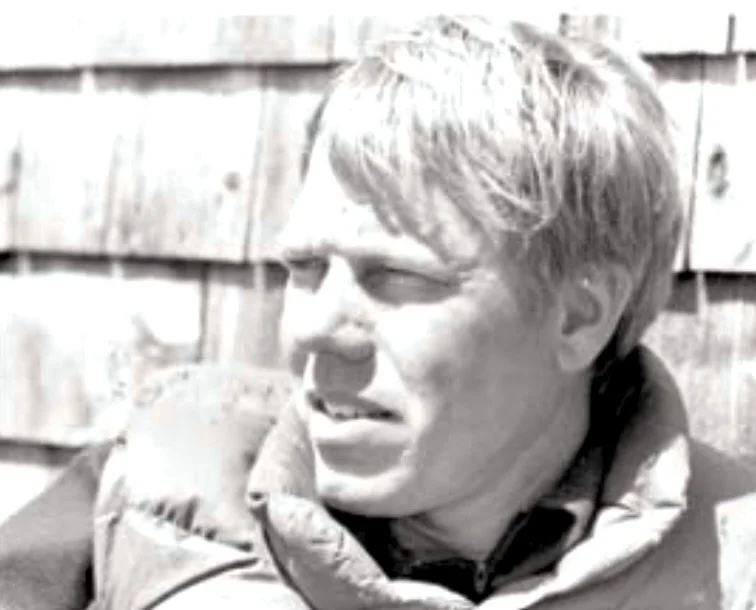
John “Jock” Williams at the Shirley & Freeman launch in 1977. Photo courtesy of Brucine and Stacie Robbins.
As I mentioned earlier, if you wanted to talk about offshore lobstering in the mid-1970s, there were some names and there were some stories ... and most of the stories wouldn’t make the average person want to go off there.
Joel (who passed away in 1997) and his crew approached the project the same way Jock and his team had: this boat is going to take a beating; it’s up to us to build her as rugged as we can.
The Shirley & Freeman (named for our mother and Gramp Robbins) was launched in August of 1977. By the time we’d hopped around the Gulf of Maine searching for decent lobster bottom and ended up in the lower end of Crowell Basin, we knew we needed something bigger to fish that far out year-round.
The steel-hulled 54’ Stacie Vea was the next chapter in our offshore lobster career, hitting the water in 1981.
But the Shirley & Freeman took us out there first ... and brought us home.
There were beatings – plenty of them – but those are stories for other days. For now, I’ll just say, she was an amazing boat.
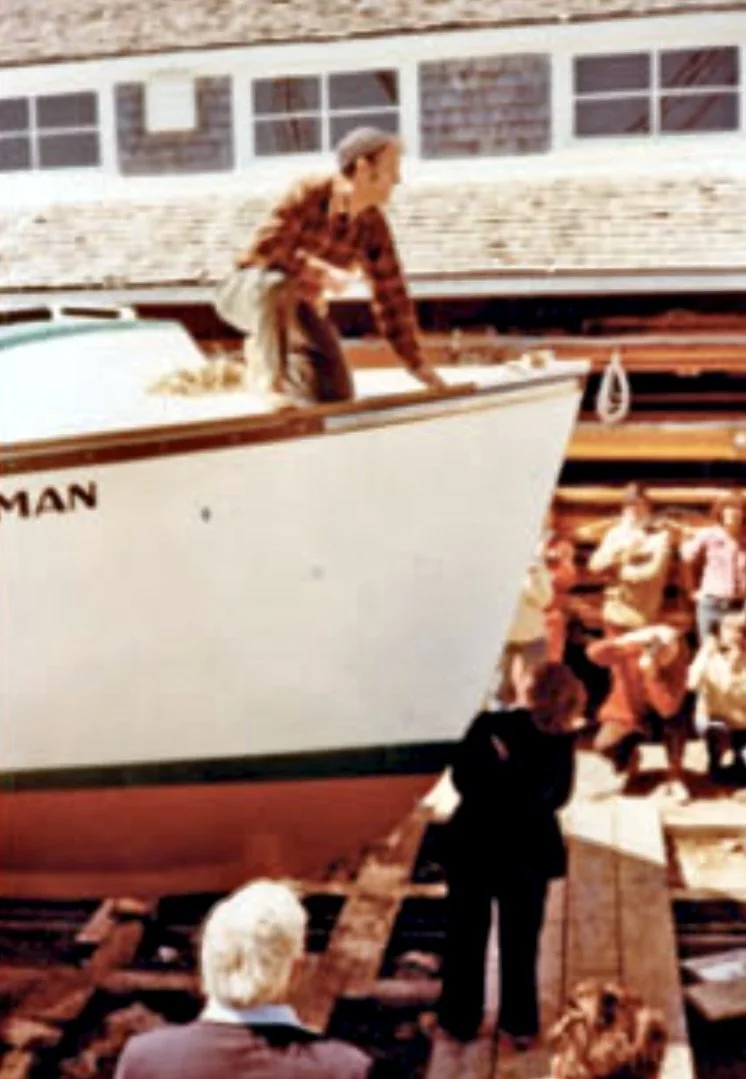
Joel White on the bow of the Shirley & Freeman, “as Stevie’s wife Brucine gets ready to bust the champagne on the bow,” Robbins said. Photo courtesy of Brucine and Stacie Robbins.
And I’ll leave you with this: I was doing a sit-down interview for Commercial Fisheries News with a veteran fisherman who was retiring after a long successful career – a hard-working highliner who’d also pushed to protect and make the industry better when he was ashore.
The fellow had fished a Stanley 44 himself most of his career; he’d had her built in 1983.
“You know why I went to Jock Williams for one of those boats, don’t you?” he asked me.
“Well, I think I do,” I answered. “I mean, they’re great sea boats.”
He looked at me kind of funny.
“That’s true ... but after I heard the story about you guys getting the roof ripped off the wheelhouse in a storm and still making it back in, I was sold.”
I looked at him for a few moments before I got the words out. “Ripped the ... what?”
He nodded. “I know; you probably don’t like talking about it – but when I heard how nobody knew where you were for days, and then you guys idled into the harbor with the wheelhouse roof peeled off ... no electronics ... but she brought you home? I couldn’t believe it.”
“Uhhhhh ...,” I was dumbfounded. “Look, we saw plenty of weather ... and we took some savage poundings ... and that boat was something else. But we never cleaned the top off the wheelhouse. Good Lord – the way Joel White and his crew built it, it wasn’t going anywhere. Honest.”
He gave me a “I know and you know and I know you know, so I’m not going to make a big deal about this ... but I do know” sort of look and went on to something else.
But I swear we never took the top off the wheelhouse.
Here’s to Jock Williams and Joel White – two men who made their mark in the big world ... but who were both awfully proud of a one-of-her-kind lobster boat they had a hand in creating all those years ago.
—Brian Robbins grew up in Stonington and now lives in Nobleboro, where he writes his monthly column “Wheel Watch” for The Rising Tide.
