

WHEEL WATCH: When trucks were trucks and cars were…also trucks
A Stonington fisherman recalls the ‘hybrid’ vehicle sometimes called a ‘Deer Isle clam wagon’
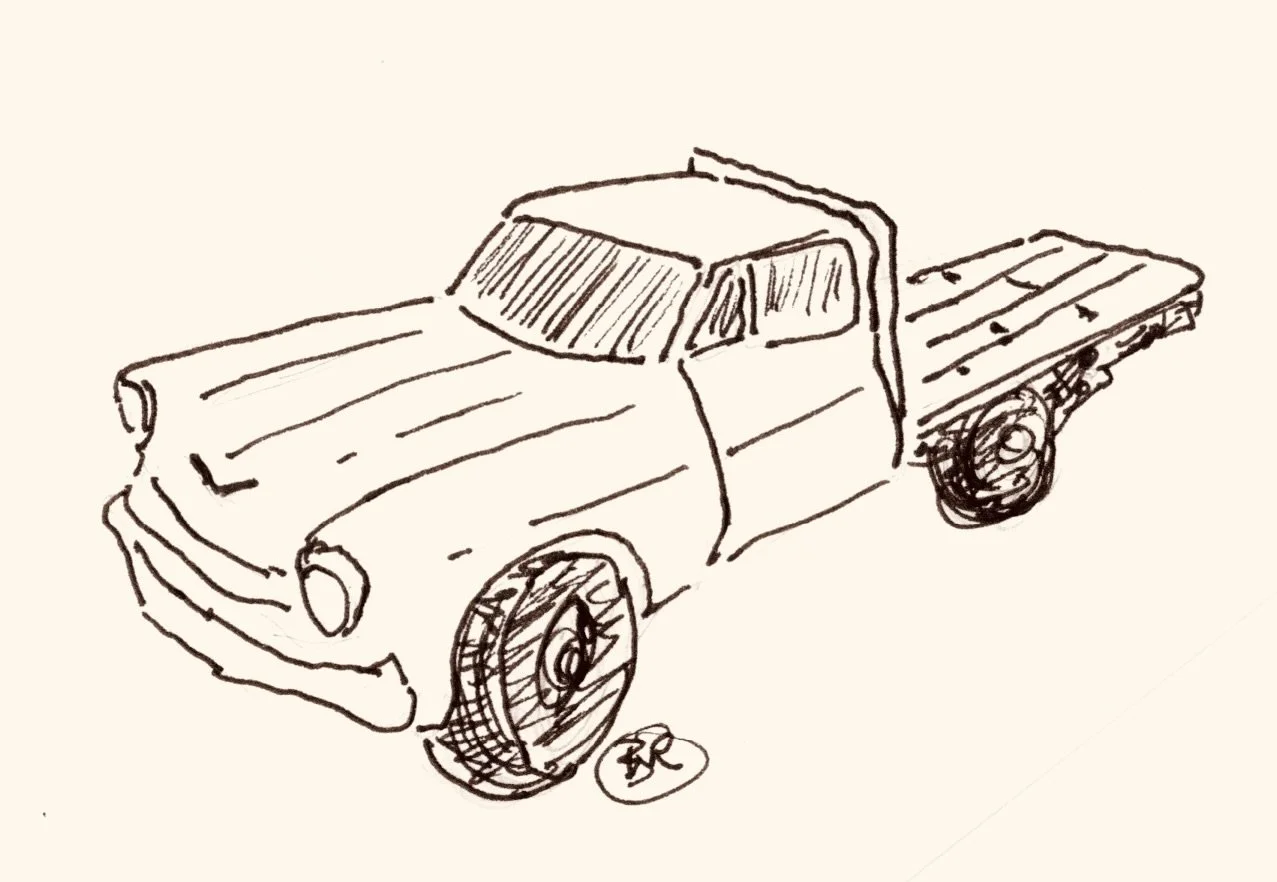
“Back in the day, the family car was often born again as a hybrid truck,” a Stonington fisherman says. Illustration by Brian Robbins.

Brian Robbins.
April 6, 2026
By Brian Robbins
When I was a kid, you didn’t see a lot of new trucks on the Island. There were trucks, of course, but it was a big deal for a fisherman to have a brand-new right-off-the-lot pickup to lug lobster gear to the shore with.
I have a dim memory of the truck my father had when I was little: a hulking black Dodge with a wooden flatbed body on the back. I couldn’t tell you the year, but it was old enough to have a two-panel windshield (I’m guessing late-40s/early-50s, maybe?) It was old, but it served him well.
Of course, Pa didn’t drive a lot of miles in the course of the average year: Leaving the Island was a big deal. My brother Stevie’s description of riding from Stonington to Castine in February of 1958 to see his newborn baby brother (me – there were 14 years between us) always sounded like a cross between some grim Jack London novel and the story of the Donner Party if they’d been piled into an old Dodge pickup.
Besides the near-blizzard conditions, I think that trip set the record for most flat tires (three) in the lowest number of miles (a round trip of 75). Fortunately, Pa always had several spare tires with him; truth be known, he never had actual snow tires – he just used whatever hadn’t gone flat during the summer and fall with chains lashed around them.
But I digress.
What you did see when I was a kid were a lot of cars – regular passenger cars – that had been reborn as fishermen’s trucks, with the original bodies cut off just behind the front doors and a homemade wooden platform bolted to the rear portion of the frame.
This speaks to the ruggedness of the average vehicle in those days. What an investment, eh? It was sort of like bringing home a baby piglet: Mom and the kids excitedly pick out a name for the little cutie, while Dad starts dreaming of bacon.
In this case, the nice upholstery and the extra-large glovebox in the family’s new car didn’t do much for Dad. He was already doing rough calculations in his head of how big a platform he could bolt on the frame in a few years once the body started to rust out.
Somewhere along the line, the cutesy name “Deer Isle clam wagon” was applied to those hybrid vehicles, but I don’t remember them being called anything back in the day. No longer a car, but not really a truck, they were simply how you got done what needed doing.
When my brother Stevie started out lobstering, he owned an actual truck, an old pickup that he’d bought off one of the contractors on the Island. It still had the business name on the door, which is why I’ll always think of it as the “Colby C. Weed truck” – a short bed Ford that was of late-50s-or-so vintage. The small body wasn’t ideal for lugging lobster traps, but Stevie taught me about stacking and tying – you took them as serious over the road as you did down the bay – and the old Ford earned its keep transporting crazy-high piles of traps, rope, and buoys.
Where it really shone, though, was during those early morning runs to the shore. During my school vacations and weekends, I was Stevie’s crew if he didn’t have a regular sternman. Looking back, it was the best thing that could’ve happened to me as a kid. Along with a lot of other things, my brother taught me how to work, with lessons that often weren’t much fun, but they stuck with me. If Stevie said he’d pick me up at 3:30 in the morning to go to haul, that meant be ready by quarter past.
I don’t know what the old Ford had in it for an engine (I’m guessing maybe a 6-cylinder), but I’d hear it roaring down Clam City Road long before his headlights showed up. I’d go barrel-assing out of the house and jump into the cab of the Colby C. Weed truck, Stevie popping the clutch and lurching out of the driveway in reverse before I got the door closed.
For whatever reason, the only station the old AM radio in that truck would pick up at that hour of the morning was WWVA – “50,000 watts of power coming to y’all from Wheeling, West Virginia – yeeeeeeehawwwww!” the early-morning DJ would scream, dropping the needle on a Lester Flatt & Earl Scruggs banjo-fueled breakdown as we fishtailed crazily through Stonington village, headed for Billings Diesel on Moose Island, where Stevie’s Campobello-built boat – his first full-sized lobster boat – was moored.
To my knowledge, no one ever complained to the authorities about the pickup truck roaring through town long before dawn with its tires squealing and gears grinding, accompanied by a soundtrack of frantic banjo music, making the whole thing seem like a chase scene out of Bonnie & Clyde.
I like to think that the folks who lived downtown knew how hard of a worker my brother was and cut him some slack for the pace of his early-morning commute.
I wish there was someone to ask.
—Robbins, who grew up in Stonington and now lives in Nobleboro, writes his monthly column “Wheel Watch” for The Rising Tide.
