

Students need to fail. That’s why we go to the woods.
An annual retreat to the woods is just the sort of confidence builder we need more of in the classroom
Oct. 19, 2026
By Rebecca Gratz
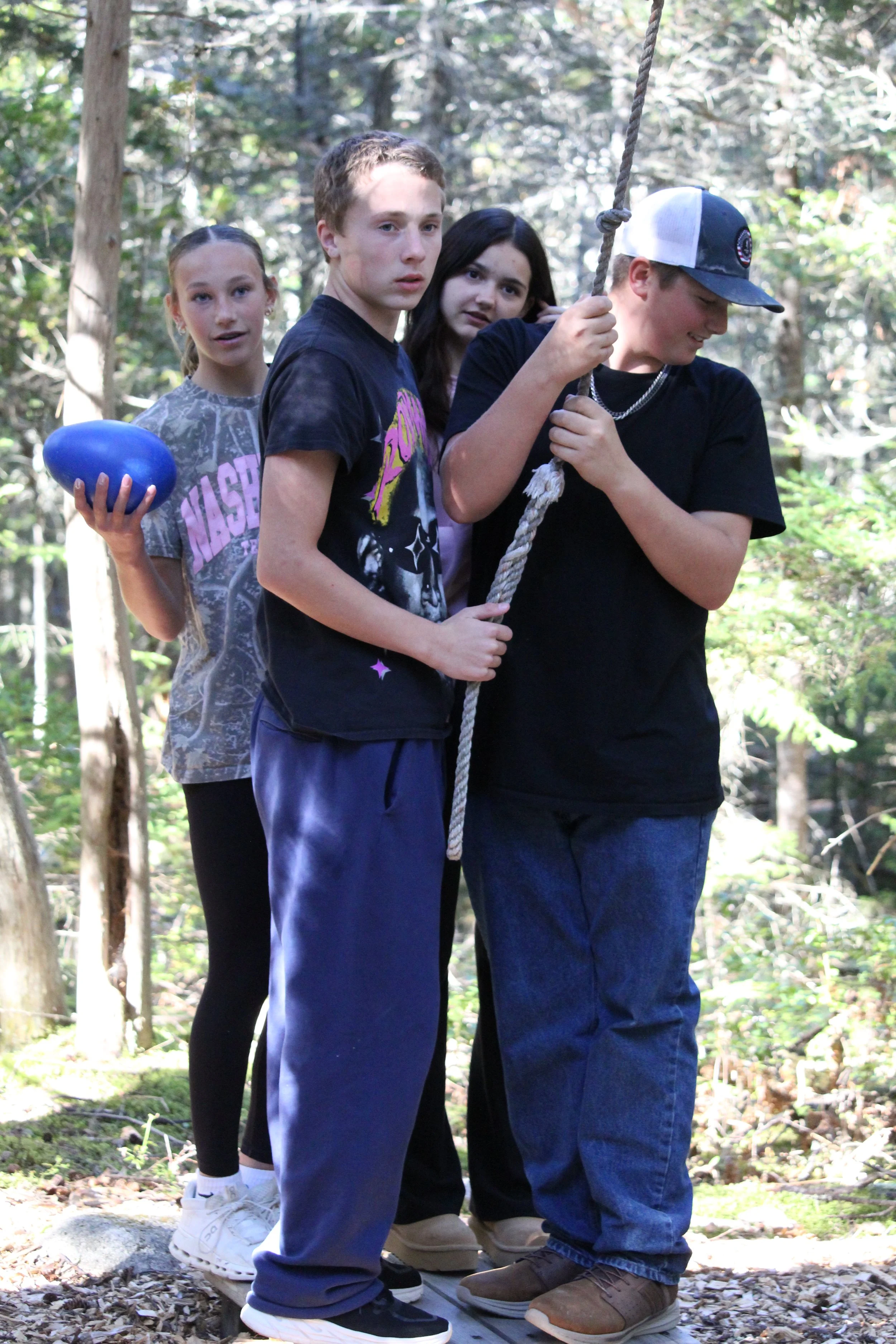
From left, 9th graders Julianna Perez, Jasper Gray, Kennedy McDonald and Andrew Weed at Camp Beech Cliff. Photo courtesy of Rebecca Gratz.
For three days in September, the 9th grade class of Deer Isle-Stonington High School took over the staff housing and commons at Camp Beech Cliff on Mt. Desert Island. At a time in education when everyone talks about learning gaps and literacy rates, why do we take three days from instructional time to go to the woods? Because we believe in the transformative power of experiential learning; challenging our students to get out of their comfort zones to work collaboratively, and fail or succeed together.
Most adults realize that we learn more from failure than success. Yet in education today we try to protect our students from failure - to the detriment of their growth and learning. A student who fails a test in elementary or middle school may learn an important lesson about preparation. Even better, they will learn that through studying and preparing they can succeed, which builds confidence.
By high school, failure has higher stakes - failing a test or a class becomes embedded in a student’s transcript and can have repercussions post-high school. But it’s still an opportunity for growth. One of my colleagues used to say, “it’s cheaper now” when we talked about students failing classes or not getting into programs or colleges of their choice. What he meant was experiencing failures and setbacks while in high school when there is a safety net, trusted adults, and room to recover and improve is “cheaper” emotionally and financially than after students graduate from high school. Providing opportunities for meaningful failure with room for growth is a critical aspect of preparing high school students for life after graduation.
When (and even before) Covid sent our students home and disrupted learning and development, education had been moving in the direction of protecting students from failure. The idea that failure can, and sometimes does, lead students to feel demoralized and quit on themselves before they have a chance to learn, has merit. Removing failure, perseverance, and pride in doing hard things is worse for our students in the long term.
“Removing failure, perseverance, and pride in doing hard things is worse for our students in the long term.”
So, in a time when parents get daily updates on their students, and when many of them hold teachers and schools responsible for their grades, how do schools provide opportunities for productive struggle and meaningful failure?
We take to the woods.
In the woods, a group of 10 students look skeptically at a rope hanging from a tree, with three wooden platforms of different sizes arrayed in a nearby semi-circle. Their job is to figure out how to get every member of their team safely onto the platforms in the correct combination, using only the tools at their disposal. In less than a minute, students work together to tie up two sweatshirts so they can “grab” the rope and start figuring out how to get their team safely onto the platforms. After the first, second, third, and several more attempts, starting over again each time, the students are listening to each other, laughing together, thinking out loud, and finding a way to make it work.
When they finally figure it out and everyone is on a platform and they have solved the problem posed, they feel so accomplished and proud. Not despite their initial failures, but because of them.
If it is ok to fail and keep trying, to make mistakes and learn from them in a problem-solving scenario in the woods, isn’t it ok in the classroom? The mistakes these students worked through, the failures they experienced did not harm their self-esteem. Overcoming them certainly improved their confidence. So, how do we recreate this in the classroom? And how do we get the adults on board?
Protecting students from mistakes and failure, does our students and our society a disservice. Learning to experience challenges, failure, and develop the perseverance necessary to become successful adults is one of the greatest lessons of high school. That’s where experiences like our three days and Camp Beech Cliff serve an important need, with permission and safety to fail individually and collectively, the space to figure it out and try again (and again, and again) to solve a problem and succeed, and allow our students to realize that perseverance is its own reward.
One of the central tenets of Camp Beech Cliff is “challenge by choice,” which means that everyone participates but they each choose their own level of challenge. Students are encouraged to push themselves, to take on (a little) more than they think they can, and feel the pride of rising to the challenge. As a school leader I believe my greatest success is creating an environment where students can achieve more than they thought possible. At our school, that begins in the woods.
-Gratz is the principal of Deer Isle-Stonington High School.
The Rising Tide welcomes letters and opinion pieces from a wide variety of viewpoints. Please review our guidelines for helpful tips on what we look for in letters and opinions. Published pieces do not reflect the editorial stance of The Rising Tide or its board, and are not endorsements. To submit a piece to us, email info@risingtide.media.
