

OP-ED: The patriotism of dissent
Brooklin’s flags remind one writer of ‘the right to say when we have fallen short’
Sept. 15, 2026
By Michael Colombo
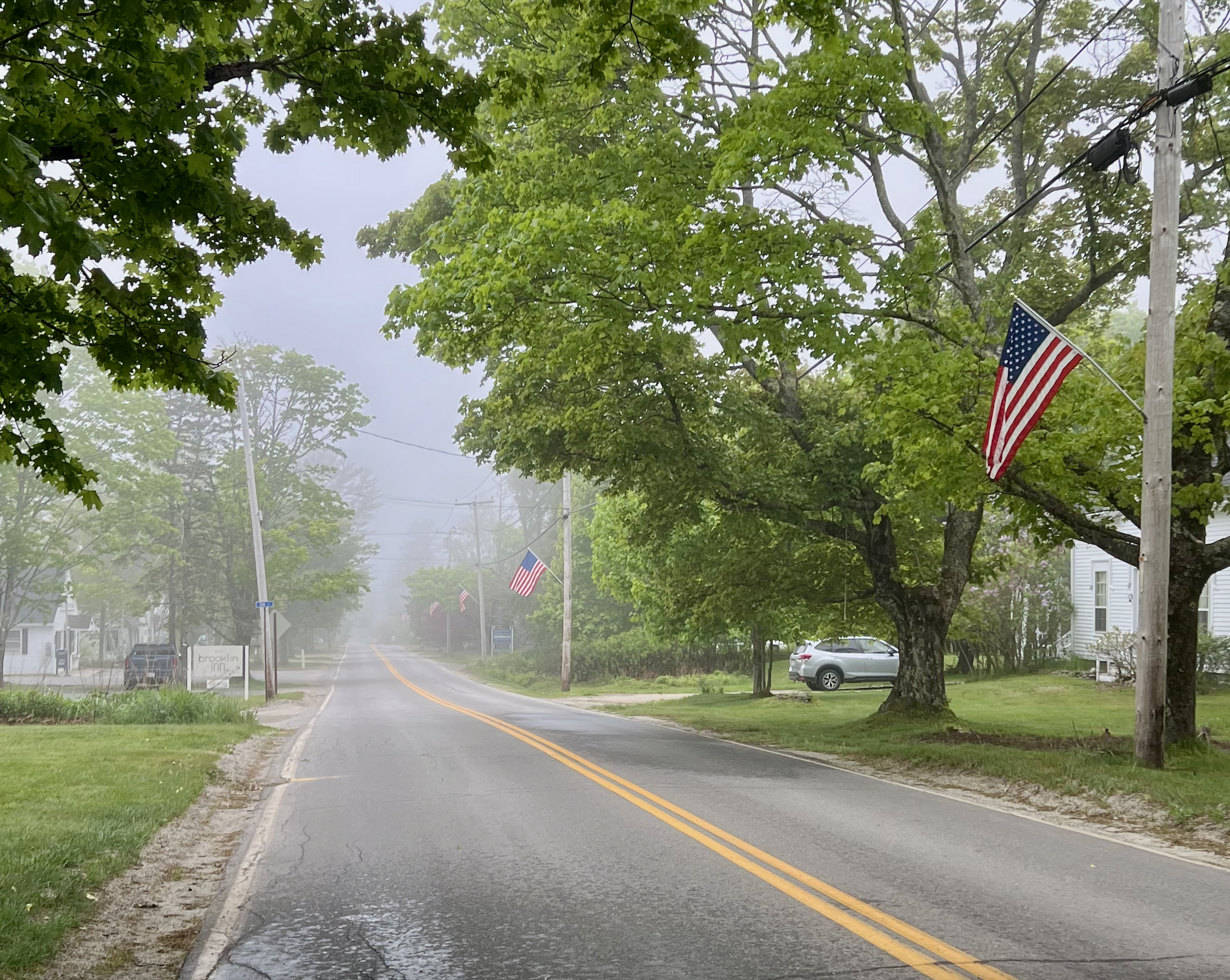
Flags along Reach Road in Brooklin. Photo by Trish Colombo.
As another Brooklin summer comes to an end, and the hatches prepare themselves for battening, one of the sights I’ll miss most is the cascade of American flags that we see along Reach Road coming into town. Of all of our extreme seasons in Maine, summer feels like it’s when we’re most patriotic. It’s when we’re most enchanted by our own traditions. We drink beer at cookouts, go to the movies, and watch baseball, parades, and skillet tosses. We spend most of our time outside in appreciation of the land that centuries ago served as refuge and beacon for both the vulnerable and the adventurous alike. In the summertime, we can feel that history beneath our bare feet as we light the fire to roast our marshmallows.
Refined down, patriotism is the love one has for their country. It’s a “devotion to a particular place and a particular way of life,” George Orwell wrote. It’s also a devotion to ideals. America’s ideals were not invented in America. The Enlightenment in Europe, Classical Republicanism in Greece and Rome, and the Judeo-Christian tradition gave us the concepts of equality under the law, freedom of speech and worship, and the commitment to self-government that established the foundation of our republic. These ideals, though descended from centuries of tradition, found their full expression in the American experiment. Once put in practice, they took root in a unique culture — our “particular way of life” — defined in part by non-conformity, individualism, and relentless creative energy.
I love that culture. Like many folks my age, I’m nostalgic for the America that I grew up in. The summers of my childhood were filled with Little League and E.T., Mark Twain and Mark Hamill. I hung out at the mall, listened to Nirvana, and watched Ronald Reagan talk on TV about “a shining city on a hill.” I loved watching NASA change our view of the world through both triumph and tragedy. I loved (still love) eating Whoppers and onion rings. “Patriotism,” Orwell goes on to say, “is of its nature defensive, both militarily and culturally.” The ideals, the place, the culture, that we so love are to be protected rather than projected. For decades this sort of patriotism was our common ground.
But our culture is changing, and with it, our understanding of what it means to be patriotic. Over the last decade we’ve begun defining patriotism as a love of America beyond good and evil. A view of patriotism that renders dissent as treachery. We’ve been warned in the past about this trap, whereby the powerful seek gratitude, telling us that loving one’s country means loving its leaders, ignoring its sins, and quietly complying with its aims. This is the framing that Samuel Johnson had in mind in 1775 when he said, “Patriotism is the last refuge of a scoundrel." He’s describing dangerous leaders that wrap themselves in the flag and demand loyalty.
“Dissent as an act of patriotism is not merely an incidental part of American political life, it’s the raison d’être of the republic itself.”
But dissent, dissatisfaction, even disgust are legitimate expressions of a love that is defensive. A love that seeks to protect that which is loved. Dissent as an act of patriotism is not merely an incidental part of American political life, it’s the raison d'être of the republic itself. The Declaration of Independence was an act of dissent, dissatisfaction, and disgust. So too were the movements for abolition, suffrage, labor, and civil rights. Dissent in each of these cases did not ask us to "burn it down." It merely held us accountable to our own ideals. Frederick Douglass's "What to the Slave Is the Fourth of July?" doesn't reject the Declaration, it turns it into an indictment by its own terms. Douglass taught us that, "Power concedes nothing without a demand. It never did and it never will."
Brooklin’s patron saint, E.B. White, wrote during the worst years of the last century, “I am in love with freedom…and I am deeply suspicious of people who are beginning to adjust to fascism and dictators merely because they are succeeding in war. From such adaptable natures a smell rises. I pinch my nose….” In his essay, Freedom, he roots his patriotism in the stubborn sovereignty of the individual conscience. He’s refusing to be absorbed into the mass.
When the summer ends in another week or two and the hatches are all battened and the flags along Reach Road have come down, I'll miss them. But I know the flag is not the thing I love — only its emblem. To honor those flags is to protect what they stand for, and that means defending the right to say when we have fallen short. That isn't a betrayal of the love I started with. It's what the love requires.
—Colombo is a former speechwriter for the Heritage Foundation in Washington, DC. He now lives year-round in Brooklin.
The Rising Tide welcomes letters and opinion pieces from a wide variety of viewpoints. Please review our guidelines for helpful tips on what we look for in letters and opinions. Published pieces do not reflect the editorial stance of The Rising Tide or its board, and are not endorsements. To submit a piece to us, email info@risingtide.media.
