

Blue Hill candidates face off at cordial forum night
Public bathrooms, GSA budget, town hall hours and taxes discussed by candidates in Blue Hill’s only contested race

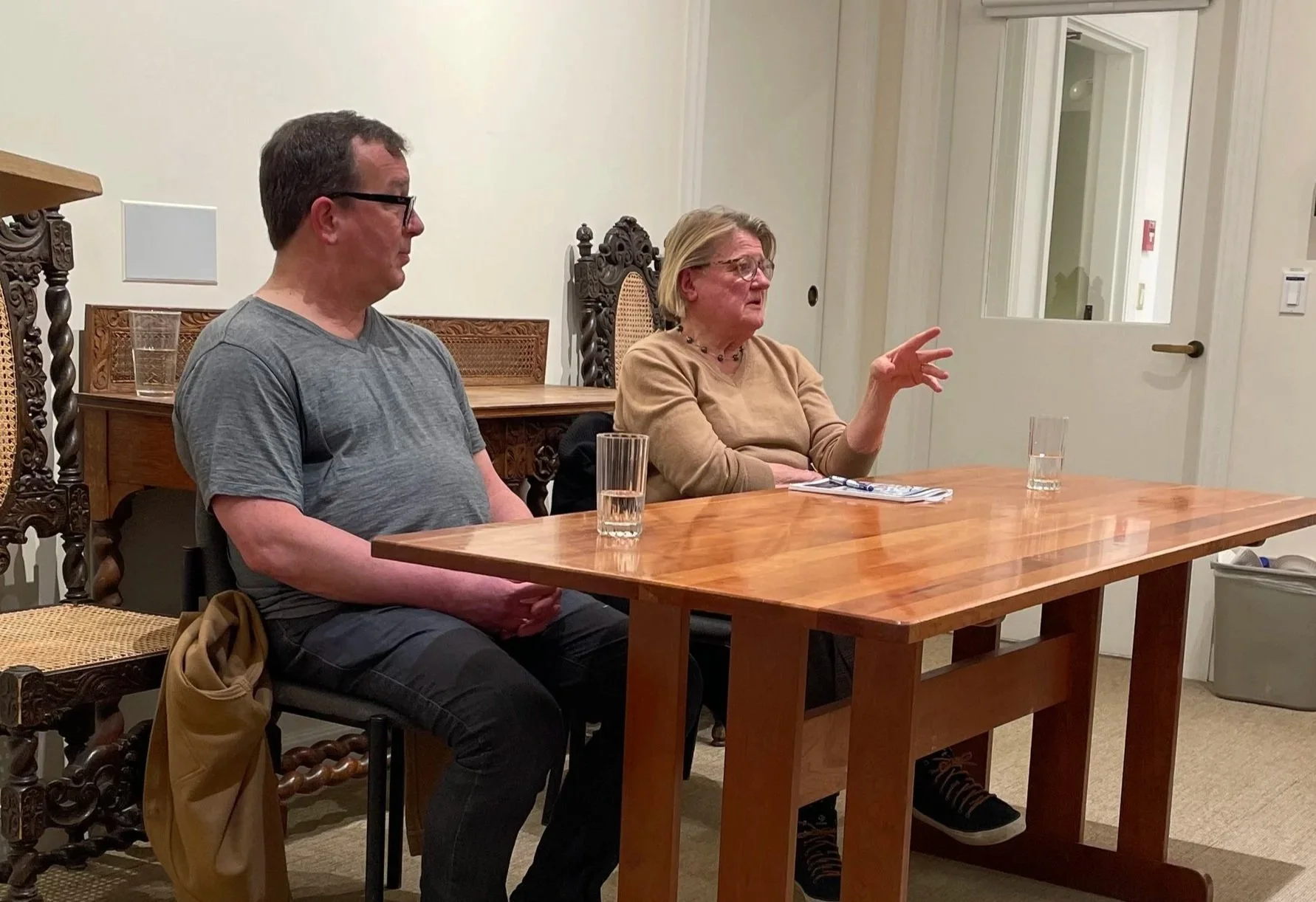
Select board candidates Scott Cromwell and Ellen Best at the March 31 candidates event. Photo by Tricia Thomas.
April 1, 2026
By Tricia Thomas
BLUE HILL—Two candidates running for an open seat on the Blue Hill select board faced the public and each other during a cordial voters’ forum at the Blue Hill Public Library on March 31. The 90-minute event preceded the town’s municipal election on Friday, April 3.
Incumbent Ellen Best, who serves as chair of the five-member select board, is running for a fourth term against newcomer Scott Cromwell. Theirs is the only contested race in Blue Hill this year, as candidates for seats on the town’s planning and school boards are running unopposed.
During the 90-minute event, sponsored by the library and moderated by longtime school administrator and local business owner Mark Hurvitt, Best and Cromwell gave their takes on six pre-selected topics, including parking in the village, trash and the transfer station, town hall hours and staffing, George Stevens Academy, the new public safety building and the existing fire station, and taxes and the town’s mill rate. The candidates also fielded questions from the audience on affordable housing, whether the town will hire another town administrator or manager, climate change threats, how municipal meetings are handled, and recycling and hazardous waste.
Best, an attorney, has lived in Blue Hill for five decades, since graduating from college. “I visited here when I was in college, and it just seemed like home to me,” Best said.
Cromwell, an automotive engineer, moved from Michigan to Blue Hill with his family in 2002. He was attracted to Blue Hill because of its schools, including GSA, he said.
Best and Cromwell both said they supported the construction of a new public safety facility on Tenney Hill, which is in the early planning stages after the town purchased the property from GSA last fall.
“It seems like it’s setting the town up for decades to come,” Best said.
The candidates also both agreed that a mix of recreational space, seating and public restrooms may be a good option for the site of the existing firehouse, which would be raised when the new facility is completed.
“I would like to see the town have a free-standing public bathroom, because we don’t have that in town, and it’s really distressing for people who come to visit,” Best said. “Because we already have the water there…it seems that it would be a pretty good place to put that.”
Best said she did not support selling the waterfront property where the current fire station sits.
“I can’t imagine being a coastal town and giving up the small piece of a coast that we have,” she said.
Both candidates also acknowledged a lack of available parking in the village, especially during the summer. Cromwell said that while working from home limits his need to park in the village on most days, he wants to solicit ideas from residents and business owners on how to solve the problem.
“We should hear what the people have to say,” Cromwell said.
Aside from on-site traffic flow problems and concerns about the safety of exiting onto Ellsworth Road, both candidates praised the operations and staff at the Blue Hill/Surry Transfer Station. Select board member Amanda Woog has secured a federal “Safe Streets for All” grant totaling nearly $300,000 to study Blue Hill’s traffic issues, including issues involving the transfer station, Best said.
Cromwell said he understood the need to reduce public hours at town hall to three days last year due to staffing issues, but stressed that days and times should be clear and well publicized. Best said that a new plan to open town hall for a fourth day would be announced at the town meeting on April 4.
Best called the topic of George Stevens Academy “the thorniest issue we have in front of us right now,” and “quite divisive.”
“I do want to see George Stevens succeed, very much so,” she said.
Best praised the school’s efforts over the past six months to address public calls for better budgeting and transparency.
“A lot of us perceive that George Stevens used to be run much more like it was a public school. Then, sometime in the early 2000s, it started to run much more like a private school, but it’s not a private school” she said. “It’s a community school, and there’s a feeling that it’s going back to that more, which I feel is very positive.”
Cromwell said he was happy with GSA’s recent transparency and fully open board of trustees’ meetings.
“I was really happy to see that the school board was open to the public and that they’re sharing numbers, and I think it’s really important for them to continue,” he said. “In the same way that the select board shares their numbers, I think the school should share theirs as well, so that it’s open and there’s a sense of trust.”
Best also touched on GSA’s recent, controversial idea to ask towns to enter into enrollment contracts with each of its sending towns. GSA has said it has shelved that idea, at least temporarily, as it works on other initiatives to boost flagging enrollment.
“I don’t know, if we voted right now, how people would vote on school contracts, for instance,” she said. “If that’s the only way they can survive, it’s a tough situation for them.”
On the topic of taxes, Cromwell said that it is vital to be prudent with the revenue the town collects from taxpayers.
“The challenge is to use it as effectively as we can,” he said.
Best acknowledged that taxes are high, but said the revenue is necessary to help pay for infrastructure improvements, the rising cost of education, and other costly expenditures that benefit the town.
“Nobody loves to spend money on infrastructure. It’s not that much fun, but it sure is good for everybody in the long run,” she said.
The open select board seat is the only municipal position that is contested in this year’s election. Incumbents Marcia McKeague and Gavin Riggal are running unopposed for two open seats on the town’s planning board. Incumbents Elaine Lawrence and Ben Wootten, along with newcomer Hannah Bates, are running unopposed for three open seats on the school board.
Also on the April 3 ballot is a request from George Stevens Academy for a total of $116,280—or $1,530 per student—in supplemental tuition for each Blue Hill student who attends the historic school. This is the seventh consecutive year that GSA has asked sending towns to approve supplemental tuition to help shore up budget shortfalls from declining enrollments. Until this year, the controversial request has been approved in each of the towns that send students to GSA.
This year, however, Penobscot voters denied the request, and the school board in Surry is recommending a “no” vote ahead of municipal elections there on April 10.
Polls will be open at town hall on April 3 from 10 a.m. to 8 p.m. A town hall meeting will be held the next day, on Saturday, April 4, at the Blue Hill Consolidated School. There, more than 60 additional warrant articles will be up for consideration, including those that would authorize spending for primary and secondary education, reconstruction and repaving of Turkey Farm Road, repair of a broken sewage outfall pipe in Blue Hill harbor, and construction of a new public safety facility on Tenney Hill.
If all of the funding requests are approved, Blue Hill’s 2026 budget, which includes municipal, school and county expenditures, would total more than $23 million, with about $11.5 million raised through property taxes. As a result, Blue Hill residents could see a 9.7-percent increase in their taxes in the coming year, select board member D. Scott Miller said at the recent pre-town meeting on March 26.
Additional information on the April 3 election is available on the town’s website. Information on the issues up for a vote at the April 4 town meeting is available in slide format, and the town has also posted its warrant article online.
