

Election security experts say system is ‘solid and secure’
Secretary of State Shenna Bellows says Mainers can ‘be proud’ of record voter turnout over the years
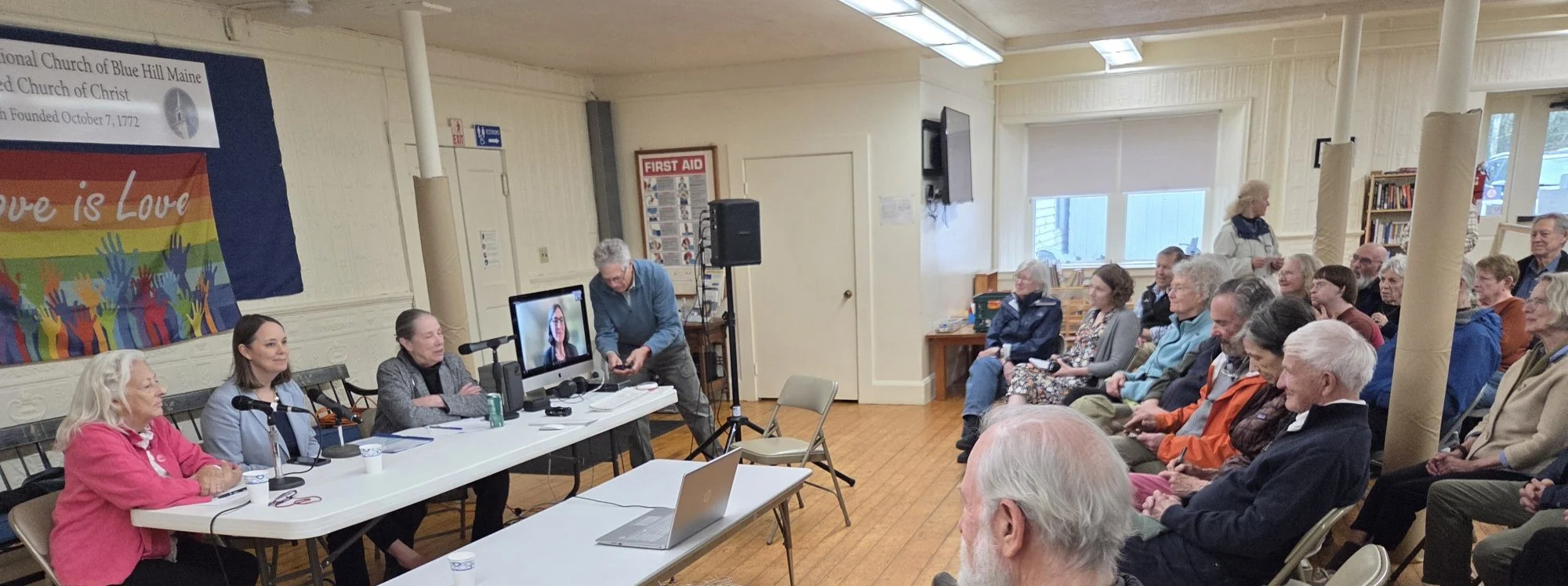
Voters joined panelists to discuss election security. Holly Idelson, director of the advocacy group Protect Democracy, said the biggest threat is the public “getting dispirited.” Photo by John Epstein.
May 18, 2026
By John Epstein
BLUE HILL—More than 50 people filled the seats in the Fisher Hall meeting room at First Congregational Church in Blue Hill on May 15 to hear a panel discussion about election security. The event was co-sponsored by WERU and the Blue Hill Constitution Committee, a local bi-partisan group that seeks to protect the electoral process.
“I’m a concerned voter,” said Karen Foster, of Brooklin. “Based on our current national government, this fall’s election could potentially be different. I know our state officials have things well in hand, but I want to hear what they have to say.”
The event was moderated by Ann Luther, current treasurer and former president of the Maine chapter of the League of Women Voters, and included three panelists who discussed voting at the local, statewide and national levels. The panelists included Cindy Reilly Coughlin, former Sedgwick Town Clerk, recently retired after 34 years of service; Shenna Bellows, Maine’s Secretary of State and candidate for the Democratic gubernatorial nomination; and Holly Idelson, director of the advocacy group Protect Democracy and previously chief counsel to U.S. Congressman Jaime Raskin.
Idelson, who participated virtually from Washington, DC, admitted that the electoral system has been subjected to intense scrutiny in recent years. She said that there is “a growing amount of ignorance and disinformation” and that those conditions have created a climate of fear. Still, she thinks “the United States has a very solid and secure election system with a lot of protections.”
Bellows echoed Idelson’s confidence in the overall election system. “But we are seeing a deeply alarming attack on elections by the federal government --make no mistake about it,” she said, mentioning efforts by the Trump administration to seize ballots and relitigate the 2020 election. Bellows' office continues to resist federal attempts to obtain Maine’s voting records, calling the federal action “unlawful and unconstitutional.”
Reilly-Coughlin said that she hadn’t seen “anything go wrong ever with the ballot” while managing elections in Sedgwick for more than three decades. She did say there was some concern about safety in 2020 and that, in a proactive effort to protect the process, the town’s volunteer firemen were asked to stand near the voting area, “but everything was calm,” she said.
“Election officials are the world’s best contingency planners,” Bellows said, noting that her office prepares for weather disasters, power outages, and bomb threats.
In response to a written question from the audience, Idelson said her national organization, Democracy Protection, isn’t worried about mail-in ballots. “It’s a legitimate way to vote,” she said.
Bellows stressed that mail-in voters need to have their ballots sent soon enough for them to get to their polling place before 8 p.m. on Election Day. She suggested using drop boxes for absentee ballots, if possible, because local mail is being sent to regional processing centers in Hampden and Scarborough and is subject to delays.
All three panelists made it very clear that the electronic voting systems used in Maine are not internet-accessible and, as a result, not hackable. Bellows calls the machines “modern day abacuses,” whose function is to quickly tally paper ballots—not store them.
“Our voting machines make voting safe and honest, and they work,” said Reilly-Coughlin. The veteran town clerk said the machines are tested by both parties at the end of Election Day to make sure the count is accurate.
While the Trump administration has been pushing for a centralized voting system, Idelson said that there is a real benefit to not having one: Having many independent state systems is an impediment to hackers.
Both Idelson and Bellows noted the “irony” of a federal government that criticizes state voting practices, yet fails to provide funds to protect election integrity even though federal candidates are on the ballot. Bellows said that a number of states now are sharing responsibilities “to fill the gap.”
Bellows, who focuses on cyber-security as an officer in the nation-wide Association of Secretaries of States, emphasized that “paper ballots are still the gold standard” and the “ultimate safeguard” for elections.
“Over 95% of the jurisdictions in this country use the paper ballot,” she said.
Reilly-Coughlin described the process that Sedgwick engages in to secure ballots after the election. They are placed in special blue boxes that are locked, sealed and stored in a vault. When a recount is required, the boxes are taken to Augusta by the state police and opened in front of multiple witnesses.
Another audience member asked if there was concern about Trump’s calls to have “election protection teams” organized to monitor polling sites. Idelson didn’t know if that would happen. “We don’t want intimidation, and hope that won’t be a problem,” she said.
Bellow said that Maine state law prohibits interference with elections, including electioneering within 250 feet of the polling place. There should be no presence of ICE officers at election sites in Maine, she added, since law enforcement is not permitted in the voting area under state law.
Idelson reiterated that the biggest threat to election integrity is the public “getting dispirited.”
Bellows urged towns to recruit an equal number of Republicans and Democrats to serve as volunteer ballot clerks. “It’s a powerful way for people to see how secure the process is,” she said, adding that voter engagement and participation is the best push back to election interference.
“The People, writ large, are incorruptible,” said Bellows, who noted that Mainers can be proud that they have historically had the best record for voter turnout in the country.
The forum discussion was taped by WERU and will be rebroadcast by the radio station. Please visit the WERU website for more information.