

BHHS effort to catalog archives nears completion
The volunteer-led project has been six years in the making and includes thousands of documents
May 18, 2026
By Steele Hays
BLUE HILL—After six years of work by two volunteers, and a professional archivist who assisted just a few days a year, the Blue Hill Historical Society has nearly completed a project to catalog and preserve the thousands of documents that make up the society’s archives. The archives date to 1762 and serve as a veritable “time machine,” providing fascinating glimpses into life in the past on the Blue Hill Peninsula—and to other places around the world where local residents traveled by ship.
“I remember thinking that if I work just two afternoons a week, I can be done in two years,” said Ann Durgin, the volunteer archivist who’s led the work. Durgin has worked alongside fellow volunteer Leslie Litwiller to complete the work. “It’s taken six years, but it has been so interesting. The project has given me more than I’ve given it.”
When Durgin began the project in 2020, the archives were in dozens of cardboard boxes, stacked randomly in the society’s storage building behind its headquarters in the 1815 Holt House at 3 Water Street. They had never been systematically cataloged or organized.
Today, the archives have been organized chronologically into 108 “large collections” and 565 “small collections,” and stored in special archival boxes designed to safely preserve paper. For each large collection, a detailed description has been written, summarizing key information about the contents, its origins, its size, its connections to other collections and notes on its significance and more.
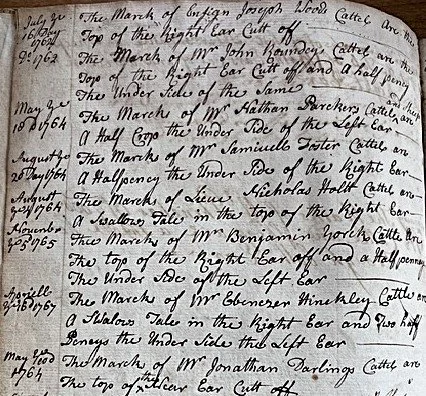
Among the fascinating items in the archives are a leather-bound book dating to 1767 titled “Records of the Marks of Cattle and Sheep,” which lists the differentiating marks used by the inhabitants of Blue Hill to define ownership of their cows and sheep, something that was essential at a time when residents used an unfenced common to graze their animals.
“The mark of Ensign Joseph Wood’s cattle are the top of the right ear cutt [sic] off,” says one of the early entries. In those days, the town was called Newport rather than Blue Hill.
The archives also include a half dozen ship’s logs written by local ship captains during the 1800s, documenting their voyages around the world.
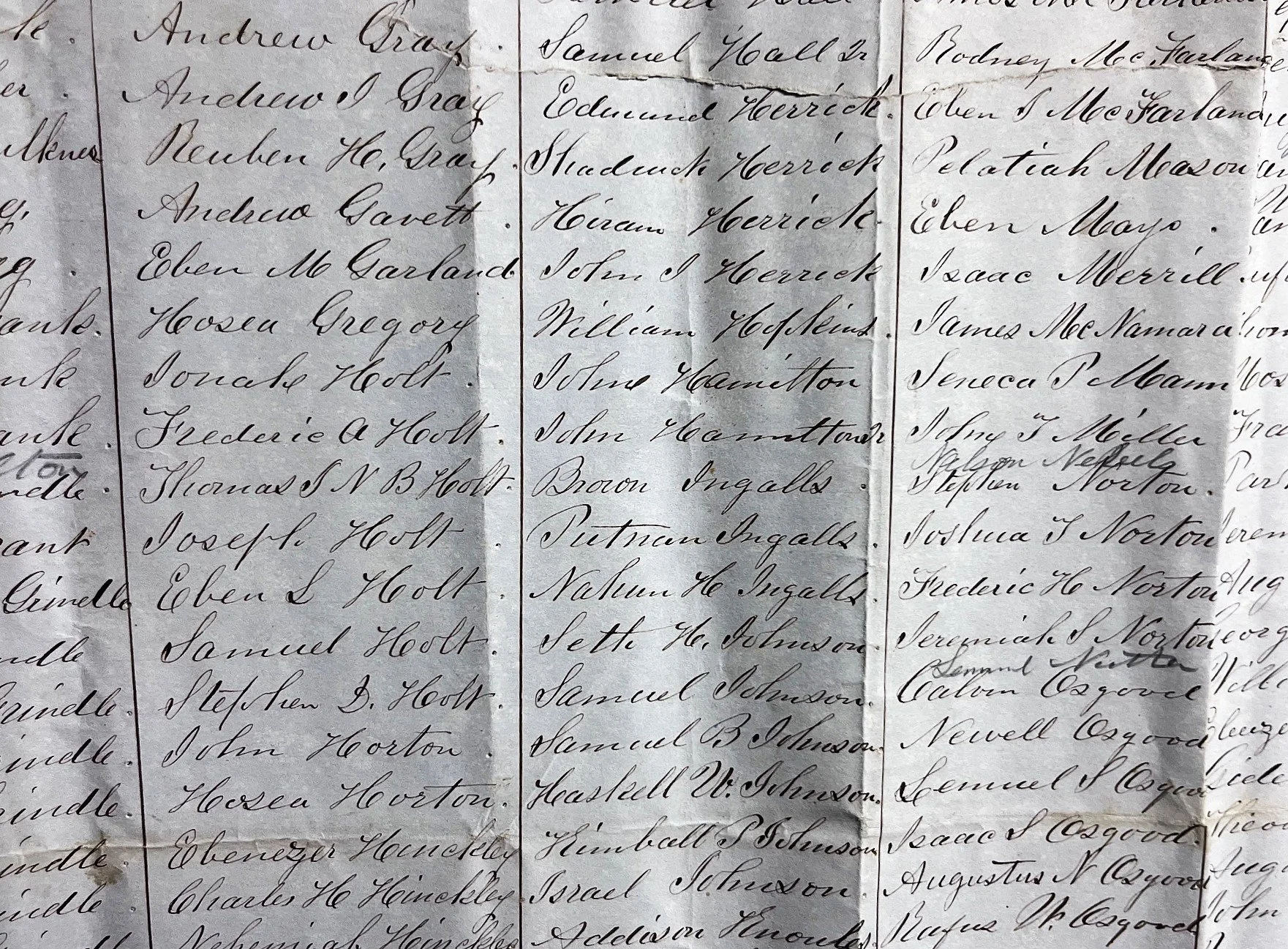
There are dozens of handwritten voter rolls from the 1800s, listing every person who was registered to vote in elections, with pin holes punched into the paper to mark those who came to the polling place to cast their votes. The rolls are literally rolls, stored in protective tubes.
All the archive materials are stored in a large fireproof, climate-controlled vault, which the Society purchased and installed in 2008. Since the town of Blue Hill has no fireproof vault of its own, it has entrusted its oldest historical records to the Society for safekeeping. The town’s earliest town records date to 1789 and the most recent date to 1926.
The archives contain hundreds of fascinating stories—not only about the history of this area, but about the ways in which that history was collected and preserved. One such story involves the collection of Roland Howard, a local antique dealer and amateur historian. One day in 1940, he was at the town dump when he noticed a large wooden trunk tossed into the pile. Curious, he investigated. He soon discovered that it was filled with town records from the 1700s and 1800s, which had been discarded. Many of the records were bills, receipts and expense claims from town residents along with notes from select board members, which provide rich details about the area’s economic, social and political life, according to Durgin, the lead on today’s effort to catalog the society’s archives. Durgin said Howard saved the trunk and its contents and later donated the materials to the Society.
The archives also include:
The account books of Wescott & Hinckley store from the 1800s
Guest registers of the Blue Hill Inn from 1922 to 1935
Store records of Merrill & Hinckley store from 1890 to 1921
Extensive research notes by Rebecca Herrick on the history of shipbuilding in Blue Hill in the 1800s
The collected papers of lawyer Harrison Tripp, a Civil War veteran who later served as leader of the local Grand Army of the Republic (Civil War veterans) and who persuaded many local men who fought in the war to write personal accounts of their experiences
The collected papers of Dr. Otis Littlefield (1861-1942), who was Blue Hill’s only doctor for many years and who wrote an unpublished autobiography
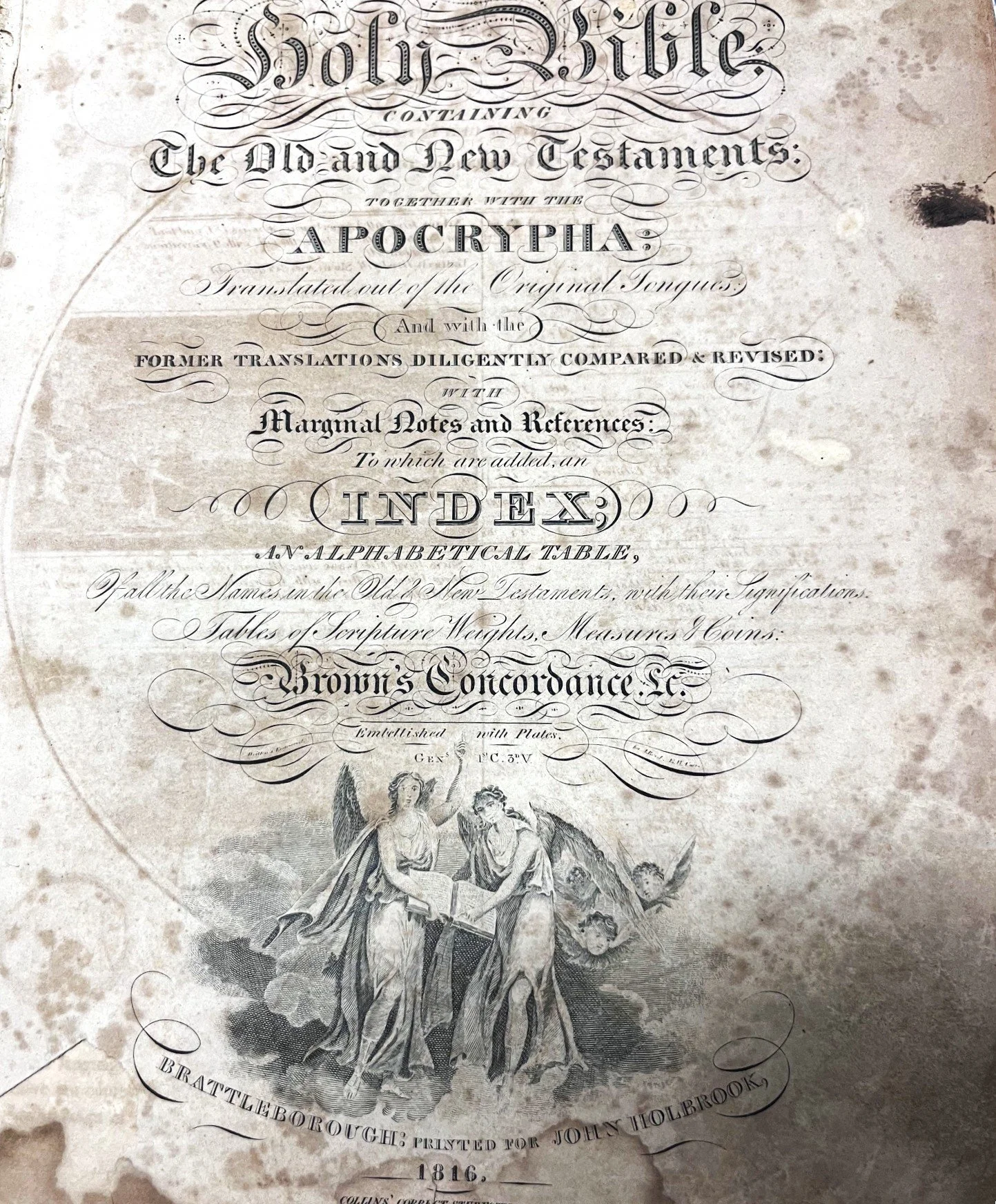
An elaborately illustrated 1816 Bible that belonged to the Friend family, who gave their name to Friend’s Corner, an area midway between Blue Hill and East Blue Hill. The late writer and teacher Ester Wood, who lived for many decades at Friend’s Corner, belonged to the Friend family. Dozens of family members’ births, deaths, marriages, baptisms and other life events are recorded in the Bible
Several issues of the area’s first local newspaper, The Blue Hill Times, which was published for less than a year in 1889
Elizabeth Wescott’s genealogical research on more than 600 local families
Early maps of Blue Hill
The archives are available to view by anyone who wants to see them and use them for research, according to Durgin. In recent years, the most common requests are from visitors interested in exploring their genealogical history or inquiries from people wanting to learn more about the history of their houses and previous owners. Still, she thinks the resource is underutilized.
“We’ve had very few people come to do research because nobody knows what we have,” Durgin said. “Now perhaps we will have more to come after there is more awareness of what we have.”
The archives are not available online, Durgin said, but descriptions of the collection will be available on the society’s website. The society is not equipped to display selected contents from the archives, Durgin said, but does plan to offer small group meetings this summer for groups interested in seeing and learning more about the archives.
To learn more, visit the Society’s website at www.bluehillhistory.org.