

Local sea captain guides tanker to safety through Strait of Hormuz
Brooksville captain recounts what it took to navigate the world’s most dangerous passage
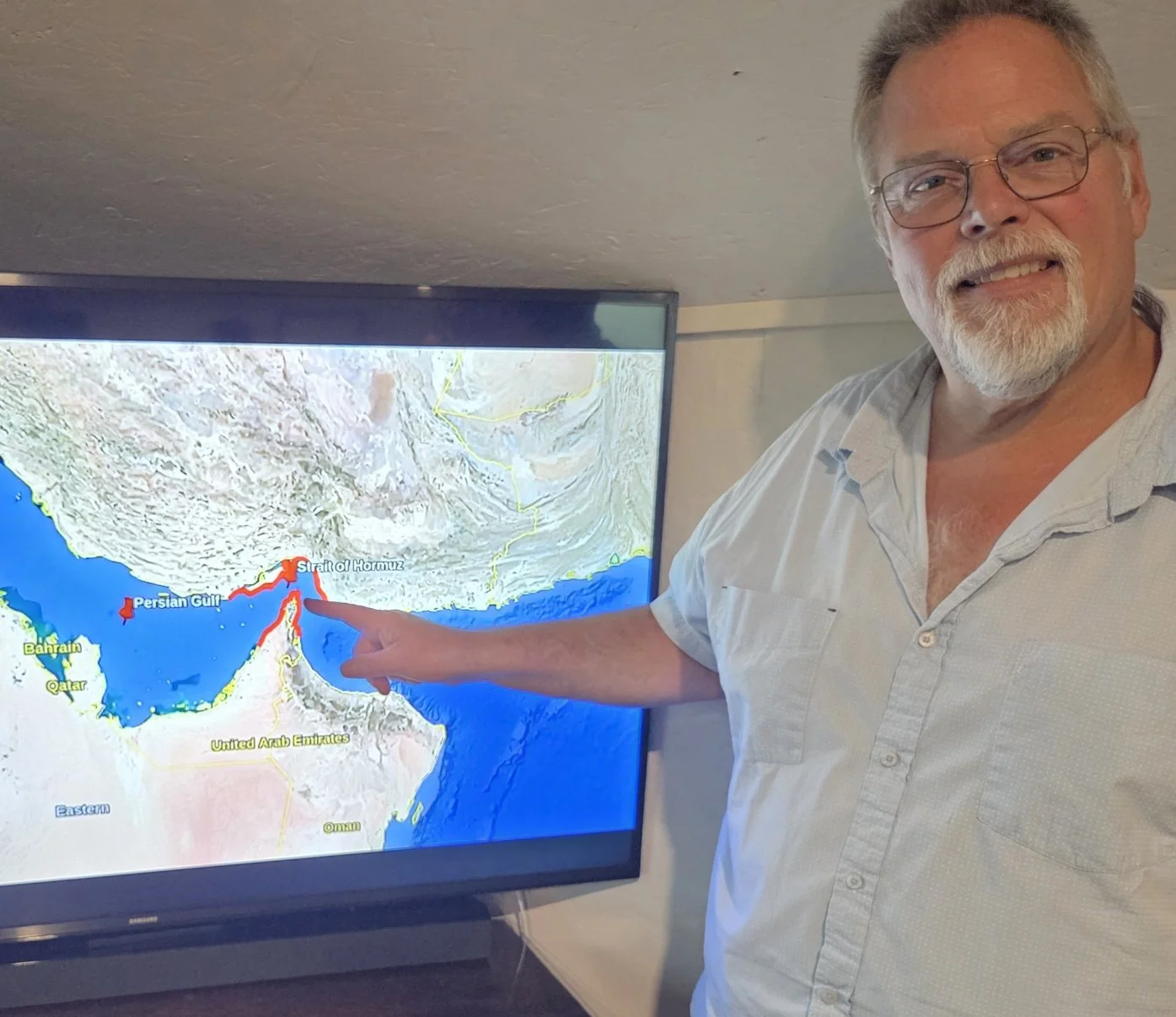
Tom Leaf points to the route his ship, C/S Anthem, took to pass through the Strait of Hormuz. Photo by John Epstein.
Aug. 12, 2026
John Epstein
BROOKSVILLE—Traveling from his Brooksville home, Tom Leaf has seen a fair amount of the world, much of it from the bridge of tanker ships.
While he has evaded pirates in the Pacific and been rammed by another vessel in the Atlantic, his latest command threading the Strait of Hormuz involved a carefully orchestrated plan of secret charts, armed personnel and air support.
Leaf sat down with The Rising Tide to discuss the operation to bring a 600-foot tanker loaded with explosive fuel through the most dangerous waterway in the world today.
Dangerous situations
Leaf, a Maine Maritime Academy graduate, has served in the Merchant Marine for 38 years. He has sailed the globe as an oil tanker captain with several dangerous encounters on the high seas.
Leaf guided ships away from attacks by pirates several times between 2000 and 2005, once in the in the Gulf of Aden, and twice in the South China sea, east of Singapore.
Sixteen months ago in the North Sea, he was commanding a tanker, the Stena Immaculate, which was loaded with jet fuel. The 600-foot ship, at anchor near Yorkshire, England, was broadsided by a poorly navigated Portuguese freighter and exploded into flames. Leaf directed his crew to get the fire under control and activate deterrent equipment. He then remained with the ship until all his seamen were safely aboard life boats. For those efforts, Leaf was awarded the Merchant Marine’s highest honor, the Gallant Ship Unit Citation Bar.
War-time command
Then came the war with Iran on February 28 of this year.
“I was going towards the end of my vacation time, and then I got the call around the middle of March,” Leaf said in an interview with The Rising Tide. The directors of Crowley, the shipping company that employs him, wanted Leaf to take command of the 600-foot tanker, C/S Anthem, which was trapped in the Persian Gulf along with approximately 3,500 other commercial ships due to Iran’s war-time closure of the Strait of Hormuz.
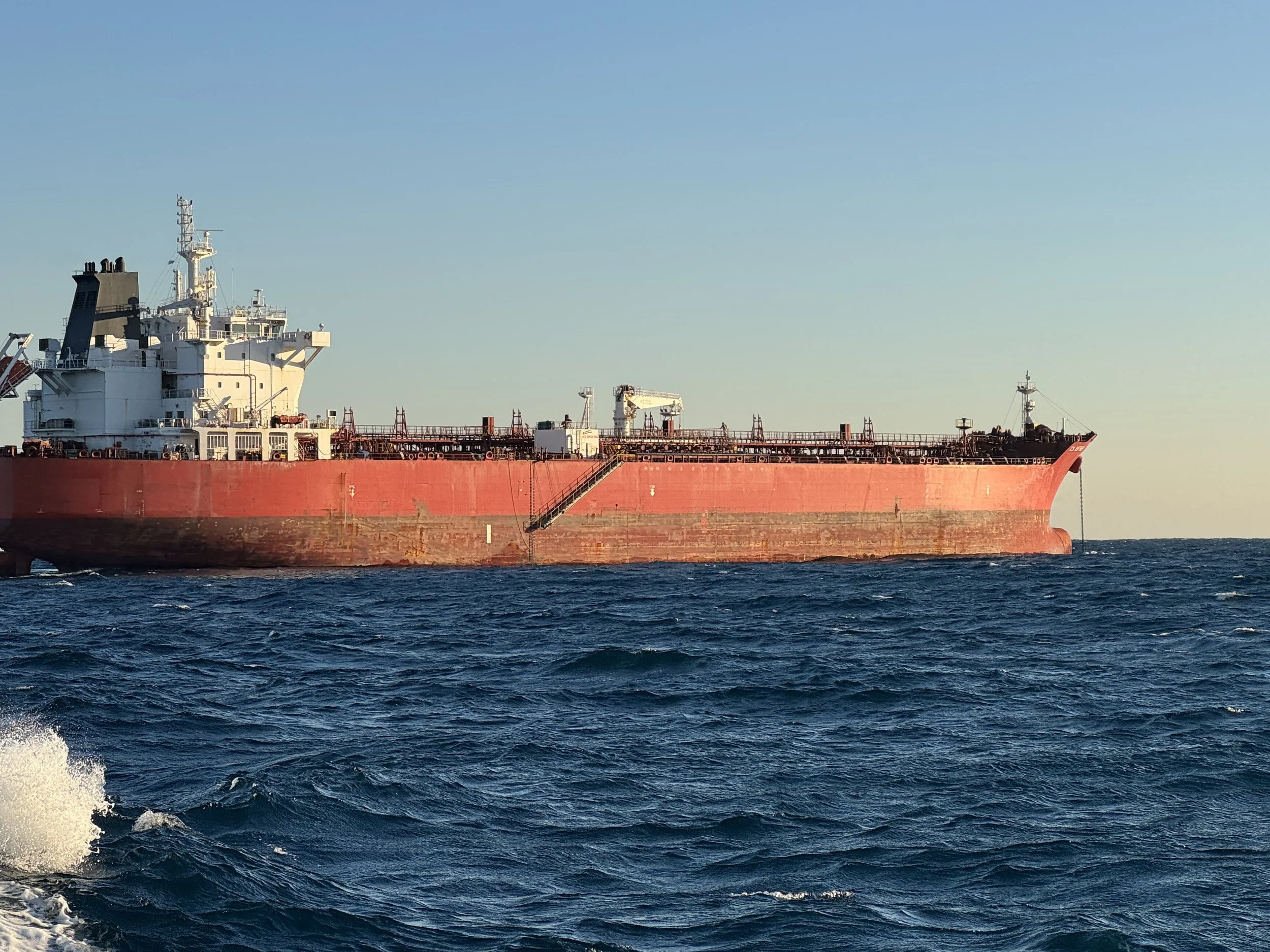
C/S Anthem anchored off the coast of Dubai just before it was boarded by Tom Leaf and his 10-person relief crew. Photo courtesy of Tom Leaf.
The ship, which Leaf had previously commanded, had taken on a load of naphtha the day before the war started.
“Naphtha is used to create gasoline, but it’s also used as lighter fluid. “It’s extremely flammable,” Leaf said. He said that of the five U.S. flagged ships in the Gulf at the beginning of the war, the C/S Anthem was the only one loaded with the volatile product.
In conjunction with company logistical meetings in Florida and New York over a two-week period, Leaf assembled a 10-person crew–many of whom had worked under his command for years–to relieve half the seaman who had been sailing the C/S Anthem around the Persian Gulf in zigzag fashion to avoid attack.
“We had been on the C/S Anthem before, and we had a sense of duty to go back to her no matter where she is,” Leaf said. “But a lot of us had to look pretty deep into ourselves and ask why we should go back there to active wars,” he added. “But these guys would literally follow me to the ends of the Earth.”
Leaf and his relief crew flew from New York into Dubai on April 3 and traveled to the port of Ras-Al-Khaimah in Dubai on the eastern side of the peninsula that juts into the Strait of Hormuz. There they took a launch out to the C/S Anthem anchored off the coast, a trip that took three hours because of rough water.
When the launch reached the tanker, the seamen that were being relieved came running desperately down the ship’s gangway to get on the shore bound boat.
“I got knocked down by the first assistant engineer coming off the ship because he was so agitated,” Leaf said. “They were all convinced they were going to die at any minute because of their cell phones,” he added. Leaf said that many of the sailors – a polyglot of nationalities – were convinced that drones could home in on their phones.
Zig-zag course
When Leaf took command, he continued sailing the C/S Anthem on a zig zag course throughout the Persian Gulf to avoid becoming a target.
“We were hiding, going around islands,” he said.
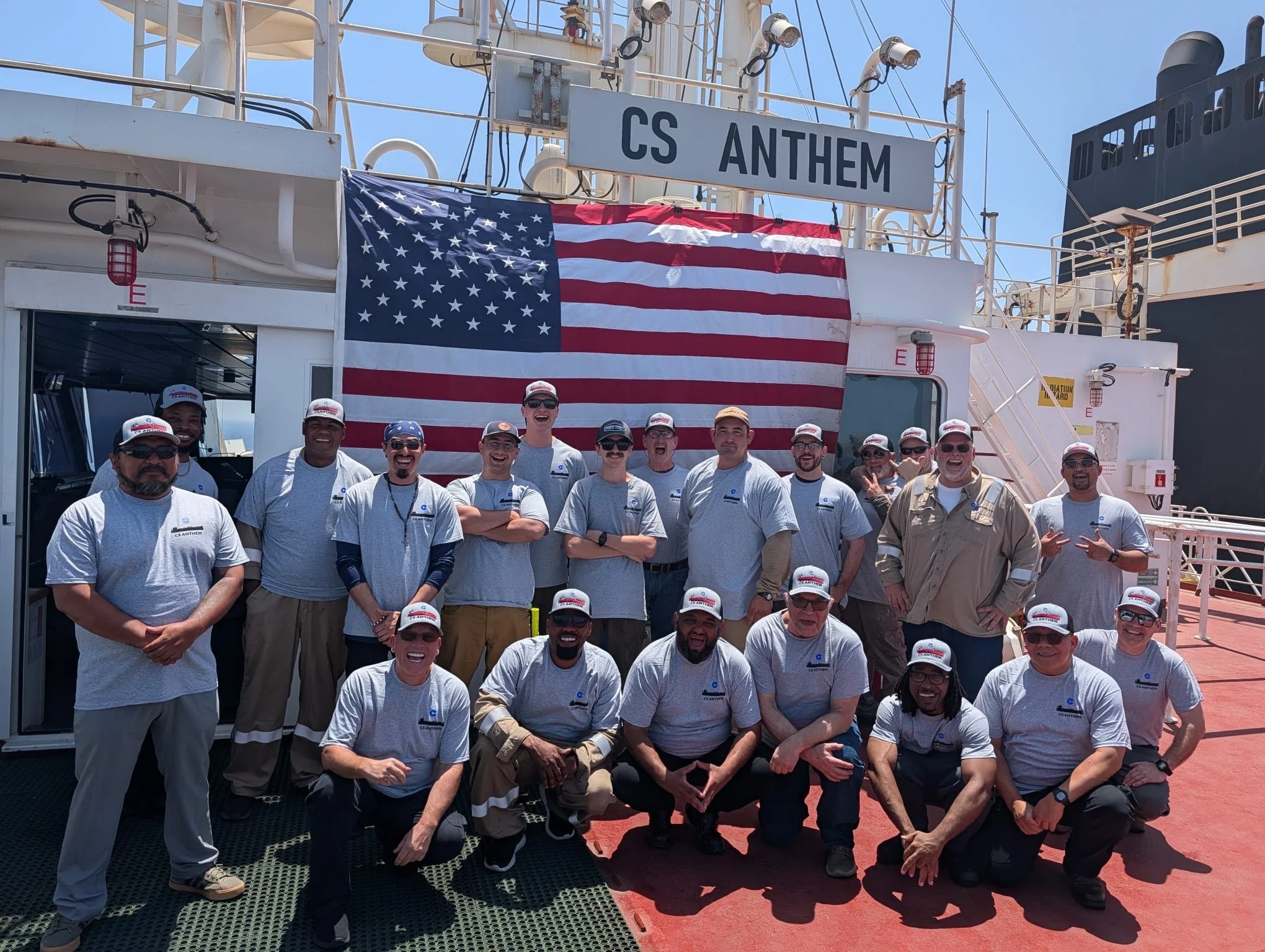
Tom Leaf (in brown shirt at right) with his crew aboard the C/S Anthem after passing through the Strait of Hormuz. Photo courtesy of Tom Leaf.
The Brooksville sea captain took steps to foster morale. He reminded his crew that, under the terms of their contracts, they were only going to be on board the ship for 90 days. He instituted daily reviews of ship readiness and his staff fixed the water-making equipment. He sailed the ship to Dubai to get more food. Crew members were reassured they could use their cell phones or satellite cell phones, which were untraceable.
“There was a mushroom cloud fireball that came up and it was so bright you could read your newspaper on the bridgeway.”
“We brought out videos, we had card games, played darts, and just stayed positive,” Leaf said, while noting that it also helped that the sailors’ salaries were doubled during combat duty.
But the crew still witnessed the terror of war. Pointing to a video screen map of the Persian Gulf, Leaf pointed to an island.
“It’s part of Iran and it has crude oil tanks on it and we were within 17 miles of it one night when I was called up to the [ship’s] bridge and saw [the island] get hit and blown up by American or Israeli forces,” he said. “There was a mushroom cloud fireball that came up and it was so bright you could read your newspaper on the bridgeway,” he said.
Sailing through the Strait of Hormuz
Before the end of April, Crowley informed Leaf that they wanted him to sail through the Strait of Hormuz and take the ship to Seattle after unloading its cargo of naphtha in Singapore.
“Two days later I get a super-secret call from the company and they tell me, ‘You’re leaving on the 3rd of May,’ Leaf said, noting that the date happened to be his birthday. He was allowed to tell his chief engineer, who did fuel calculations; his chief mate, who handled cargo logistics; and his third mate, who did voyage planning.
The standard route through the Strait of Hormuz was off limits because of concerns that the Iranians had mined that area.
According to Leaf, the plan was to take the tanker up through the strait by hugging the coast of the Dubai/Oman peninsula. For added protection, the C/S Anthem would carry an armed contingent of U.S. Marines. The ship’s crew would also navigate using secret electronic navigation charts provided by the Marines. Leaf synchronized the charts with the ship’s radar to determine if the water close to shore–sometimes within a quarter of a mile–was deep enough for the ship to clear the bottom.
“We had to calculate everything in advance, and we really, really, really had to be accurate,” Leaf said. But he pointed out that there were instances where the secret charts proposed guiding the ship toward an oil rig or an island. Leaf and his crew would then have to rely on radar, which could be iffy since the radar sounder was situated at the rear of the tanker and data readings weren’t available until the ship had traveled 470 feet beyond the sounding point.
Leaf noted that the C/S Anthem derived mixed benefits from following behind another U.S. flagged ship, the Fairfax Alliance, a car-carrier freighter that traveled about a mile ahead of the tanker. While the freighter might, to some extent, have run interference for the tanker by potentially drawing enemy fire, it displaced less water, and made erratic course changes that endangered the C/S Anthem.
In addition to the Marines, Leaf’s tanker was protected by several airborne military assets including Apache helicopter gunships; F-16, F-18, and F-30 fighter jets; and a U-2 spy plane. Leaf said that a Marine sergeant on deck, called in air support to the U.S. military that shot down multiple drones and missiles during the C/S Anthem’s voyage through the Strait
“He didn’t have to ask anybody’s permission: he just said ‘nuke it, blow it up’ which is a great thing because it was an instant response to anything that was going on,” Leaf said.
But Leaf pointed out that his ship almost became involved in an international incident when the lieutenant in charge of the Marine contingent came within a whisker of ordering his troops to fire on an Omani coast guard boat. The lieutenant told his men to lower their weapons only after Leaf, in salty language, told him that the boat’s flashing blue light meant it was “f***ing law enforcement.”
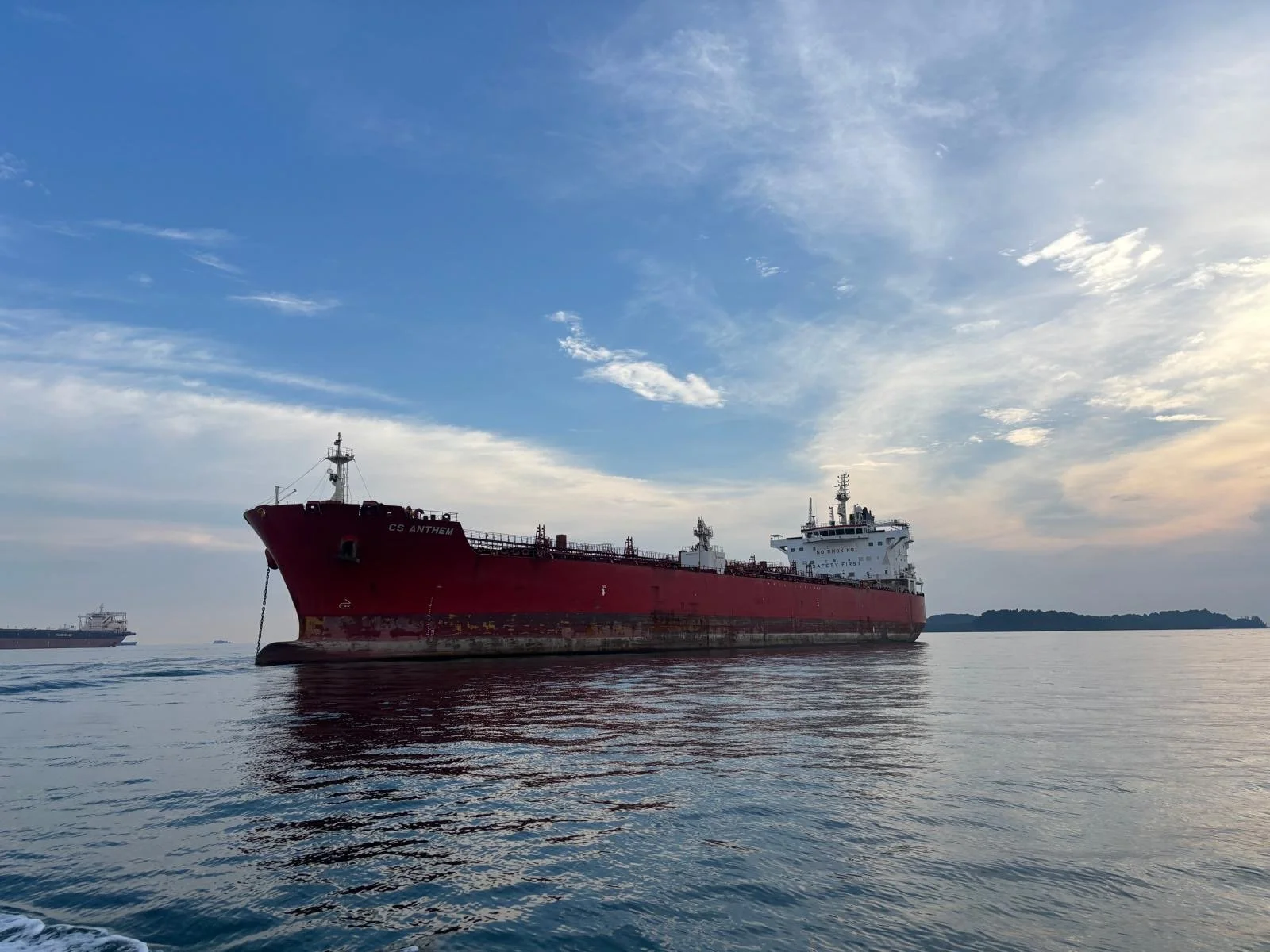
C/S Anthem docked at Singapore after unloading its cargo of highly flammable naphtha fuel. Photo courtesy of Tom Leaf.
Leaf captained C/S Anthem through the Strait of Hormuz safely with his entire crew staying awake for 18 straight hours. “We were all just wired and we were still within the range of Iranian ballistic missiles,” he said, adding that the threat didn’t end until the ship had sailed south through the Arabian Sea to the tip of India.
After unloading naphtha in Singapore, Leaf guided the C/S Anthem across the Pacific to Seattle.
Later, when he returned home to Brooksville, his relieved wife Christina organized a large welcome-home party and pot-luck for him in late spring attended by their daughter, Savannah, and dozens of friends and family.
Leaf is enjoying vacation time now until he ships out again in September.
