

Graham Platner makes campaign stop in Castine
Event marks candidate’s 66th town hall, second visit to Castine
April 22, 2026
By John Epstein
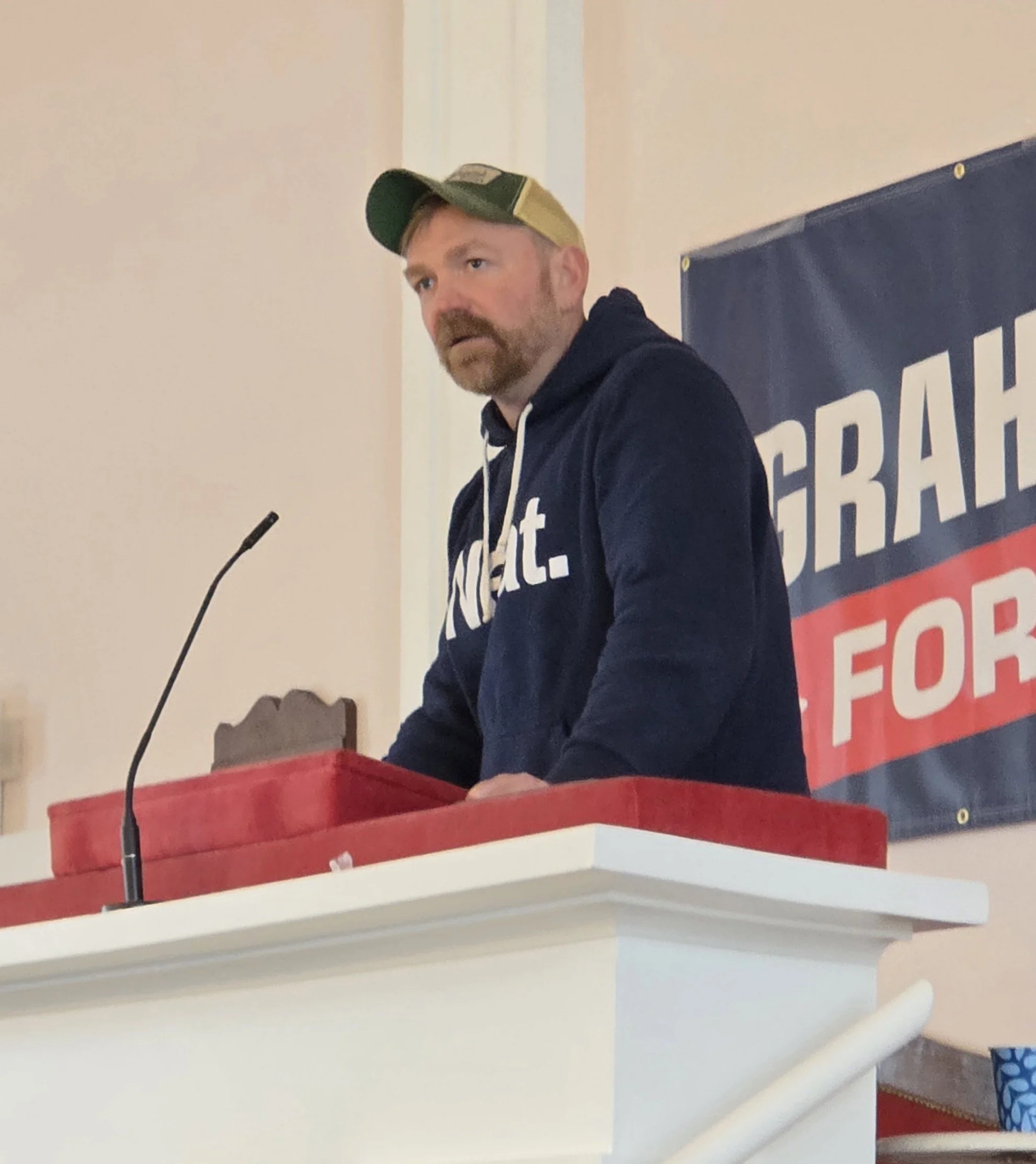
U.S. Senate candidate Graham Platner addressed the crowd in Castine. Photo by John Epstein.
CASTINE–Undeterred by cold and heavy rain, nearly 250 people crowded into Castine’s Unitarian Universalist Church for a Graham Platner Town Hall on April 14. They came to hear the military veteran, oyster farmer and Town of Sullivan harbor master explain why he’s running to try to unseat Susan Collins for the U.S. Senate.
“The only time it gets this crowded is during the Christmas concert,” said Kevin DeBeck, whose wife, Amy DeBeck, is the church’s pastor.
John Faulkner, a retired pharmacy technician from Bucksport, said the Castine event was his third time seeing Platner speak. “I like what he has to say,” Faulkner said. “He’s spot on about where the problems lie–corporate greed.”
“I’m sick and tired of that mealy-mouthed Susan Collins,” said Castine resident Meriby Sweet, who said she used to be a Republican.
Before he spoke, Platner visited with attendees, including Fox Fernald, a Maine Maritime Academy student, who described the candidate “as very approachable, someone you can talk to, not like a lot of politicians today.”
Platner told The Rising Tide that this town hall was his 66th. The day before, he had events in Freeport and Gorham, and a rally in Portland with Elizabeth Warren, U.S. Senator from Massachusetts. Warren endorsed Platner’s bid to be the Democratic Party’s nominee for the Maine Senate–a seat now occupied by Collins–in March.
In a hotly contested race that is drawing national attention, the campaign trail can be grueling, Platner said.
“Well, the food is terrible, and I can’t do my usual workout routine,” said 41-year-old Platner. “But I make sure I get eight hours of sleep each night, and as long as I get that, I’m ok.”
The town hall was his second campaign visit to Castine. The first, a meet and greet at the Pentagoet Inn in October 2025, came amid the uproar over his past social media remarks, which have been described by many as demeaning to women, African Americans and rural Mainers, as well as a skull and crossbones tattoo that resembles a symbol used by the Nazis. Platner acknowledged his past remarks, attributed them to the distress and depression of his tours of duty in Iraq, and apologized. He called the tattoo–which has since been covered up–the “product of a 23-year-old marine’s drunken night out with friends”.
“I just don’t believe all the apologies,” said Leigh Kearney, of Castine. She said she took a front seat at this week’s town hall event to “pick up [Platner’s] vibe”
Nancy Beach, also of Castine, volunteers for Platner’s campaign and thinks people should stop subjecting Platner to litmus tests. “I get together with women and I say ‘will you stop focusing on the past?” she said. “My husband was a Vietnam vet and they all had trauma. Let’s talk about what’s important now.”
The “now” is what Platner spoke to. By the time he took the dais in the church’s nave, the pews were filled. People stood in the back of the church near the organ pipes while others gathered in the reception room to watch on a video screen.
“My name is Graham Platner and I’m running for U.S. Senator in Maine,” he said to cheers and applause. Then he discussed what he believes is plaguing the electorate in Maine and across the country.
“We have a political system that is not accountable to the average American,” he said. “It’s become a theater, a performance for the elites, that results in us having a war that nobody wants because Trump’s name is in the Epstein files,” he added. He said the war with Iran is a “monumentally stupid war that our political system can’t stop.”
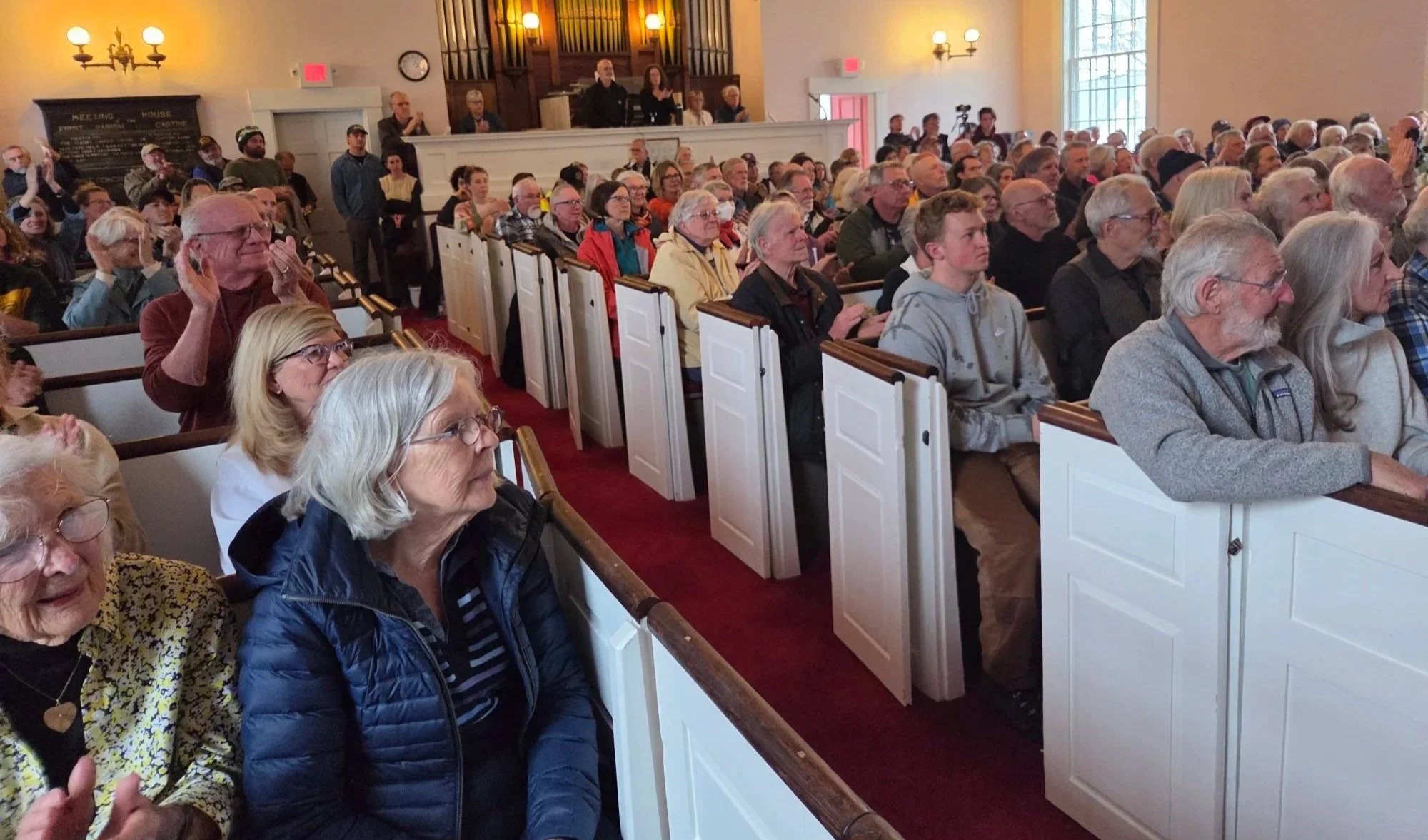
The pews were full during the April 14 event. A live video feed in the reception room was available to overflow crowds. Photo by John Epstein.
Platner, who studied history and politics at George Washington University, likens the current economic climate to the Gilded Age of the 1890’s, but “much worse”. “The Supreme Court has crafted policies to benefit corporate power,” he said, alluding to the Citizens United decision in 2010, which determined that limiting corporate spending on a political candidate violated the First Amendment.
“This has led to the largest transfer of wealth in the history of our country,” Platner added. He said there was a time in Maine when he said working people could own a home and send children to college. He said labor is being devalued because of the decline of union power and blames rising home prices, in part, on private equity firms who buy up real estate.
Platner also said health care is out of reach for many in rural Maine.
“I was born in Blue Hill in 1984, when that could happen; there used to be six birthing centers in Maine, but now there are two,” he said. “This country spends three times more on health care per capita than the next country down on the list,” he added.
Platner said now is the time for a change in politics that goes beyond making minor adjustments in the system. He said he sees American politics as influenced by two types of power: “organized money and organized people.” Platner said he favors the latter, pointing to past movements in American history–women’s rights, civil rights, gay rights–which he said were brought about by people organizing change.
Platner said the current crisis in American life is due to a decline in living standards and that large swathes of the population are trying to have families, but work so much that “they don’t have time for each other.”
“Right now, the system is built to extract energy and labor from people,” he added.
Platner called for a federal government that funds affordable housing, enforces labor rights, develops renewable energy to fight climate change, and makes health care universal.
“Every policy study shows that it would be cheaper to have universal health care than the current system we have,” he said. Platner said that free health care would allow people to become more creative, innovative and enterprising. He talked about how the free health care he receives through the Veterans Health Administration reduced financial pressures in his life and gave him the freedom to start his oyster farm.
Platner said “the richest country in the world” can make laws that help working people. But he said that the federal tax structure would have to be changed to a much higher tax rate for the rich. Platner said he intends to work with a cadre of progressive Senators, including Bernie Sanders, Chris Van Hollen, Elizabeth Warren, and Chris Murphy to push for change.
Platner has so far outraised Janet Mills, his principal opponent for the Democratic Party Senate nomination, in campaign funds and maintains a wide lead ahead of her in most public polls. But, he said that he will not be able to match what the Republican Party will spend on Susan Collins TV ads before the November election.
“Niney-eight percent of our donations are less than $100,” Platner said.
“We need to build power the old-fashioned way, in our community, by building relationships,” he said. He said his campaign is focusing on organizing people, encouraging them to show up for meetings, knock on doors, and talk to their neighbors.
“Tell people what you believe, build common ground,” Platner continued. “Our weapon is our love of each other.”
