

Behind the Callahan Mine: A mine prospector’s story
Earl Clifford, Sr.’s wild ride down a Cape Rosier mine shaft, told by his son
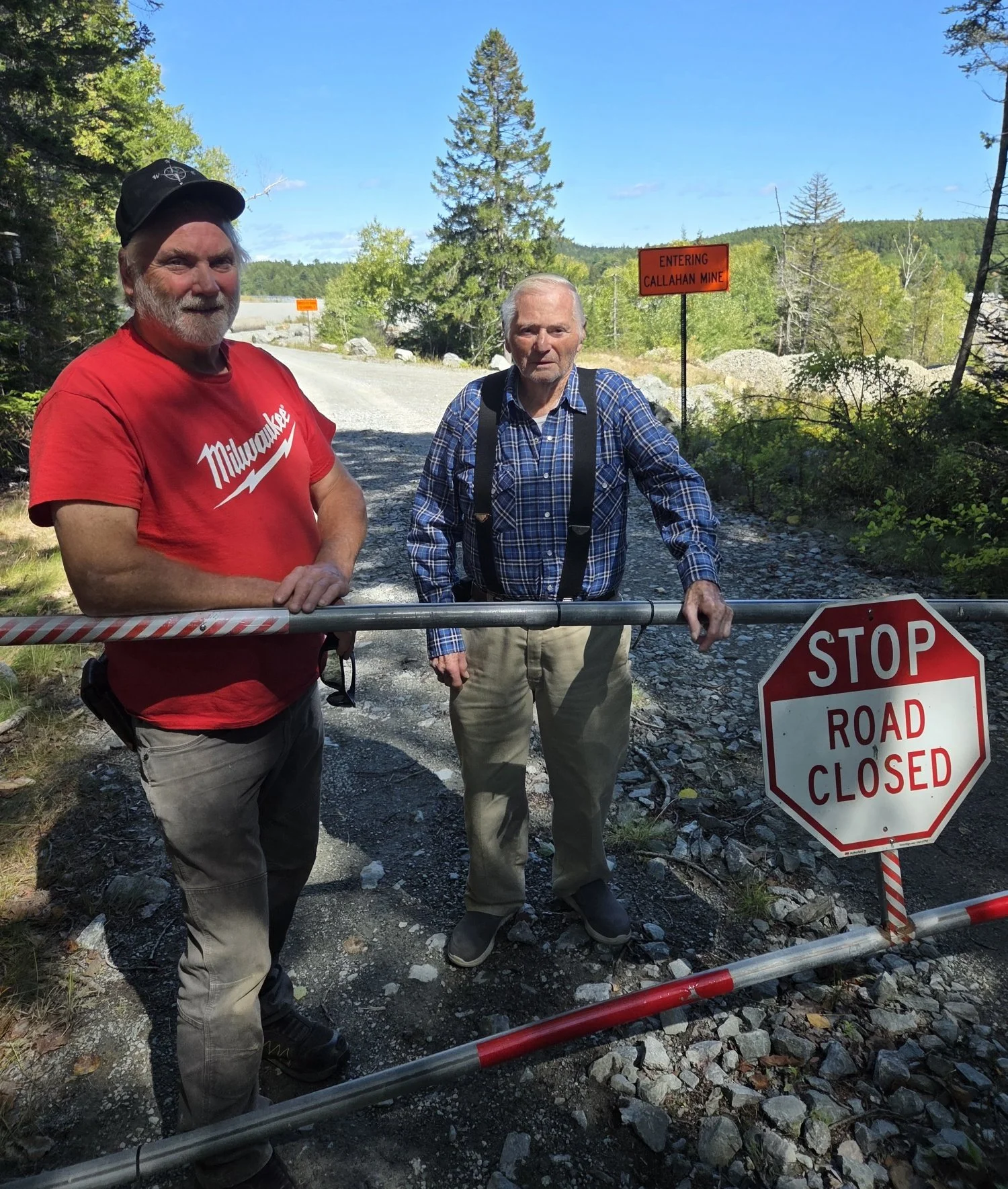
Cape Rosier's Earl Clifford, Jr., 68, and his father, Earl, Sr., 91, a former miner, at the gate leading into the Callahan Mine Superfund site. Photo by John Epstein.
Sept. 15, 2026
Editor’s note: Cape Rosier’s Earl Clifford, Sr., will be 92 this November. He’s lived all his life in Brooksville. After graduating from the town’s high school, he worked several jobs over the decades, including fisherman, builder, and small seaplane pilot, and — as his son Earl, Jr. describes below — mine prospector. Earl, Sr. still keeps busy caretaking a few homes in the neighborhood.
Below is Earl, Sr’s account of working at the mine, as told to and written down by his son, Earl, Jr.
A brief history of Brooksville mines
The copper mine that later became known as the Callahan Mine was originally founded around 1880. It wasn’t that anyone was looking for a copper mine. Actually, they were just planning on finding something for dinner.
One afternoon, a local resident, by the name of Dyer, walked down to the shore at low tide in search of a mess of clams, but he forgot about them when he found everything was green, a tell-tale sign of copper.
Within a year the Rosier Extension Copper Mine was up and running. It only lasted a few years, but at its peak it operated four copper-producing shafts, while employing 200 men. The mine closed in 1887. The copper seemed to have run out and had become too expensive to mine.
Interestingly, during this time period, between 1880 and 1890, around 40 other mines had sprouted up in Brooksville. They were sources for copper, talc, soapstone, malachite, pyrite, aluminum, garnet, and even a bit of gold and silver.
Though sold and resold several times over the decades, what was once the Rosier Extension Copper Mine would not operate for nearly 70 years. Then, in 1955, a man named Veague, who had bought the mineral rights, hired a Canadian company to test some drill samples to see if the original shafts were worth reopening again.
That’s when my dad came into the picture. At 21, he was hired as a prospector to inspect old mines.
For a year or so, he went down old shafts to see if there was enough copper in a mine to open it up. Dad would get into a steel bucket that was hooked to cables that operated from a winch house. Earl Condon and Roy Lang operated the cables to lower Dad down into the old shaft.
It must have been dark, smelly, and wet, but that’s not what Dad remembered. He said it was like stepping back in time. He found tools, helmets, and torches, and everywhere he looked, copper glistened on the walls.
Unfazed by a near-death experience
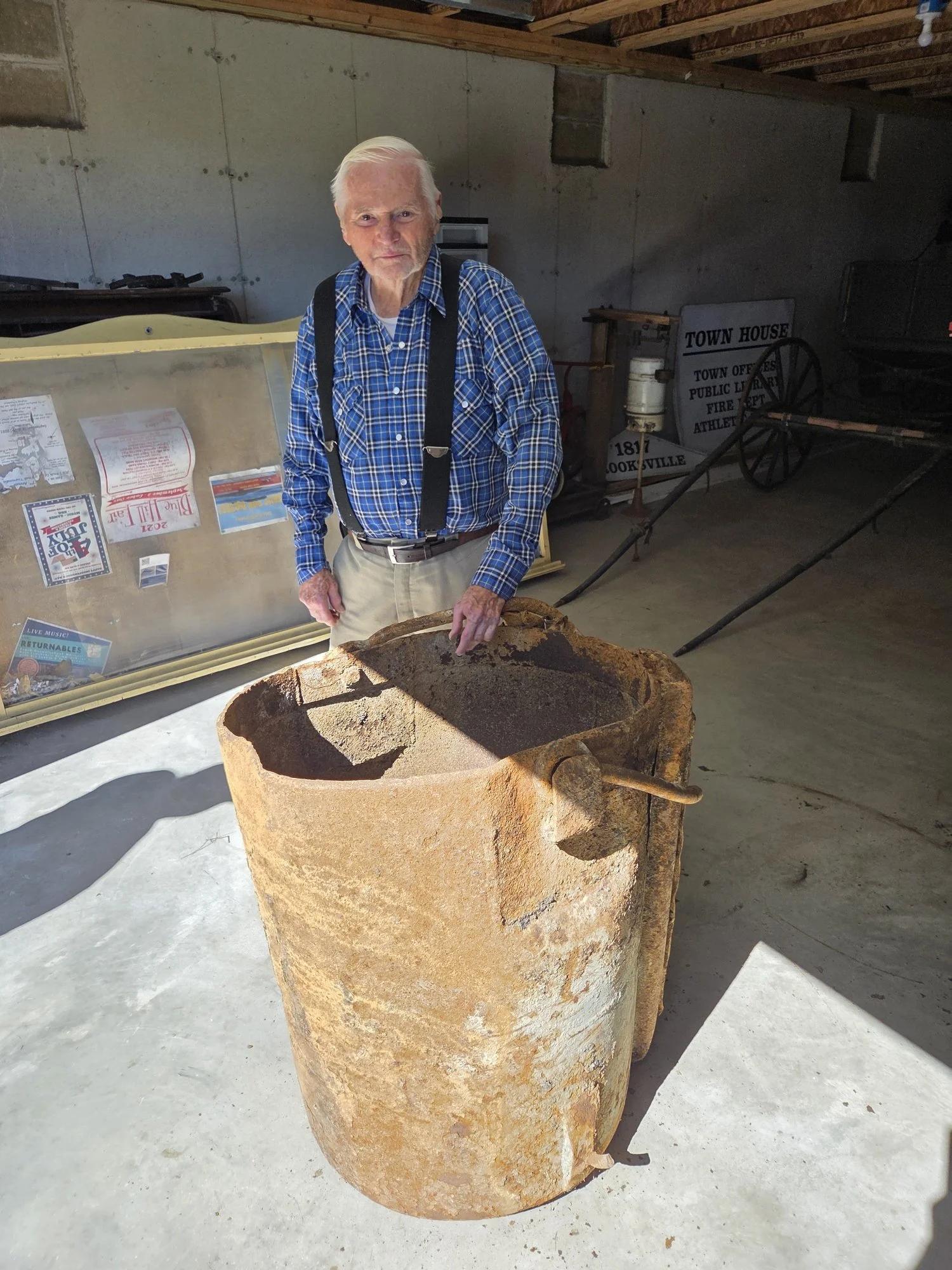
Earl Clifford, Sr., next to the old mine shaft exploration bucket that he fell from when he was inspecting mines in Cape Rosier over 60 years ago. The bucket was retrieved by the Brooksville Historical Society. Photo by John Epstein.
Dad enjoyed working down in that mine even after falling more than 100 feet down a shaft! It was the end of a 16-hour shift and time to head up to the surface when it happened. Dad, along with a couple of other miners, climbed into the lift bucket. But there was one too many miners for the bucket, and Dad ended up hanging on its outside edge.
As the bucket was lifted up, his battery pack caught on the shaft wall. The bucket shook, and he fell off of it. One of the miners caught him by the leg, holding him as the bucket rose up the shaft.
But as the bucket approached a landing platform, there was not clearance for Dad’s body. They had to let him go, otherwise he’d have been cut in half. Down Dad went at least 100 feet. He grabbed a cable as he fell, holding it tightly for a while, until he was slung off.
But rather than falling another 100 feet to the bottom of the shaft and to his certain death, he managed to just fall several feet into a muddy pocket space on the side of the shaft. Feeling lucky to be alive, he got his bearings, then reached around in the darkness until his hands found one of the ladders that runs up the side of the shaft.
Although a bit worse for wear, Dad climbed up the ladder to the very last rung, popping out to greet an astonished group of his men — brothers, cousins, friends and neighbors.
When Dad was young, he was always getting into one mess or another. After one such event that led to a visit to the doctor’s office, Dr. Babcock said to him: “Well, Earl, you were lucky. You know I believe if you make it to your 20th birthday, you’ll probably live to see a 100!”
It’s been real close, but there’s a good chance the doctor might be proven right.
