

GSA fields questions on contract initiative
School head says $1M of local tax funds are sent elsewhere, while parents defend school choice in impromptu first listening session
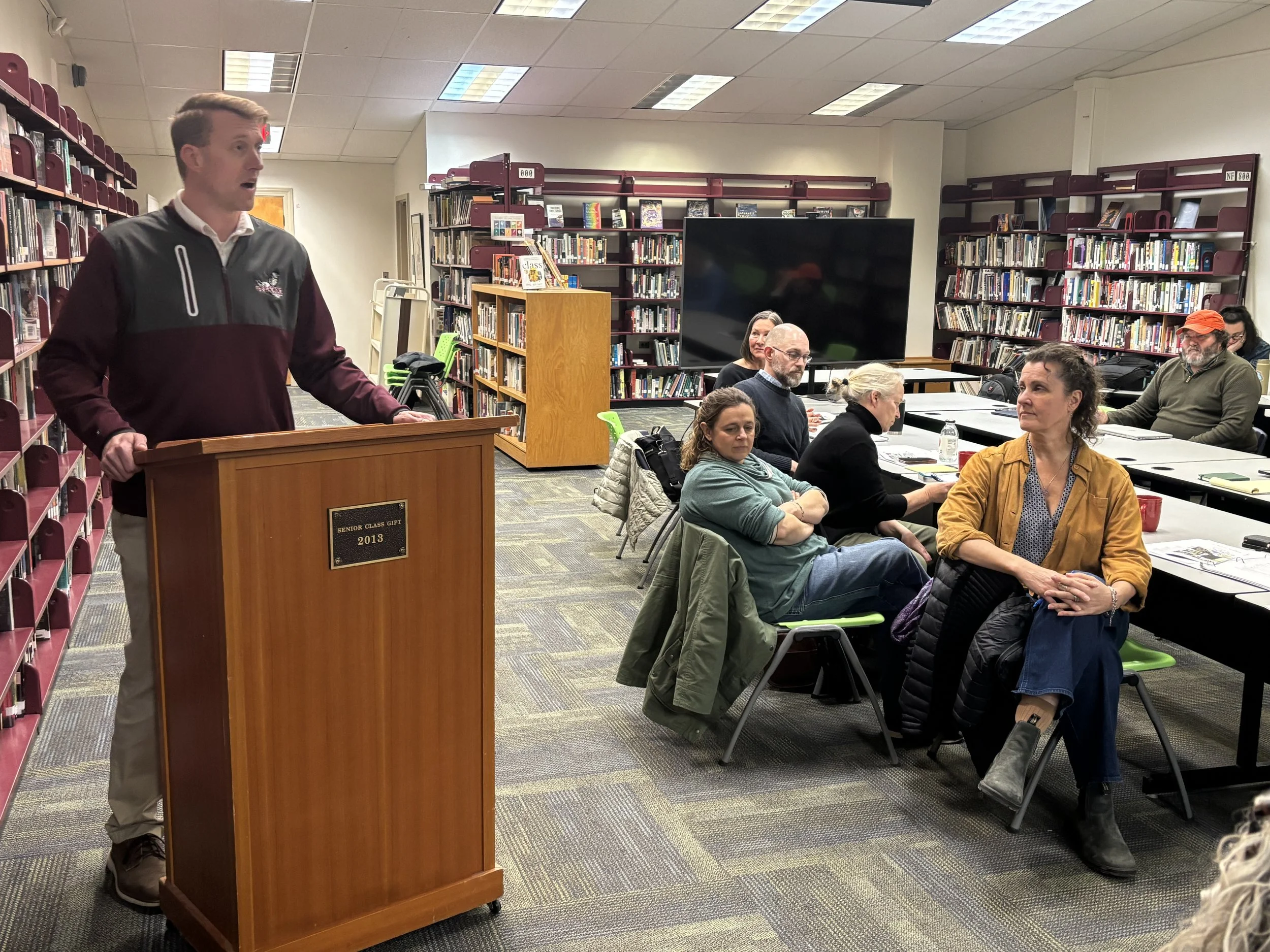
GSA head of school Dan Welch, left, at a Jan. 15 press conference on the subject of school choice. The event included the town academy’s board members, right. Photo by John Boit.
Jan. 16, 2026
By Tricia Thomas
BLUE HILL—Shortly after promising at a press conference to hold community forums on a controversial new plan to boost enrollment at George Stevens Academy, the school’s board of trustees held its first impromptu forum after nearly 50 local residents turned up at a board meeting on January 15 to question the plan.
“One of the questions [at the press conference] was ‘when are you going to have your first open forum?’ and its looks like right now. This is our first open forum,” board president Deb Ludlow said after welcoming attendees.
Ludlow told the audience that, in light of the turnout, the board would extend the public portion of the meeting from its usual 30 minutes.
“We’re going to stay open until we can get everyone’s questions answered,” she said.
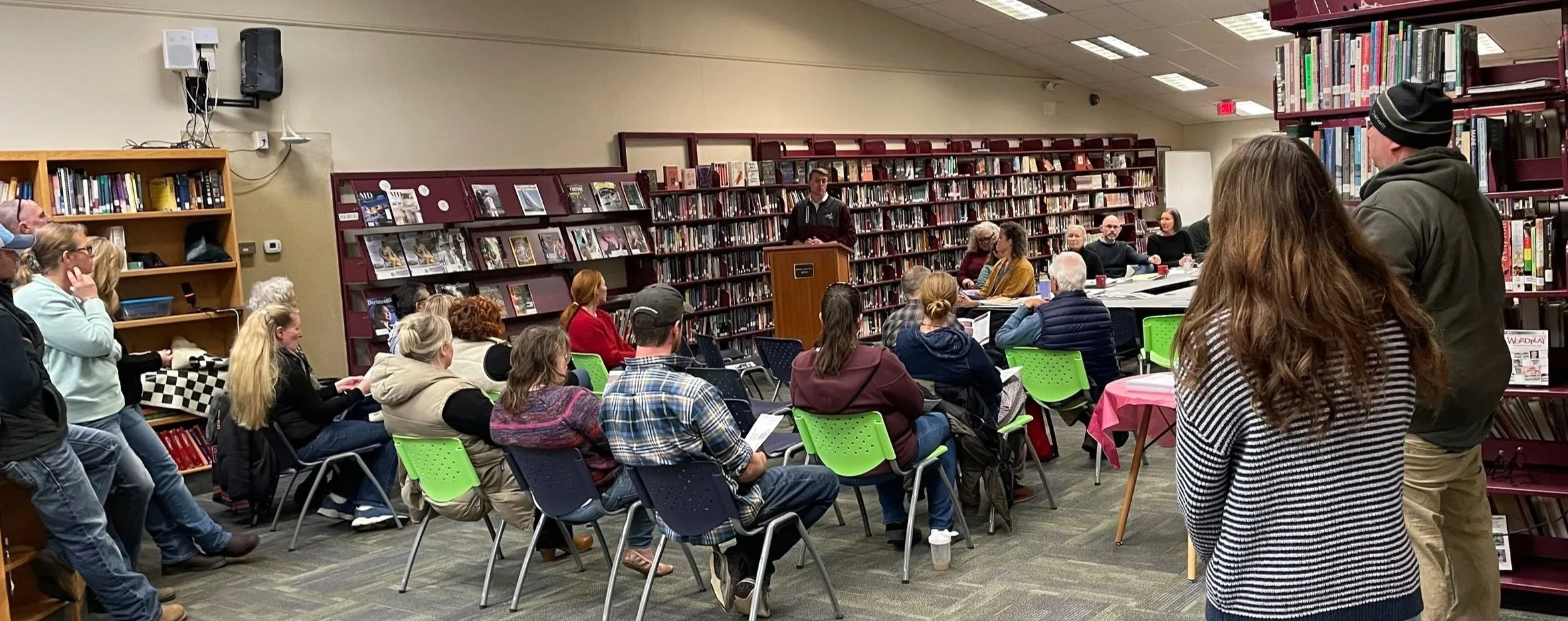
GSA officials allowed the public part of their meeting to stay open for an hour top hear concerns from parents over possible tuition contracts with towns that would curtail school choice. Photo by Tricia Thomas.
The Q & A session lasted a full hour and followed an earlier hour-long press conference in which GSA officials unveiled a plan to “stabilize” flagging enrollment at the private town academy by asking sending towns to sign enrollment contracts.
GSA head Dan Welch said during the press conference that, while exceptions would be granted, the contract initiative, if approved by voters, would effectively end school choice in the sending towns. Students in Blue Hill, Brooklin, Brooksville, Orland, Penobscot, Sedgwick and Surry now can choose to use their towns’ tax-funded tuition money to attend schools other than GSA.
“Peninsula taxpayers currently send up to $1 million dollars annually to other towns when students attend schools elsewhere,” Welch said during the press conference, reading from a prepared statement. “Town contracts would keep these local dollars and ensure students receive a top-tier education just minutes from home.”
The private high school, which serves as the area’s de facto high school, has experienced declining enrollment and budget shortfalls in recent years. Currently, 207 students are enrolled at GSA, a number that is down significantly from an average enrollment of 350 students several years ago. According to GSA, more than a third of the area’s students are choosing to attend high school elsewhere.
Contracts would allow the school to stabilize enrollment and plan and budget for a set number of students each year, Welch said.
“With contracts bringing an additional 14-15 guaranteed students annually starting in the 2027-2028 year, the school projects surpluses of $60,000 to $275,000 by 2030-2031,” Welch said.
Welch added that 220 students would need to enroll for GSA to “break even.”
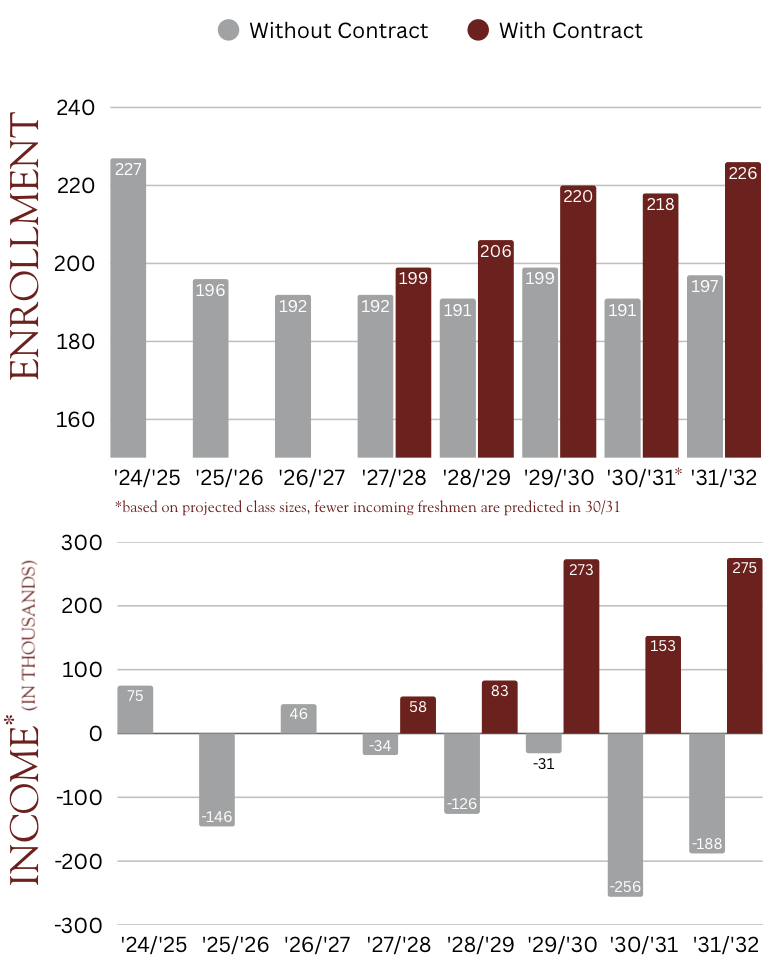
A graphic from a brochure prepared by GSA on its town contract initiative. Courtesy of GSA.
During both the press conference and open portion of the trustees’ meeting, Welch and board members stressed that no decisions have yet been made on the plan and that no action will be taken without community buy-in.
Exceptions that would likely be made would allow students to attend the Blue Hill Harbor School, a small private school nearby of about 30 students, or in cases of children with special needs who cannot be accommodated at GSA, Welch said. Other exceptions are possible, but have not yet been determined, he said.
Welch said that towns are free to say ‘no’ to the proposal, and the earliest that contracts with agreeing towns would start would be the 2027-2028 school year.
“We know that we can’t do this without community support. We have no desire to try to ramrod this down your throat, for lack of a better term. We’re not trying to pull a ‘fast one.’ We’re not trying to push this on people,” Welch told the crowd. “We simply want to talk to you.”
“And, if the communities’ answers are ‘great, we’d like to talk about it,’ then we are really looking forward to engaging in those conversations,” Welch added. “If the communities’ answer is ‘no, we’re not interested,’ then we are going to keep doing everything we can to provide an outstanding educational experience for every student that does choose to come here.”
Welch said that the school relies on tuition as its primary source of income, and that students’ current ability to choose from among a handful of area schools—including Ellsworth High School, Bucksport High School, John Bapst Memorial High School in Bangor, the Maine School of Science and Mathematics (MSSM) in Limestone, and the Harbor School, makes annual budgeting “difficult.”
“We have to wait to see how many students currently show up in September. We want to start passing our budgets well before that. We want to pass our budgets before the fiscal year begins,” Welch said. “That budget we adopt could change an awful lot if 10 or 12 kids show up that we weren’t expecting—we’d love that problem—but if 10 or 12 kids transfer out, all of a sudden that creates a budget deficit. Right now, we’re in a place where 5 to 10 students in any given year makes or breaks our budget. That makes planning [difficult].”
“School contracts would provide known variables. We can plan,” Welch added before opening the meeting to questions from the audience.
Blue Hill parent Willough McEnroe, whose son recently transferred to GSA from MSSM, said she appreciated the recent improvements at the school, but feared that the proposed contracts could further harm GSA’s reputation. Previous staff layoffs and other belt-tightening, a controversial former school head, reports of student bullying, and the school’s annual request for supplemental tuition support from sending towns have been cited in news reports and public forums peninsula-wide as reasons why the school has lost its standing in the community.
“I feel that doing something like this could create some more bad blood and create more of a reputation for GSA and a stain on the school that doesn’t look great,” McEnroe said.
McEnroe suggested that GSA better market itself to entice students to enroll.
“I really worry about how it looks to families that are looking for their kids to have a different experience, who moved to the peninsula for the school choice itself,” she said. “I worry about backlash.”
Penobscot resident Jamie MacNair, a GSA alumna, said she values school choice. She said parents and students primarily base enrollment decisions on what’s best for them—not what’s best for the schools.
“That’s the beauty of the peninsula. It’s school choice,” MacNair said. “I graduated from this school and I don’t want to see it fail, but to not have school choice? This is a bad path.”
Board member Kate Stookey asked if there was public concern over “sending taxpayer dollars off the peninsula to get invested in other schools.” MacNair shook her head no.
“Not when that school is a better choice for my child. It’s not a bad choice. It’s what’s best for my family,” she said.
Blue Hill resident Sean Dooley agreed.
“Nobody puts their kid on a bus for an hour each way every day without a good reason,” Dooley said.
Blue Hill select board member Ben Adams, who has two sons nearing high school age, said that, while “GSA is important to the peninsula,” he urged the school to consider its own role in fixing its enrollment problem.
“I want to know what you think you can do better to bring these kids back to the peninsula,” Adams said.
Surry resident Pat Shepherd, who created a Facebook page “Protect School Choice Blue Hill,” when he learned of the potential contracts plan, said that GSA should put in more effort to increase enrollment on its own.
“You’re putting the cart before the horse,” he said.
GSA teacher Emma Baker said that future conversations about the issue could yield insight into why families are, or are not, choosing GSA.
In the coming months, Welch and the GSA board plan to meet with select boards and school boards in each of the affected towns, hold community forums for the public, and circulate petitions and information. A dedicated webpage on the issue has been developed, and an eight-page booklet outlining the plan, distributed to attendees at the meetings, will be made available throughout the peninsula, said school communications consultant Amy Strother. Questions and comments on the plan can be sent to community@georgestevens.org.
“There is no pre-determined outcome,” Stookey said. “This is just the beginning of the conversation.
That conversation could extend far into the months ahead, Welch said.
“We’re very interested in the long game. We’re not trying to get a referendum or a vote or anything for the fall. The quickest we see this happening is the fall of 2027,” Welch said of any potential contracts. “That gives us a year and a half to keep talking.”
