

GSA unveils strategic plan to increase enrollment to 225 students
Trustees also reduce board meetings, increase Gateway Project to $2.9M
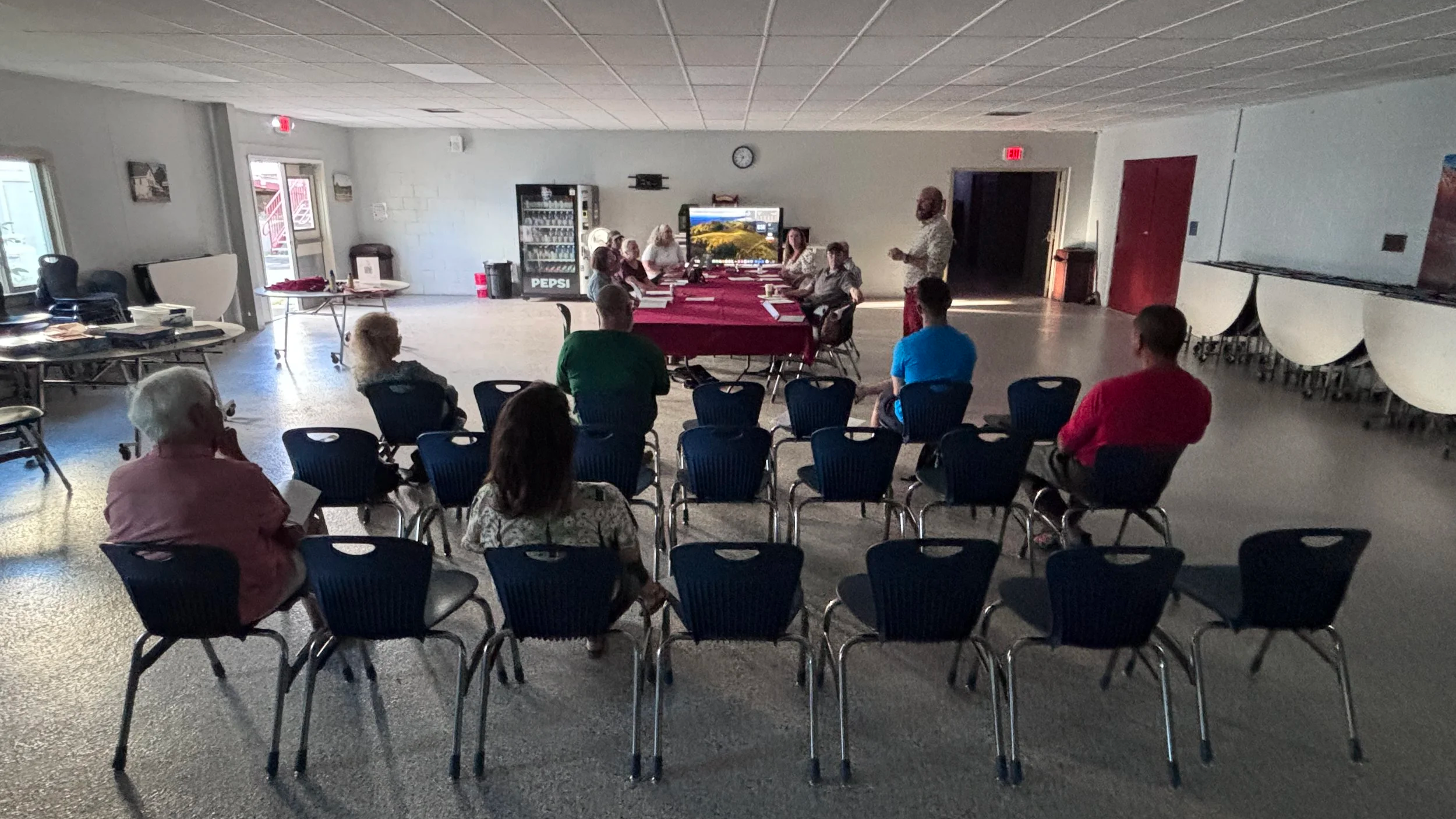
GSA trustees held their July 16 board meeting in a darkened room after a storm knocked out power, using a car battery to run a monitor. Photo by John Boit.
July 21, 2026
By John Boit
BLUE HILL—George Stevens Academy trustees have unveiled a strategic plan to guide the school for the next five years that calls for boosting enrollment to at least 225 students.
The new plan, which was the centerpiece of the school’s July 16 board of trustees meeting, was designed after feedback from students, families and faculty. The public is now invited to review the plan and submit feedback via the GSA website.
The trustees meeting was the first for new school head Shelly Schildroth, who started the job on July 1. It was held hours after a powerful sudden storm knocked out power to the school, necessitating a relocation from the upstairs library to the cooler climate of the downstairs cafeteria. Trustees used a makeshift car battery power pack to run a flat-screen monitor for board presentations during the meeting.
The five-year plan aims to see total student enrollment rise to between 225 and 235 students by 2031.
Once bursting with 350 students decades ago, GSA had as many as 208 students at one point in the past school year. The strategic plan as written says the school expects 193 day students in the coming year, although trustees in the meeting said the number was 192. That figure was later revised to 190 by school officials this week to The Rising Tide, although they stressed that the numbers are always shifting until the school year begins.
The figure does not include visiting students from the school’s international homestay program. School officials told The Rising Tide this week they are actively looking for families who wish to host a total of six foreign students this year.
The strategic plan outlines five priorities over the next five years:
Deliver a “distinctive” high school experience
Deepen connections to the community
Build a sustainable revenue model
Strengthen the school’s “organizational capacity and resilience”
Modernize the campus
A town academy that serves seven towns, GSA has faced decreasing enrollment due to changing demographics and a drain from families who have applied their taxpayer-funded tuition dollars toward other schools. Roughly one out of every three high school students within the seven sending towns chooses to attend a school other than GSA.
The strategic plan states that long-term growth “will depend on GSA's ability to clearly define its value, strengthen relationships with families and communities, grow enrollment, and align its resources around a compelling educational experience.”
Success will rely in part on the school's ability to “win back” towns like Castine, Penobscot, Surry and Orland, who are sending more of their students to other schools than they have in the past, according to the plan. The school also says it will reach out to prospective students earlier in their elementary school years.
“We are not competing in a growth market,” Schildroth said. “We cannot simply wait for population growth to save us. We have to earn every student by winning back families who have drifted, keeping the students that we have, and clearly showing what makes GSA worth choosing.”
In discussing the growth plan, trustee Chris Gleason discussed the need to switch from a “passive system to a managed system.”
“Across every case study we looked at, schools that grow actively manage their enrollment pipelines…Today when a family inquires about GSA we don’t systematically track what happens next. That’s what we’re going to change,” Gleason said.
Gleason said the school will create a customer relationship management system, or CRM, to build those relationships with families when their children are in early elementary school. “We can’t wait until eighth grade,” he said.
“Once we have those relationships, it’s going to convert to enrollment,” Gleason added.
While math, science, social studies, and English will remain the core foundations of the curriculum, the school will also focus on six additional areas: health and medical such as nursing training; maritime and coastal STEM that focuses on ocean studies; trades and fabrication; digital and media arts; outdoor leadership; and individualized study plans and internships.
The plan describes the typical GSA graduate as “future-minded, with goals for a fulfilling life beyond campus.” Under the plan, each student will be a “learner” who is inquisitive, an “innovator” who explores and takes risks, a "citizen" with community pride, and a “strong and healthy” young person with a sense of self worth.
In addition, the new plan sets a goal of raising between $375,000 and $500,000 each year through donors – funds that are separate from the roughly $17,000 per student each sending town pays for tuition.
GSA has posted the full plan on its website as well as a link to a six-question survey for community feedback.
Reduced meetings, increased Gateway budget, cell phone ban
At the start of the trustees meeting, board chair Deb Ludlow said the school will reduce the number of meetings it has to six from the current monthly schedule. The meetings were opened up to the public last year.
The decision to reduce the number of meetings came after a recommendation by the New England Association of Schools and Colleges, which accredits the school.
Ben Wooten, a member of the Budget Review Committee that has questioned the finances of the school for several years, said the decision risks alienating the public.
“This is coming at a time when you are trying to reestablish relationships with the towns. It’s not a good message,” Wooten said.
Additionally, the trustees voted to expand the scope of the school’s Gateway project by $500,000. The project is part of the school's “campus renewal” process to create a “safer, more welcoming entrance” to the school. The money will be raised through fundraising, trustees said, and would allow the school to replace aging siding along one of its buildings.
The additional money increases the total budget of the Gateway project to $2.88 million, Schildroth confirmed to The Rising Tide.
The school will also be discussing a cell phone policy for students. Maine now requires all schools to have a “bell-to-bell” policy restricting cell phone use. GSA is looking at a range of options, from an honor policy where students are trusted not to use their phones, to one where students deposit their cell phones in a locker for the duration of the day.
Trustees also announced that they had set this year’s budget during an executive session held last month on June 18. Trustees said they need to format the budget before posting it to the school’s website. Schildroth confirmed after the meeting that the 2026-2027 budget is $5,524,408.