

Hancock County Dems choose delegates for July 25 convention
Historic efforts to replace Platner have required ‘mind-boggling’ logistics
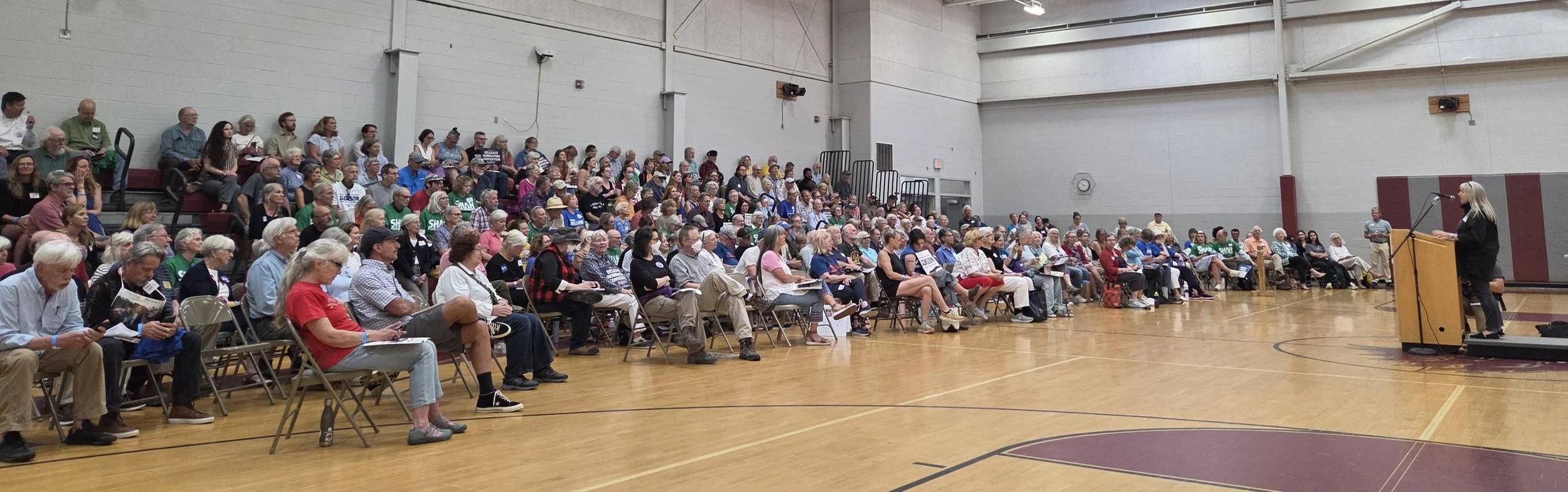
Marcia Myers, Chair of the Hancock County Dems, addresses the crowd before the delegate selection vote. Photo by John Epstein.
July 21, 2026
By John Epstein
ELLSWORTH—It’s been an extremely hectic couple of weeks for state and county Democrats after Graham Platner suspended his campaign on July 8, leaving local organizers scrambling to develop a process to choose a replacement candidate.
“We faced an almost impossible task,” said Marcia Myers, chair of the Hancock County Democrats. “The logistics have been mind-boggling.”
In meetings across the state over the weekend of July 18-19, county Democratic organizations selected 500 delegates who, along with 101 members of the state’s Democratic Committee, will vote for a new candidate on July 25. That vote will take place in-person at the Cross Insurance Center Arena in Bangor.
In Hancock County, the Democratic organization held its delegate selection meeting in Ellsworth on July 18. During that meeting, voters elected 23 delegates, and 5 alternates. Nearly every delegate chosen—22 out of 23—indicated support for Troy Jackson, the former President of the Maine Senate.
The Maine Democratic party has published a list of all the Hancock County delegates who will head to the convention.
The vote by the Hancock County Dems reflected the state-wide trend, where more than 75% of the party delegates selected over the weekend have committed to voting for Jackson. The tidal wave of support for the lumberman and union organizer has prompted the three other principal contenders—Nirav Shah, Shenna Bellows and Jordan Wood—to suspend their campaigns and unify behind Jackson.
The pace of events has been remarkable.
Identifying a process
On July 16–two days before delegates were selected–the Hancock Dems hosted an informational meeting at Ellsworth’s Unitarian Universalist Church called ‘What’s Next for Maine? Maine Senate Selection Process.’ Imke Schessler, vice chair of the Maine Democratic Party, led a discussion about how the process to elect delegates was developed and what voters could expect in advance of the July 25 convention in Bangor.
Carlos Maibeth-Mortimer, an electrician from Brooklin, talks about why the Democrats need to care about young Maine voters. Video by John Epstein.
“A state-wide primary isn’t possible, but we wanted to make the delegate selection process as open, inclusive and as fair as possible,” said Schessler. A journalism professor at the University of Maine, Schessler explained that the state Democratic Committee’s decision to hold a delegate convention was based on legal advice, party guidelines and state law. Independents would be excluded from choosing delegates, she added.
“I know this makes unenrolled people who voted in the primary cranky,” she said, “but the Democratic Party needs to take care of the problem within the party.” She noted that the party was also leery of legal challenges from the GOP.
Attendees at the July 16 meeting expressed concern that many of the prospective delegates’ statements about why they wanted to be chosen were overly vague. Of the 211 statements that prospective delegates submitted, only 10% specified a preferred candidate. Most contained general statements about supporting “progressive values” or Platner’s positions on issues, but did not elaborate further.
“I’m confused,” said Marty Williams, one of the attendees at the Thursday night meeting. “How would I know which person they support? It should be clear.”
“I want to know what people think,” said another.
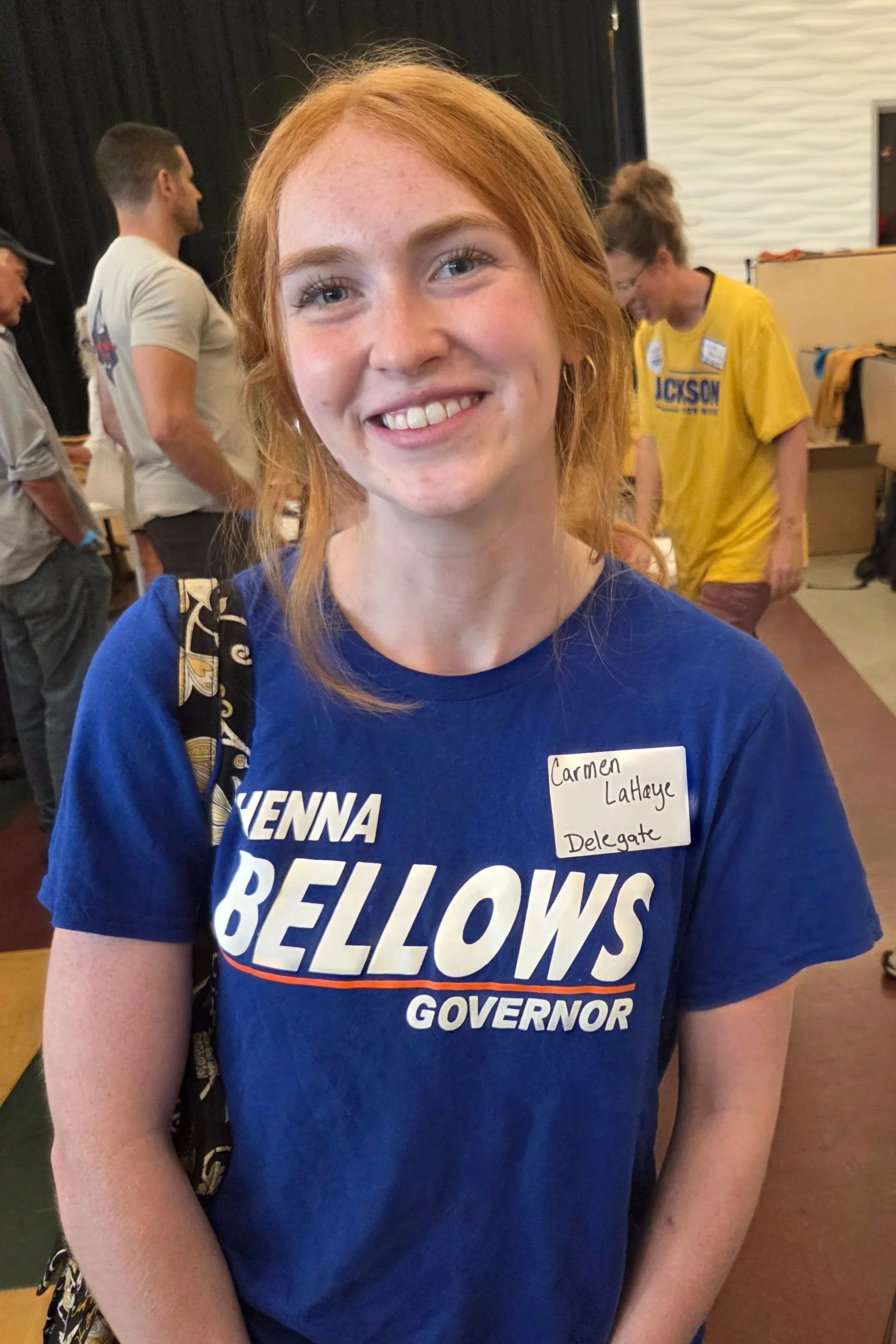
Carmen LaHaye, 19, had volunteered for the Platner campaign. She wanted to be a delegate for Shenna Bellows. Photo by John Epstein.
Others said that a delegate’s duty is to determine the preferences of the community he or she comes from.
“A delegate should know the will of the people,” said Maggie Williams, chair of the Penobscot Democratic Committee.
Marcia Myers, chair of the Hancock County Democrats, urged people to be mindful of the impact that Platner had on the Democratic electorate in the primary. “Seventy-two percent of the votes belong to him,” she said. Platner had supported Jackson’s candidacy for the gubernatorial nomination.
Ian Murray, of Blue Hill, who once served on the Democratic National Committee in Pennsylvania, said young voters in Maine who provided Platner with huge ground support are crucial. “We need to integrate with his base,” Murray said. “If we don’t embrace them, we’ll lose the heart of the movement.”
Schessler said that delegates and participants at the delegate selection meeting “should wear as much candidate gear—buttons, hats, T-shirts—as they want.”
Hancock County delegate nomination meeting
Indeed, there was lots of campaign paraphernalia at the Hancock County Dems’ July 18 delegate selection meeting at the Ellsworth Elementary Middle School. Before the voting began, prospective delegates and voters mingled in the school’s large cafeteria. Some carried placards stating which candidate they supported.
Staffed campaign tables for Shah, Bellows and Jackson offered campaign literature, swag and, most importantly, a list of delegate candidates whom the Senate candidates believed were committed to them. There also was a well-staffed table for Jordan Wood, along with the candidate himself. Wood ran for Senate, then switched to run for Congress in the 2nd District and lost, and was now running for Senate again. His table had lots of handouts, but no list of committed delegate candidates.
Wearing a bright yellow Jackson t-shirt, Maine State Representative Nina Millikin from Blue Hill made no bones about whom she was supporting. “I’ve always been a supporter of Troy,” she said. Her thoughts on the delegate selection process: “No one knows the right strategy and we’ll figure it out and then it won’t ever happen again.”
At 9:50, Bucksport’s David Weeda, a local political activist, Bellows supporter and bagpiper, played a Scottish marching tune to voters into the gymnasium where voting would take place. State organizers leveraged ElectionBuddy, an app, to facilitate voting. In-person attendees voted from their cell phone in the gym; others, who had registered online, voted remotely.
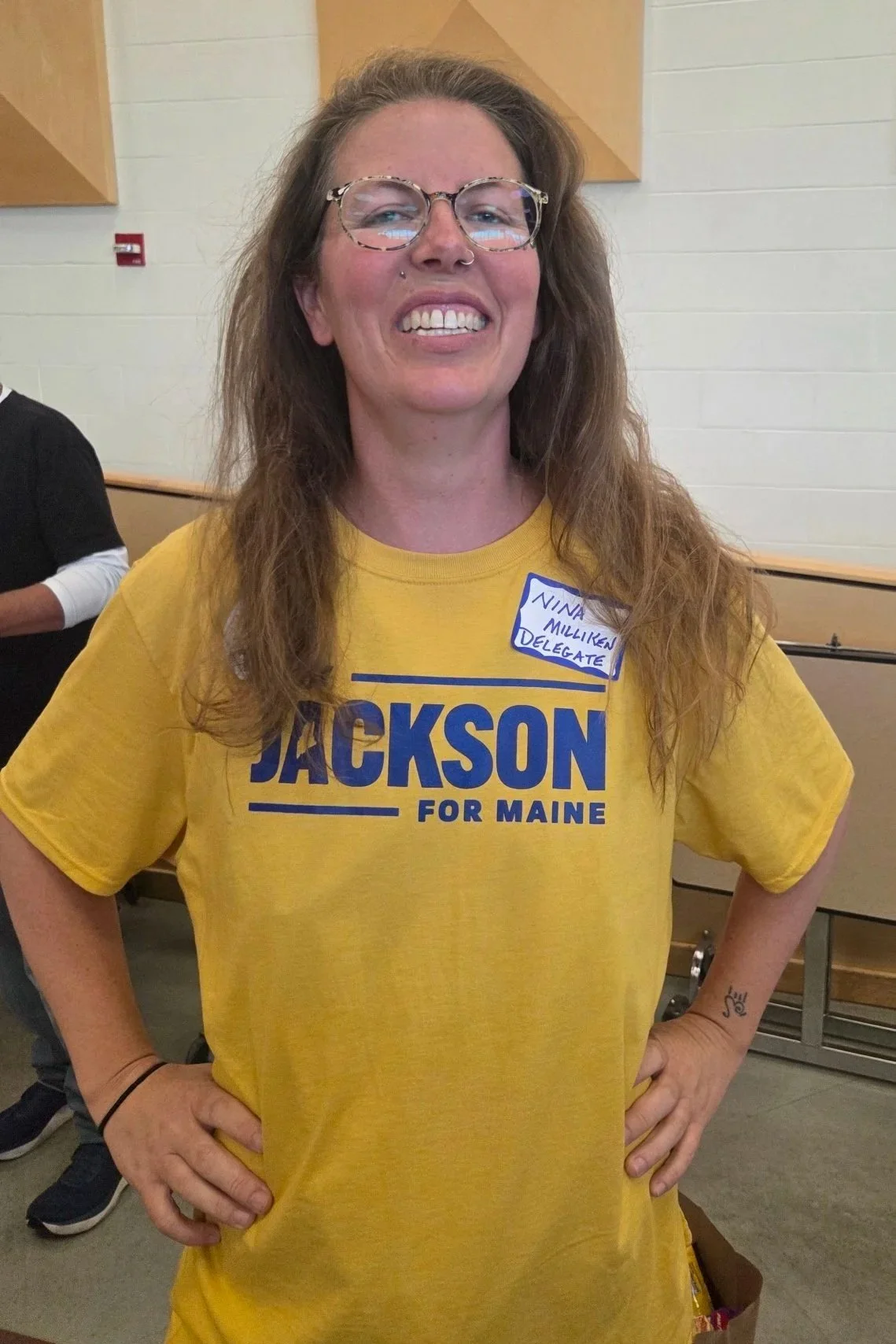
State Representative Nina Milliken of Blue Hill got the most votes to be a delegate at the July 25 convention. Photo by John Epstein.
Hancock County Dems chair Myers addressed the crowd from a podium in the middle of the gym. Press, roped off to one side, included reporters from The Bangor Daily News, Maine Public Radio, The Nation, NBC, The Christian Science Monitor, and The Rising Tide.
“This turnout is great in this room and more than 500 people are participating remotely,” said Myers, who told The Rising Tide that the delegate selection vote was open to all Democrats who voted in the June 9 primary, and was announced via email, social media, and news releases.
Before the vote she read a letter from Charlie Dingman, Chair of the state’s Democratic Committee. The letter stressed the importance of electing a Democrat “to put the brakes on a corrupt, cruel and repressive federal administration supported by a compliant Susan Collins.”
While the in-house voting was largely completed within 30 minutes, it took a few more hours to assemble the vote totals for the remote voters.
Election results for Hancock County delegate selection
Troy Jackson’s near sweep of the Democratic Party delegate slate in Hancock County was largely mirrored in county selection meetings across the state. This makes him the likely choice at the July 25 delegate convention to replace Platner as the party’s senatorial candidate.
A CNN pre-convention debate that had been scheduled for July 23 has been cancelled.