

Local residents face winter with highest heating costs ever
Heating oil costs have risen 80% since last year. Here’s why–and resources to help

At more than $6 a gallon, it now costs Mainers about $1,650 to fill a standard 275-gallon heating oil tank. Photo by Unsplash.
Oct. 14, 2026
By Jessi Hardy and John Boit
When state representative Holly Eaton began to prepare for winter by filling her heating oil tank, it came with the highest price in state history: about $6 a gallon, which for Eaton meant a bill of $1,429.55.
“I know what a fill-up like that does to my own household budget, and I know plenty of other households are doing that same math right now,” Eaton said on social media. “On average fuel costs are about two dollars more a gallon than they were a year ago. It is going to absolutely cripple so many people in our community!”
According to the Maine Department of Energy Resources, the statewide average price for heating oil reached $6.02 per gallon for the week of September 21.
Now, as the weather turns colder, costs remain at historic highs for Mainers. And while the reasons for the high costs can be blamed on international events, there are some state programs that can help alleviate the surging costs of keeping a home heated as the weather turns even colder in the months ahead.
More wood, more layers
Liz Lincoln of Deer Isle expressed deep concern regarding the financial strain on her household of seven, even with two incomes.
“With a large family, increased heating costs mean less financial flexibility and that’s especially difficult during the holiday season,” Lincoln said. “Families like ours are already burdened by increased grocery costs which for us at least are almost twice what they were two years ago.”
Lincoln said her family plans to be diligent about insulating windows and doors, keeping the thermostat low, using more wood as a second heating source, and dressing in layers.
“It’ll be a cold, frustrating winter for many families and I’m concerned about our community members who don’t have the ability to receive assistance or take measures to seal up their homes,” Lincoln said.
Surging fuel prices also place heavy budgetary pressure on public facilities, restaurants, and municipal buildings. Municipal facilities, public institutions, and local dining establishments face escalating utility overhead, forcing administrators and business owners to divert crucial operational funds from core services, staffing, and maintenance to meet rising heating expenses or actively explore energy-efficiency upgrades and alternative energy solutions to minimize future costs.
To help maintain functional learning conditions amid fluctuating seasonal temperatures, the Deer Isle-Stonington CSD 13 School Board recently adopted a school temperature policy (EBBD) establishing an optimal classroom comfort zone of 60 to 85 degrees.
The school’s policy states: “On cold days, when building and classroom temperatures hover near the minimum, schools are encouraged to incorporate more opportunities for physical activity during class time and may consider having extra layers of clothing available. Families should ensure that their students are dressed appropriately for expected weather conditions.”
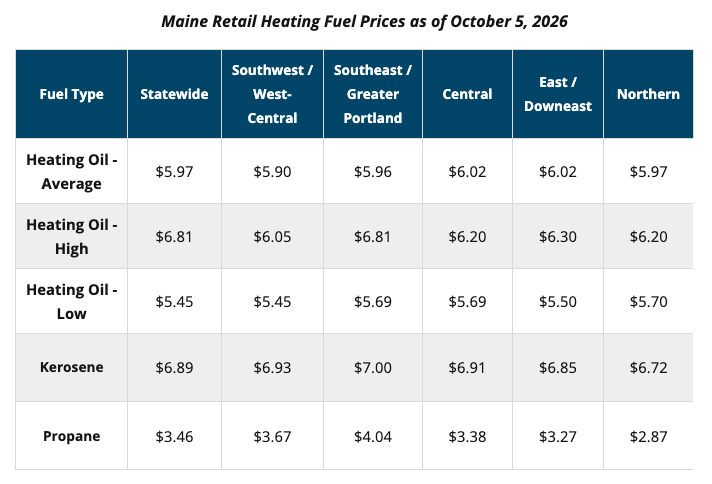
Source: Heating Fuel Prices | Maine Department of Energy Resources
Who’s to blame?
Ashley Black of RH Foster in Penobscot said there is a common misperception that fuel companies benefit when the costs go up. She told The Rising Tide that higher retail costs stem directly from significantly increased wholesale acquisition costs.
“People like to think we’re making a whole bunch of money. We’re not because we’re paying a substantially higher price to buy the heating oil,” Black said.
A primary driver of recent price surges is the US-Iran War affecting the Strait of Hormuz, a chokepoint through which 25 to 30 percent of the world’s crude oil must travel to reach global markets. As of today, the strait has been closed or severely limited to traffic for 227 days.
According to Dr. Sharon Klein, Associate Professor of Economics at University of Maine, any disruption global disruption will cause a price fluctuation.
"Broadly speaking, just the price of oil is set in a global market. There’s oil being produced and sold all across the globe.” Klein said. “So if there's a disruption in any part of that supply chain, it can affect the whole supply. And so it'll basically mean that there's higher prices for everybody."
Historical context reveals that similar geopolitical conflicts over the last five decades have consistently triggered major oil supply shocks and sharp price increases:
1973 Arab oil embargo: Crude oil prices quadrupled from an average of $3 to roughly $12 per barrel, driving up gasoline and food costs worldwide.
1979–1980 Iranian Revolution and Iran-Iraq War: Crude oil prices surged from $15 to $35 per barrel amid widespread regional instability and production cuts.
1990 Persian Gulf War: Iraq’s invasion of Kuwait created consumer anxiety and pushed oil prices from $15 to $46 per barrel before strategic reserves were deployed.
2022 Russia-Ukraine War: Russia’s invasion of Ukraine spiked crude oil prices from $75 to $130 per barrel.
Klein, the UMaine professor, added that even without wars, the price of oil will naturally climb in the future.
"Over time, it is getting harder and harder to access oil in places where we used to be able to access it cheaply. And so there is some thought that eventually, over time, prices are going to increase more steadily because it gets more expensive to pull it out of the ground," Klein said.
Prices have already been surging in the past decade. Ten years ago, the average price for heating fuel was $2.45 per gallon—representing a 146% increase over the past decade. Just one year ago, heating oil averaged $3.34 per gallon, reflecting an 80 percent jump in 12 months.
Data provided by RH Foster and the Maine Department of Energy Resources tracks heating oil prices per gallon over recent years, underscoring the dramatic escalation across the state and Eastern Maine:
2016: $2.45 per gallon (Statewide Average)
2017: ~$2.30 – $2.60 per gallon (Historical range)
2018: ~$2.70 – $3.00 per gallon (Historical range)
2019: ~$2.70 – $2.90 per gallon (Historical range)
2020: ~$1.90 – $2.20 per gallon (Historical range)
2021: ~$2.60 – $3.20 per gallon (Historical range)
2022 (October): $5.599 per gallon (reaching higher into November)
2023 (October): $4.099 per gallon
2024 (October): $3.399 per gallon
2025 (October): $3.499 per gallon
2026 (September): $6.03 per gallon (East / Downeast Regional Average; $6.099 at RH Foster, $5.559 at Wardwell Oil)
Need assistance with fuel costs?
Eaton, whose legislative district includes Deer Isle, Stonington and Brooklin, echoed fuel providers like RH Foster in recommending several assistance options and cost-saving measures for struggling households. Some of those include:
12-month budget plans: Spreads heating expenses evenly throughout the year to avoid large spike payments during peak winter months.
Price cap protection: Allows customers to cap their price per gallon for a small fee to guard against sudden price spikes.
Community heating assistance: Local programs, town municipal offices (general assistance funds), and community churches offer emergency heating aid.
Flexible payment arrangements: Direct payment extensions and flexible schedules arranged directly with fuel suppliers.
Oil company payment options: Check with local fuel companies, which may offer prepaid plans and fixed price programs.
The Low Income Home Energy Assistance Program (LIHEAP) also provides financial assistance to eligible low-income households to help offset home heating costs. The program operates seasonally, typically opening applications in late summer or early fall ahead of the winter season.
For additional information, application support, or to reach key assistance organizations directly, contact the following resources:
MaineHousing (LIHEAP Administrator): Visit their website or call 1-800-452-4668 for state energy assistance program information and eligibility details.
AvecMaine: A local community action agency that can help residents fill out applications for heating cost assistance. Visit their website or call 207-764-3721.
Municipal offices: Reach out directly to your town hall for local emergency heating relief grants.
Efficiency Maine also offers home weatherization programs and some rebates to help homeowners lower energy consumption and heating costs. Financial incentives are available to some homeowners for heat pump installations, air sealing, insulation upgrades, and high-efficiency heating systems. Weatherization helps reduce thermal loss, making homes easier and less expensive to heat throughout Maine's winter season.
Here are some DIY tips for lowering heating costs:
Seal drafts and insulate: Weatherstrip doors and cover windows with plastic insulation kits. Apply foam pipe insulation to hot water pipes, hang heavy curtains over windows, install door sweeps to exterior doors
Lower thermostats: Reduce indoor temperatures by a few degrees, especially overnight or when away from home.
Use alternative heating sources: Supplement primary oil heating with wood stoves or pellets where safely available.
Layer up: Wear extra clothing layers inside.
Explore supplier programs: Contact fuel providers early to take advantage of payment plans, price protections, or assistance options.
Eaton and other state lawmakers say they are exploring emergency legislative measures and policy responses to relieve the financial strain on households. Proposed actions include supplementing energy assistance funds, expanding weatherization grant access, and considering targeted fuel relief initiatives for vulnerable residents ahead of winter.
Meanwhile, the federal government last week released $38 million to Maine for heating assistance.
MaineHousing’s Home Energy Assistance Program provides benefits for low-to-moderate income homeowners and renters to help pay heating costs. The funds are distributed throughout Maine by nine Community Action Agencies, in most cases directly to the fuel vendors. The program is not intended to pay for all heating costs, but to assist in paying heating bills.
To learn more about the program, visit the Maine State Housing Authority’s website, or call their office at 207-626-4600.
