

Inside Maine’s heating aid backlog
Nov. 24, 2026

Increase in monetary aid cannot match the increase in the cost of heating oil from the average benefit program in Maine. Photo by Unsplash.
By Michael Colombo
John Herrick put $500 worth of oil in his tank this fall. Now, he said he's watching the needle go down.
Herrick, who lives alone in Sedgwick and has been on disability since a car crash 20 years ago, has relied on heating assistance before. For him, that means calling Avec Community Action, the nonprofit that takes heating aid applications for Hancock, Washington and Aroostook counties. This year, he started calling at the beginning of the summer without reaching anyone. When he finally got through this fall, he received a postcard with the date of his phone appointment: February 9.
Until then, he plans to scrape together money for another delivery.
"I don't like running out," Herrick said.
Despite the delay, he is not angry at the people on the other end of the phone, he said.
"They're wonderful people," Herrick said. "I can't say anything really bad." They are, by Avec's own account, overwhelmed.
“My two words would be desperation and exasperation,” Jason Parent, Avec’s CEO said, “which is what we're feeling, I think, from the people calling us and also from our own team.”
Heidi Rackliffe, chief program officer for Avec, highlighted an issue Avec is facing.
"We're in November, and we are still certifying applications. We're working on the last day of applications from August," Rackliffe said.
Avec's intake specialists handle applications for HEAP (Home Energy Assistance Program) and ECIP (Energy Crisis Intervention Program), Maine's two primary programs for helping people stay warm through the winter.
The pressures created by rising costs are not new for many Maine families. Since the COVID-19 pandemic, household expenses have been outpacing income for many residents living on fixed incomes. Since January 2020, overall prices have risen 30.8% while Social Security checks have only risen 26.8%. The problem becomes acute when you zoom in on heating costs. Maine residents who heat with oil are paying more than twice as much per gallon: $5.69 now, up from $2.77 in 2020. Most of that jump came this year when the war with Iran sent oil prices up worldwide.
Perhaps unsurprisingly, applications for assistance have increased in that time as well.
"This is a tsunami that's been in the making for six years,” Parent said. “It started at the beginning of the pandemic and it was actually resourced at the beginning of the pandemic, which we all knew was unsustainable."
The resourcing Parent is referring to is both the financial resources needed to buy the fuel and the people required to process applications.
More money is buying less
While the average benefit for the program has increased this year, the funding’s impact has been diminished by the increase in fuel costs. Last year the average one-time HEAP benefit was $480. This year it is expected to be $700. But last year’s benefit bought 121 gallons of heating fuel while this year’s will only buy 116 gallons.
Beyond the funding, another major problem is the time required to process applications. The average time from application submission to approval is currently 30 to 60 days, and the line is only getting longer.
"We've got about 170 people on the emergency fuel waiting list,” Rackliffe said, “We can physically process about 15 to 20 a day. [There are] about 150 voicemails that we haven't even returned yet."
Hiring, which could help aid this application process, isn’t quick either. Every new hire requires a background check, and Parent said the state’s backlog has stretched that to four to six weeks.
“We lose successful applicants because they found something else that they don’t have to wait on,” he said.
A shortage of people working on this problem extends all the way to Washington. The Department of Health and Human Services laid off all of the roughly 25 people who ran LIHEAP (Low Income Home Energy Assistance Program) in April 2025, as part of sweeping staff cuts at the agency.
"We were servicing 4,700 households in the 2019-2020 season leading into the pandemic,” Parent said, “And within two years, we were processing applications for 7,500 households in Aroostook County alone. We are now processing over 10,000 applications a year across the three counties with not many more staff than we were processing those 4,700 applications back in 2020."
A recent focus on fraud at both the state and federal levels has placed an additional tax on the intake specialists processing applications. High-profile fraud cases in Minnesota and recently in Maine have brought compliance into the focus for many program funders.
“There’s so much scrutiny right now. Nobody wants to be out of compliance or not in regulations,” Rackliffe said, “And then you want to get the dollars out. But there’s only physically so much time in a day and staff you are given administratively to process this program.”
While lawmakers in both Augusta and Washington are weighing potential legislative interventions, the community is stepping in to support privately funded programs run by town offices and churches.
For Leslie Goode, an Avec board member who’s been volunteering on the phones in the Ellsworth office, that spirit is visible.
"When you start to really look around, there's sort of this amazing civic response — whether it's food or heat — people doing what they can to help their neighbor."
If you can give
Federal heating aid moves only as fast as applications are certified, which Avec currently estimates at 30 to 60 days. Donated money can move sooner, and it can reach households that earn a little too much to qualify.
The largest of those funds in Hancock and Washington counties is the THAW Fund, which has paid emergency heating bills in the two counties for more than 30 years. Its annual radiothon aired Thursday, Nov. 19, on Star 97.7, run by Avec and Heart of Maine United Way. The money stays in the two counties.
To learn more, visit the website.
Closer to home, churches and towns on the peninsula run their own funds:
Dolly Fisher Emergency Heating Fund, First Congregational Church of Blue Hill: (207) 412-8072
Friends for a Warmer Town, Brooklin town office: (207) 359-8394
Surry Fuel Assistance Program, Surry town office: (207) 667-5912
Island Heating Assistance Program, Deer Isle Sunset Congregational Church: (207) 348-6602
Statewide, the Keep ME Warm fund, a partnership of Maine's United Ways and community action agencies, pays for fuel when other help is used up. To learn more, visit the Keep ME Warm website.
If you're waiting for fuel now
Avec volunteers say people calling now are being given HEAP appointments as late as February. There are still places to turn to in the meantime.
Apply for HEAP anyway, and keep the appointment. Avec says a completed application speeds up emergency help. Call Avec at (207) 764-3721, or apply online at ecos.mainehousing.org. Have Social Security numbers, proof of income, and recent fuel or utility bills ready; MaineHousing denies applications that are missing documents.
Ask about emergency crisis help (ECIP) if your tank is low. You should apply if: you have less than a quarter tank of oil or kerosene; less than 25% of a tank of propane; seven days or less of wood, pellets or other fuel; or a utility shutoff that affects your heating system. The benefit is one-time, up to $500 or 100 gallons. It runs Nov. 1 to April 30 and cannot be requested online; call your agency.
Call 211. Dial 2-1-1 or (866) 811-5695, text your ZIP code to 898-211, or go to 211maine.org. It's free, confidential and answered around the clock. Last year 211 Maine took 5,670 requests for heating help.
Go to your town office. Maine towns administer General Assistance, which can cover fuel for residents who meet need guidelines. The state's General Assistance line is 1-800-442-6003.
Call your fuel dealer. Ask whether they offer payment plans or smaller minimum deliveries before your tank runs dry.
Fire and health officials say never to heat a home with an oven, grill or generator, and to keep generators more than 15 feet from the house. Have working carbon monoxide detectors; if one sounds, get out and call 911. Plug space heaters straight into the wall, never into an extension cord, and keep them three feet from anything that can burn.
If you want to press lawmakers
The next decision on federal heating aid comes in less than a month. The federal government is running on a stopgap spending law that expires Dec. 11. Under it, the U.S. Department of Health and Human Services has released $3.6 billion in heating aid to states, 90 percent of a full year's amount.
What Congress does next is still open. The White House proposed zero dollars for the Low Income Home Energy Assistance Program for 2027, the sixth time the president has proposed ending it. A House committee bill would keep it at about $4.06 billion, and a Senate draft released Nov. 16 would set it at $4.07 billion. On Nov. 9, Gov. Janet Mills and the five other New England governors asked Congress for $3 billion more, for $7 billion in all.
The question for Maine's delegation is whether the next spending bill adds that money:
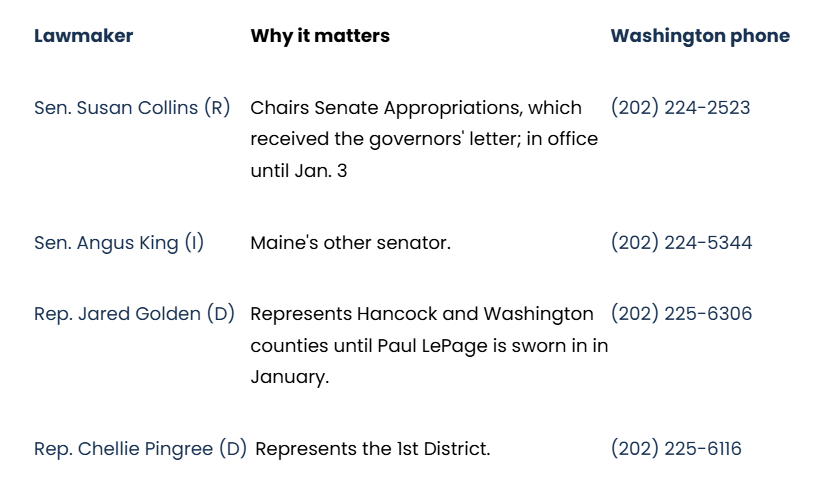
In Augusta, the ask is taking shape now. Governot-elect Hannah Pingree and legislative leaders of both parties are discussing an emergency heating aid bill to pass soon after lawmakers convene in January if Congress doesn't act by year's end. An emergency bill needs a two-thirds vote, so Republican support matters. Incoming House Minority Leader Ken Fredette says his caucus will weigh it once the cost and funding source are known. After the 2022 elections, lawmakers moved a similar package fast, including $40 million for heating aid.
Money alone won’t clear the backlog, Parent said.
“We need to expand the conversation beyond just saying there's more money needed,” he said. For example, Mainers can call their legislators and ask whether proposed assistance packages pay not just for fuel, but for the staff who process applications. Residents’ state senator and representative may be found at Maine.gov's elected officials lookup or the Legislature's senator finder.
-This story is a part of GOOD WORKS, a series featuring non-profit organizations in the peninsula. This series is made possible with the support of The Opportunity Fund.
