

Kneisel Hall launches $4M fundraising campaign
104-year-old concert hall in need of structural repair, accessibility upgrades
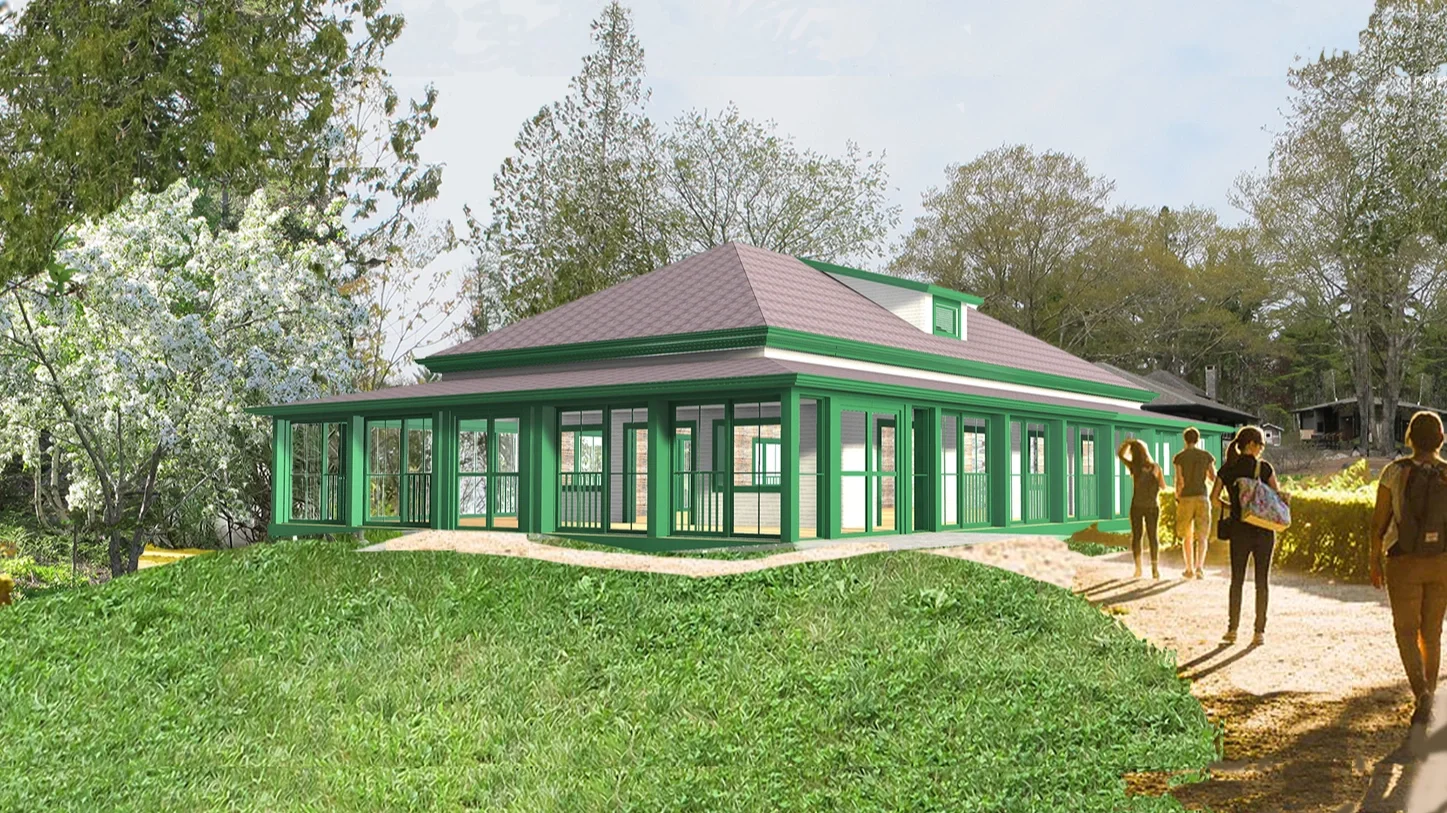
Kneisel Hall was originally built in 1922. In 2024, Maine Preservation listed the hall as one of Maine’s “Most Endangered Historic Places.” The new $4M fundraising campaign will help address structural issues and enhance future concertgoers’ experience. Rendering courtesy of Kneisel Hall Chamber Music School.
June 23, 2026
By Steele Hays
BLUE HILL—Kneisel Hall Chamber Music School has launched a $4 million fundraising campaign to make major improvements to its 104-year-old concert hall, which “has structural issues that must be addressed,” according to executive director Meredith Amado.
If successful, the campaign will allow for improvements that will enhance future concertgoers’ experience in a variety of ways, including:
Added seating. Instead of the current 171 seats, the project will allow for 184 seats, with all seating inside the hall and none outside on the porch.
Easier access to the building. The current porch steps will be eliminated so attendees will be able to enter the hall at ground level through two different doors.
Additional parking. A new 77-space parking area and drop-off lane which will be built to the east of the concert hall, eliminating the uphill climb now required from the parking area.
A quieter heating and cooling system. Currently, the hall’s air conditioning system makes noise and must be turned off during performances.
An expanded stage area. This will enable more musicians to perform together for select performances and allow musicians to walk onto the stage without using steps.
Kneisel Hall, one of Blue Hill’s oldest cultural institutions, is internationally renowned for its visiting teachers, chamber music performances and summer educational program for young musicians.
Amado said that the organization has already received $2.3 million in pledges towards the project.
The organization hopes to have at least $3 million pledged by this fall so that they can sign a construction contract and begin work in September 2027, she said, adding that $1 million of the $4 million goal will go into an endowment.
For Amado and her team, time is of the essence.
Representatives from Kneisel Hall have already interviewed several general contractors and plan to award the job to Wright-Ryan of Portland, she said. The architects for the project are Stahnke and Kitagawa of Brooksville.
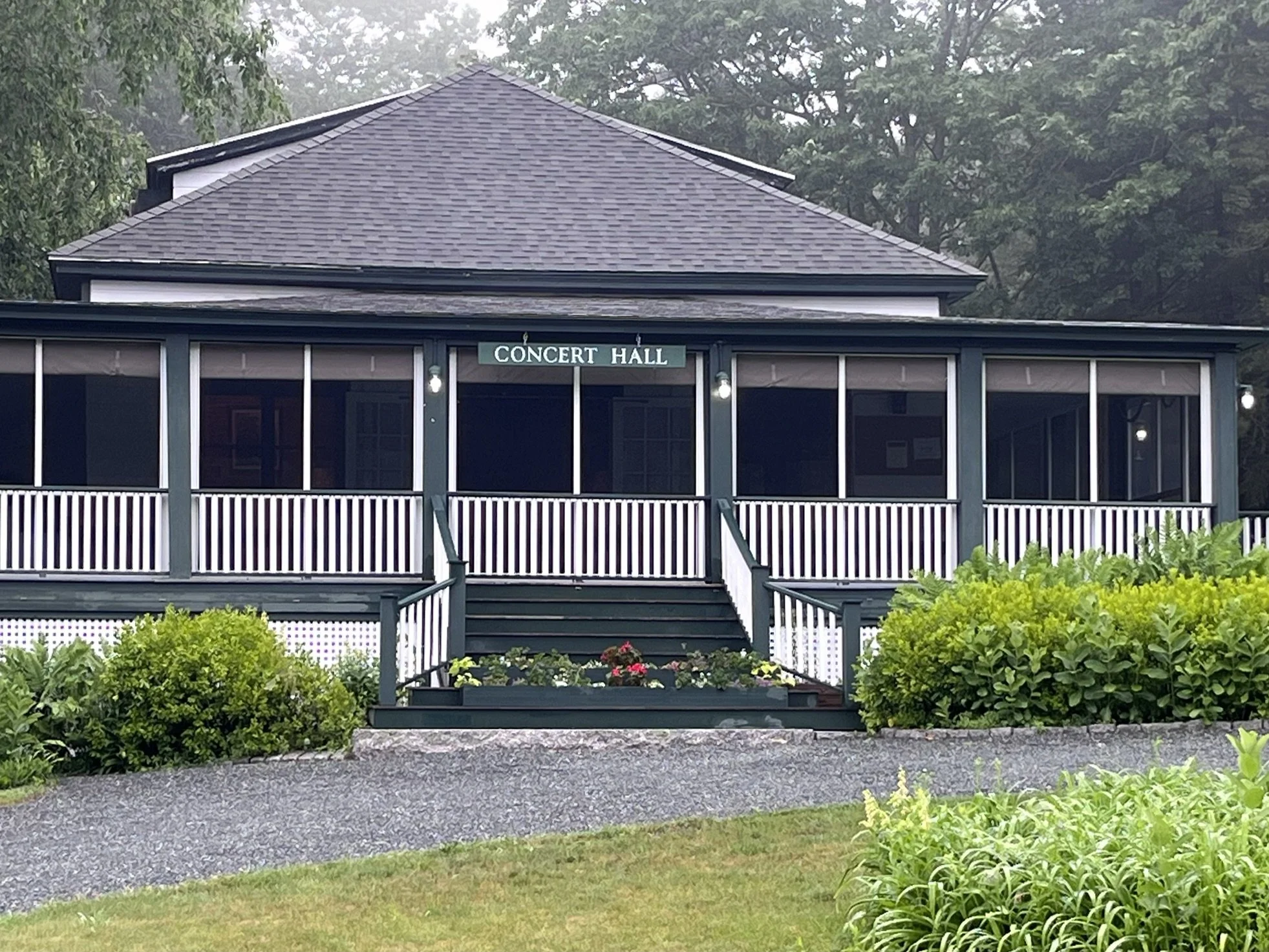
Executive director Meredith Amado said “every effort is being made to keep the look of the building” as close to its original appearance as possible. Photo by Steele Hays.
“All of this is conditional on being able to complete the [construction] work in nine months,” to be ready for opening on the 2028 season on schedule, Amado said. “It’s critical that we not lose a season.”
Founder Franz Kneisel began hosting lessons and performances in his summer home and studio on Parker Point in 1902. By 1922, the school had outgrown Kneisel’s private space and the current concert hall was built. It has remained largely unaltered in the years since but leaders within the organization have long recognized that the hall needs significant renovation work.
In 2024, the hall was listed as one of Maine’s “Most Endangered Historic Places,” according to Maine Preservation, a nonprofit devoted to preservation.
“The building does not have a proper foundation that extends beyond the frost line, the floors slant toward the outer walls, the fireplace does not have a secure foundation, and moisture seeps into the building,” Amado said in a written statement announcing the fundraising campaign.
The planned renovation will include jacking up the concert hall to install a new foundation and then permanently lowering the building and floor level by several feet in order to eliminate the need for concertgoers to climb a set of stairs. The porch will be enlarged and the porch screens will be replaced with all-season windows.
Amado is also planning for the creation of seven handicapped parking spaces that meet ADA standards—there are currently none—and the stabilization of the building's iconic stone fireplace.
An acoustician has been hired to take baseline measurements of the concert hall’s acoustics and make sure that the renovation work does not cause any degradation in sound quality.
“Every effort is being made to keep the look of the building as close as possible to its current appearance,” Amado said in an interview with The Rising Tide.
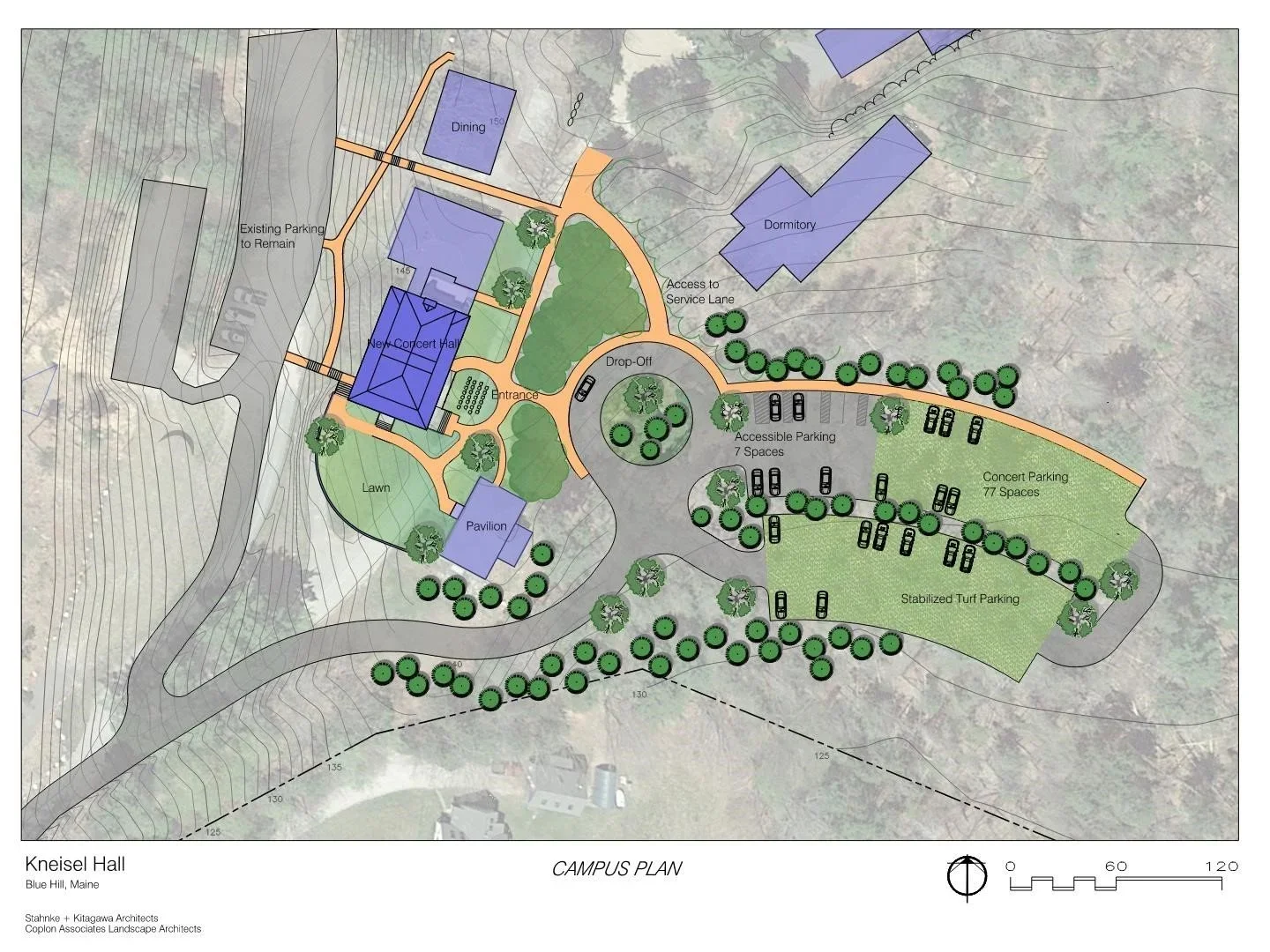
Planned improvements included the addition of ADA compliant entrances, accessible parking, a quieter heating and cooling system and an enlarged performance stage. Rendering courtesy of Kneisel Hall Chamber Music School.
Eliminating the steps onto the performance stage so that musicians can walk directly onto the stage from their entry door will address a long-standing complaint from musicians. The steps have caused a number of performers to stumble or trip and in one instance, a musician fell and badly damaged her cello, Amado said.
Each summer, Kneisel Hall accepts roughly 50 pre-professional young artists—20 violinists, 14 cellists, 9 violists and 7 pianists—for musical training and it hosts more than 50 musical performances open to the public, including Friday evening and Sunday afternoon concerts for nine consecutive weeks. This year’s performance season opens July 3 and concludes on August 30.
Concertgoers attending performances this season will be invited to walk from the concert hall to the adjacent Pavillion Building, which will feature large-scale renderings of the planned building and grounds improvements and information about the capital campaign and how to support it.
Ellen Schwartz Harris and Noël Butcher Hanley, both summer residents of Blue Hill, will serve as the campaign chair and assistant chair, respectively. Both are current board members.
To learn more about the project, visit https://www.secondcentury.kneisel.org/.