

The hunt is on to find the best apples ‘from Bucksport to Stonington’
Nov. 10, 2026
By Steele Hays
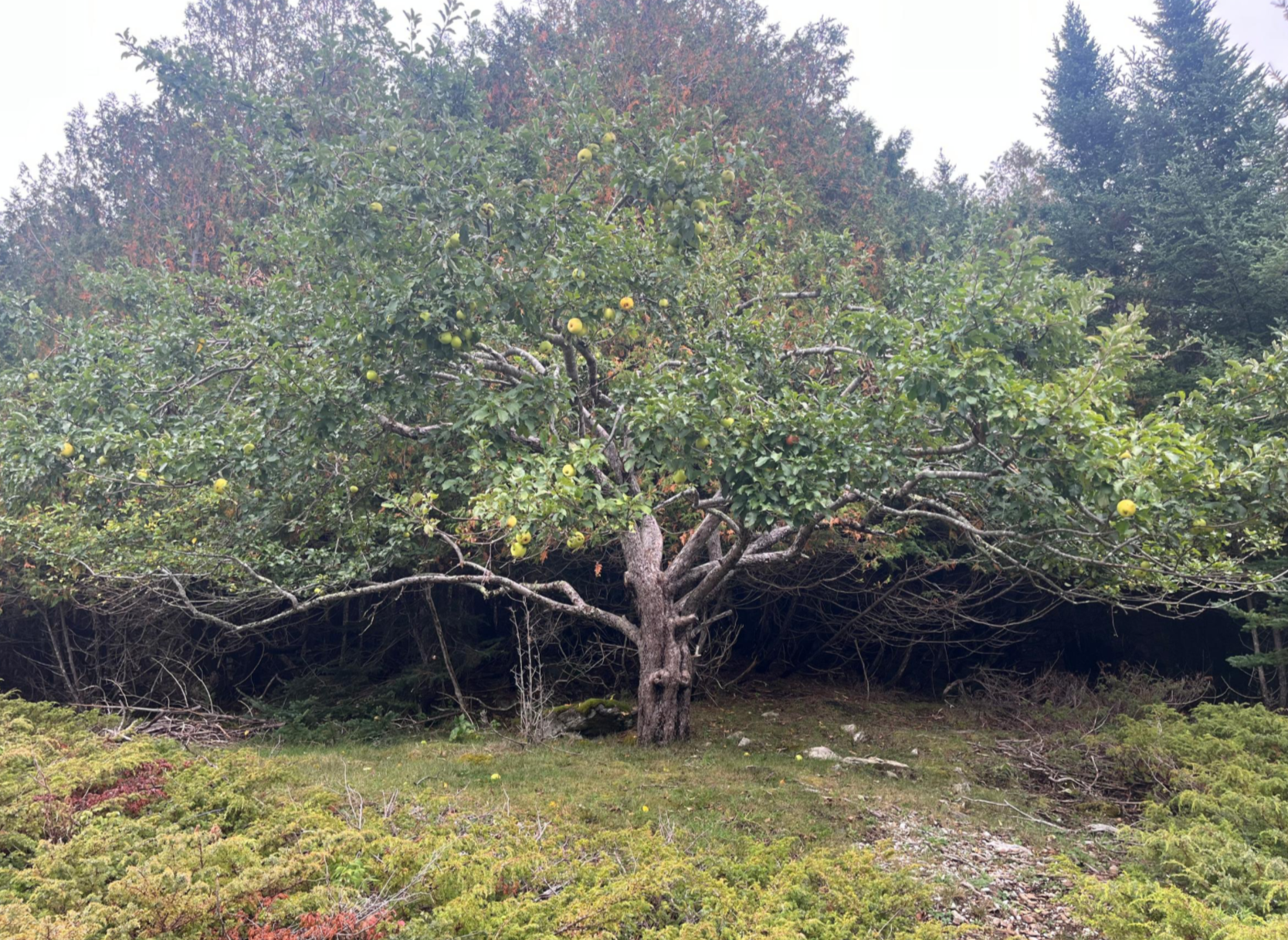
One of Deer Isle’s old apple trees. Photo courtesy of Island Heritage Trust.
The greater Blue Hill Peninsula has recently become an epicenter of scientific research on heritage apple tree varieties and their history. For anyone interested in apple history, this is the place.
One of the groups doing this research is the recently formed Deer Isle Apple Corps, a joint project of the Healthy Island Project and Island Heritage Trust. Jonny Givelber, IHT’s community tree steward and one of the founders of Apple Corps, spoke in a webinar Nov. 5 about the group’s latest work, collecting leaf samples from 28 apple trees on Deer Isle.
The samples have been sent to Washington State University for genetic testing, which will reveal whether each tree is a genetic match of a currently known apple variety, or a unique new variety. The test results should be available by February, Givelber said.
For botanists, historians and apple enthusiasts, one of the most significant new discoveries in decades happened in 2023, when a single apple tree on Verona Island was found to produce a very old French apple variety called Drap d’or de Bretagne (“gold sheet or cloth of Brittany”), which is one of four or five so-called “grandmother” apple varieties from which most modern North American apples have descended. That discovery and its importance were the subject of a recent article in Scientific American.
College of the Atlantic Professor Todd Little-Siebold is also leading a project called the Penobscot River Basin Apple Project, collecting DNA samples from apple trees “from Bucksport to Stonington,” searching for clues into when, where, and how apple trees were cultivated and transported around the area in the 1600s and 1700s.
Little-Siebold worked with Givelber to identify which Deer Isle trees were the best candidates for sampling.
“It’s pretty exciting,” Givelber said in an interview with The Rising Tide. “Some of these trees are probably 150 years old and some of them may have come from early French settlements. Part of it is parentage – if you get an apple that is a child of one of those ‘grandmother’ trees, that could be really exciting. Also, it’s intriguing because we don’t know what varieties we have. There’s definitely more sleuthing to be done.”
The test results on the Deer Isle trees will be added to a permanent database documenting local apple trees and their locations and origins. Givelber also plans to establish a heritage apple orchard on Deer Isle that would be similar to the 350-tree heritage orchard developed by the Maine Organic Growers and Farmers Association in Unity. Givelber has been in discussions with IHT about finding a location for the orchard at one of IHT’s land preserves, but no decision has been made yet.
Anyone interested in having their apple trees tested can contact the lab at Washington State University. A basic test costs $50. A more comprehensive test costs $150.
Givelber’s position with IHT has been funded by the Maine Conservation Corps. It’s a one-year assignment that is coming to an end in the next month, so Givelber is evaluating what will come next for him. Whatever happens, he wants to remain involved with the Deer Isle Apple Corps and to help see that the Corps’ initiatives continue, he said. Givelber said his interest in heritage apples was sparked after he moved to Deer Isle in early 2026.
“I enjoyed apples, but I didn’t think too deeply about them until I got here and started seeing so many apple trees,” he said.
For more information on the history and future of Deer Isle apples, visit a storymap by the Deer Isle Apple Corps.
