

WERU head reflects on decades running a radio station
From volunteer to general manager, Matt Murphy talks about what he’ll miss, the key to the future, and what to do when aliens land
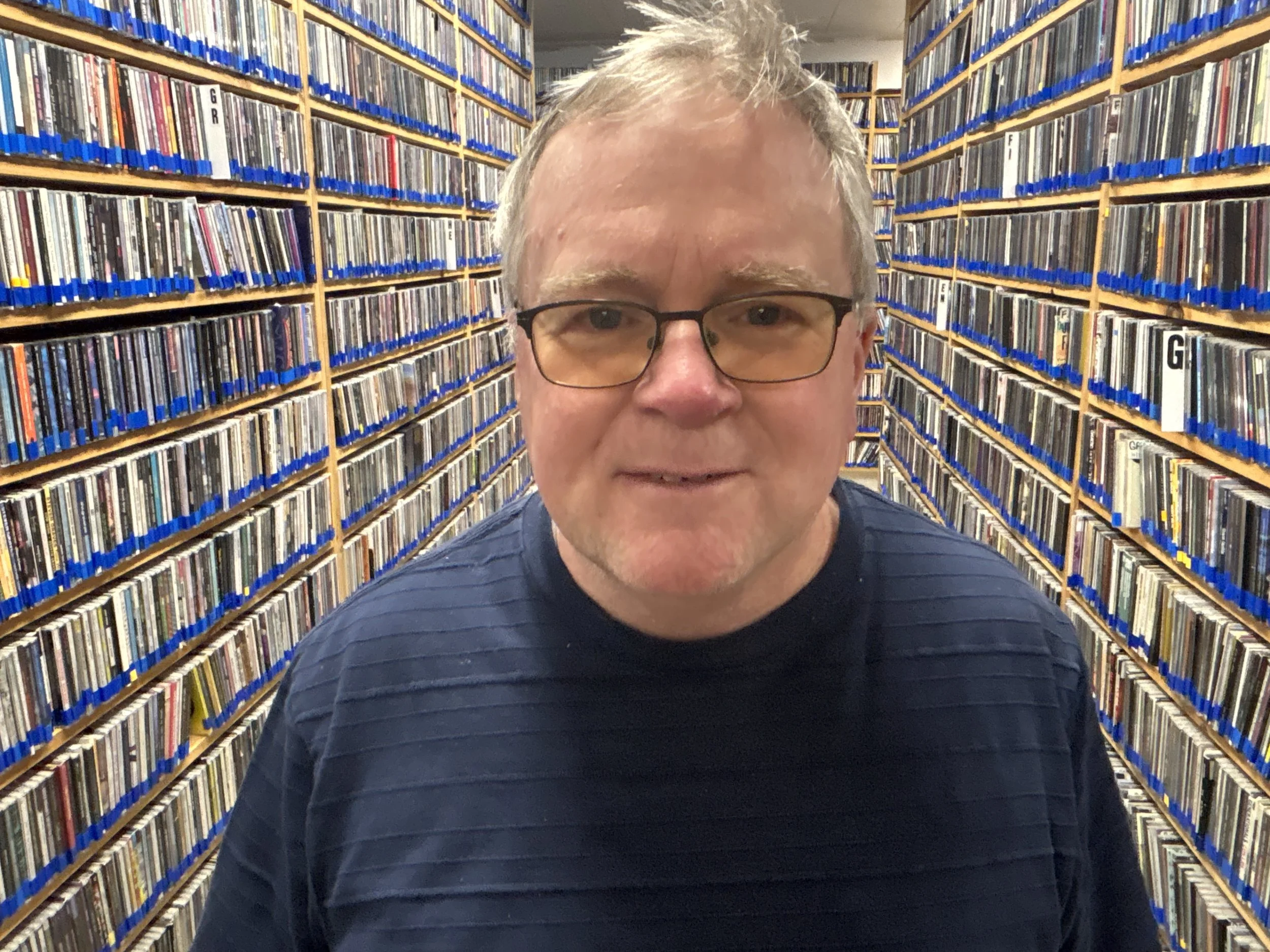
Matt Murphy, surrounded by some of the 70,000 music CDs at WERU’s studios in Orland. Photo by John Boit.
Feb. 24, 2026
ORLAND—Matt Murphy, the longtime general manager of community radio station WERU, has announced his retirement later this year. A Massachusetts native who grew up south of Boston, Murphy attended the University of Maine at Presque Isle. When a job brought him to the Blue Hill Peninsula in the early 1990s, he started as a volunteer working at WERU’s first studio at “The Henhouse,” a converted chicken barn in South Blue Hill owned by musician Noel Paul Stookey. Within a few years, he became general manager of the station.
Now 64 and living in Bucksport, Murphy sat down with Rising Tide editor John Boit to reflect on the decades that shaped his career and the station, which can be heard at 89.9 FM and online. The station, now located in Orland, broadcasts from the top of Blue Hill Mountain.
Over the course of an hour, Murphy discussed his passion for nonprofit community radio and what sets it apart, in an interview interspersed with deadpan humor. His responses have been edited for length and clarity.
How did you first find WERU and what brought you to Blue Hill?
I took a job at Brooklin Boat Yard as a painter and varnisher and drove by the station every day when it was in the Henhouse in South Blue Hill. I’d heard WERU faintly on Route 1A when I visited Acadia, so when I moved here I went in and asked to volunteer.
What was your first volunteer role at the station?
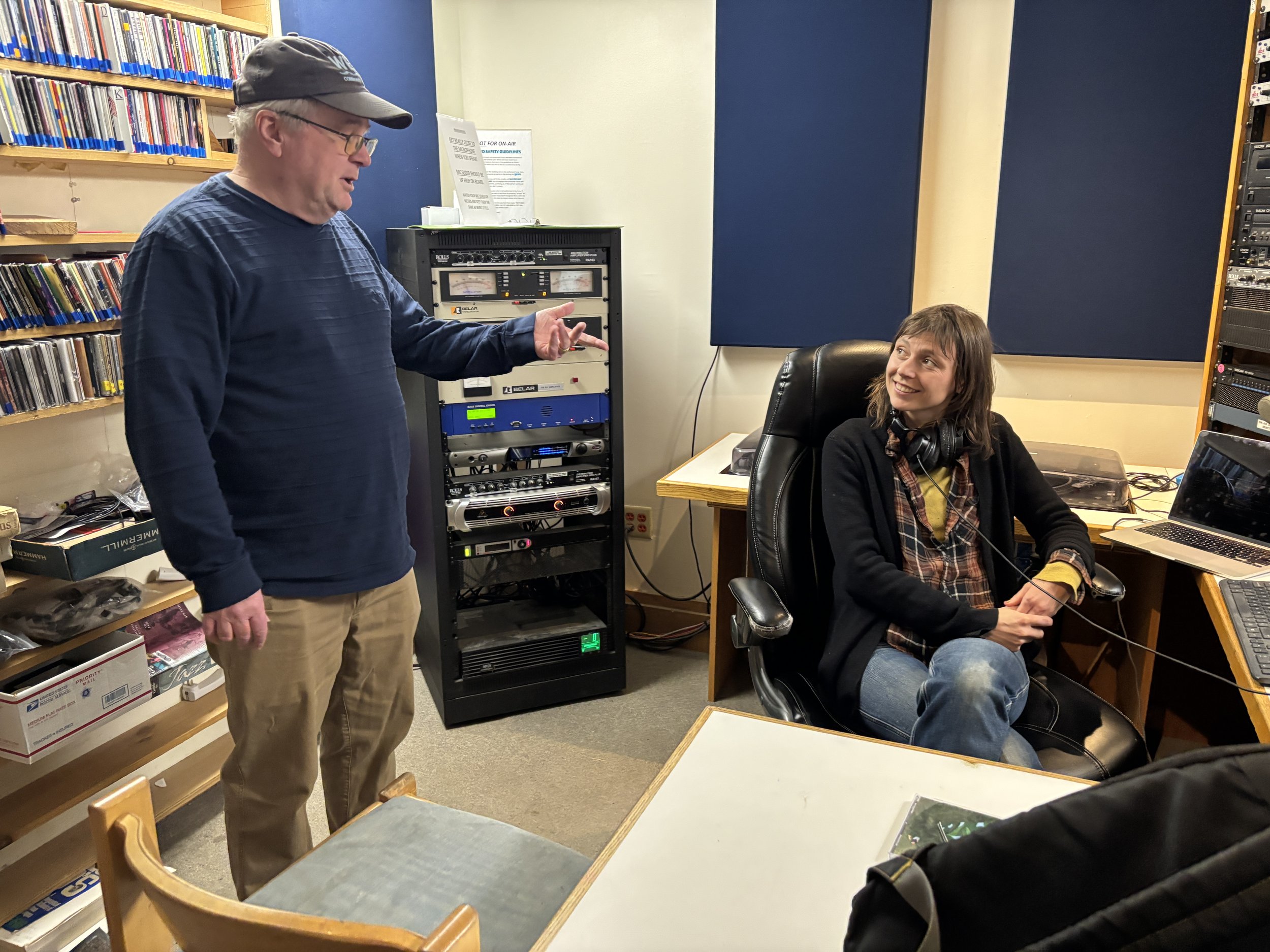
Murphy pops into one of the studios with Zabet NeuCollins, host of the music show “Off the Record.” Photo by John Boit.
Office coverage and answering phones, then I ran our newsletter, Salt Air, a tabloid newspaper. I was the lead volunteer editor of it, working under the development director, and collaborating with a local graphic designer. And so I got other volunteers to write articles about their genre or what it's like to do a show.
How did you go from volunteer to general manager?
A few people encouraged me to throw my hat in the ring, and I got it, with no nonprofit skills. I had some on-air experience, because back in those days, if someone couldn’t make their show, someone had to jump into the seat. I did an hourlong morning show, a folk show called “The Extra Small Folk Show.” I had also been on the board as one of the youngsters on the board. I was dedicated to the station, very friendly, very enthusiastic doing outreach for the station and had learned how to be a DJ and was at least competent at it. I was in my early 30s.
If Martians landed outside the station right now and asked you to explain WERU, what would you say?
First thing I’d do is to size up if they were benevolent actors. If they seemed friendly enough–and they must be interesting, they’re aliens--I’d get them on the air. I'd invite them to come in and be guests on a show and to say, “Hi, I'm Gorp from Venus, and when I'm on Earth, I listen to WERU.” We do a lot of that, getting people who visit the station to record a little promo. What I would tell them is WERU is a noncommercial, nonprofit community radio station that’s listener-supported and volunteer-powered with diverse programming–over a hundred volunteers doing genres from music from Africa to techno from Germany to folk to jazz.
Could someone pitch a speed-metal show and get on the air? Asking for a friend in Penobscot.
Yes. They’d propose it, do the training and record a demo, and then wait for a slot.
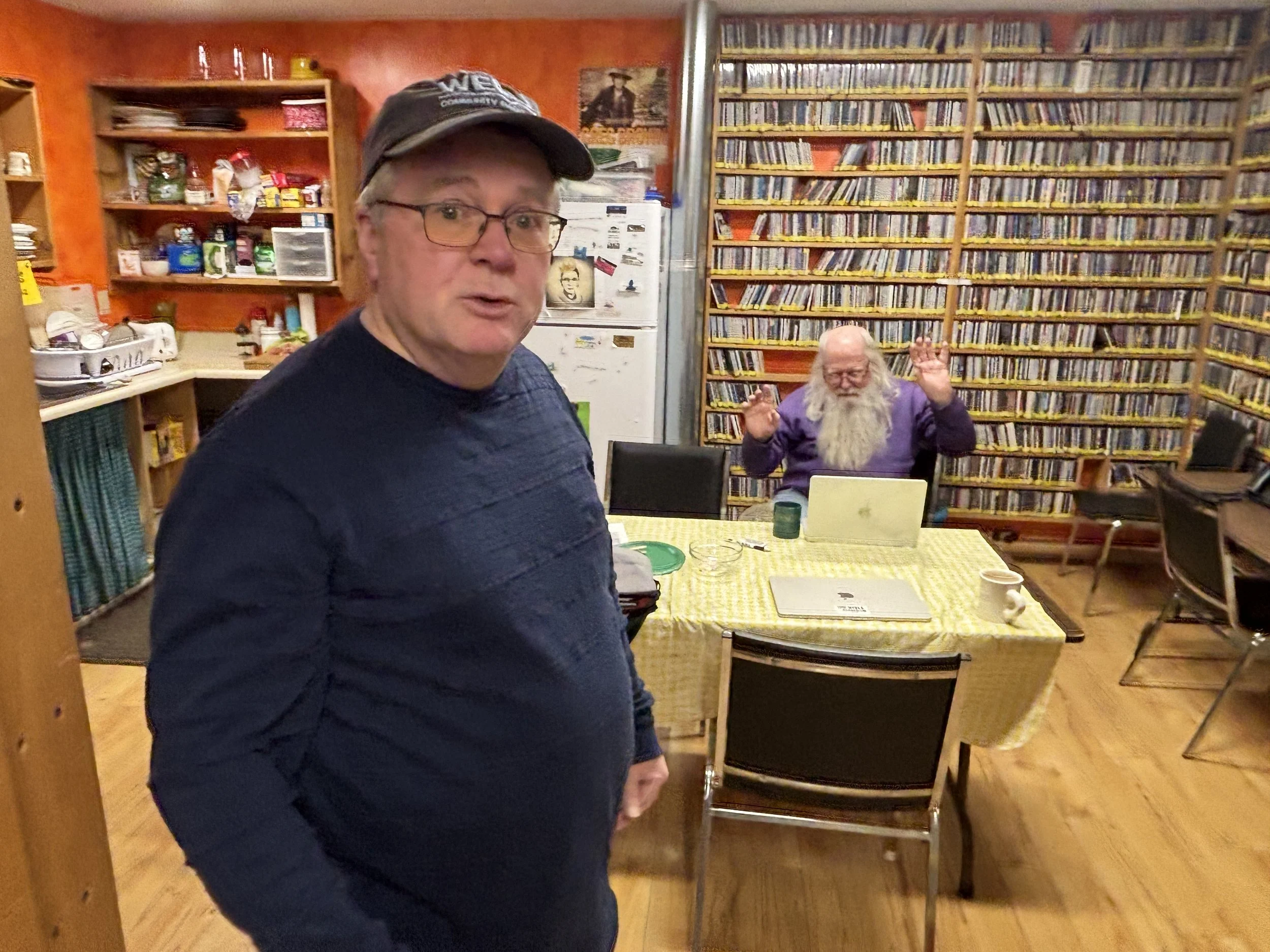
Murphy in the WERU kitchen, while station finance manager tends to a Zoom call. Photo by John Boit.
Do you listen to WERU all the time? What else do you tune into?
Well, back in the day when there were dials on the car radio, I’d tune it in and then rip off the dials. First thing I’d do when I bought a car. But no, I’d also listen to Maine Public and a little bit of the Red Sox and Celtics. I would check out Stephen King’s station, WZON, every now and then. But the buttons on my radio are WERU, Maine Public, and the Red Sox.
How has radio changed?
When I started there was just AM and FM. But people wanted to be not just consumers, but curators. So that’s where community radio came in. Instead of one program director saying “Here’s the bin, and here are the records you can play,” DJs could pick what they wanted to play. So that, content-wise, was extremely important to community radio.
What's the difference between community radio like WERU and an NPR station?
Our business model is to not pay a lot of people, right? They’re doing it for the love of it. Love of community, love of the music, love of the spotlight, love of the people they meet here and their colleagues that they get to know. And I think there are wonderful people at NPR stations like Maine Public who are doing it because they love public broadcasting. But they're professionals and it’s what they do for a living. So that's a really big difference. And both are really valuable.
What’s been the biggest threat to WERU during your tenure?
The biggest threat is forces in Washington that don’t like public broadcasting. Ever since the Corporation for Public Broadcasting was created through legislation in Congress, there have been forces in Congress trying to eliminate it. The funding part has always been under different levels of pressure, and the biggest was under Congress doing what Trump wanted. And the Corporation for Public Broadcasting was disbanded and defunded.
What have been the toughest ongoing challenges?
Fundraising. That’s always been a challenge. But we’ve always been a niche broadcaster, with all this crazy diversity. But the costs of running a radio station have gone up over time. So the financial challenge has always been really big. The other challenge is getting young people involved. We’ve really made a concerted effort to reach out to younger folks. After Covid, more and more younger people have become interested.
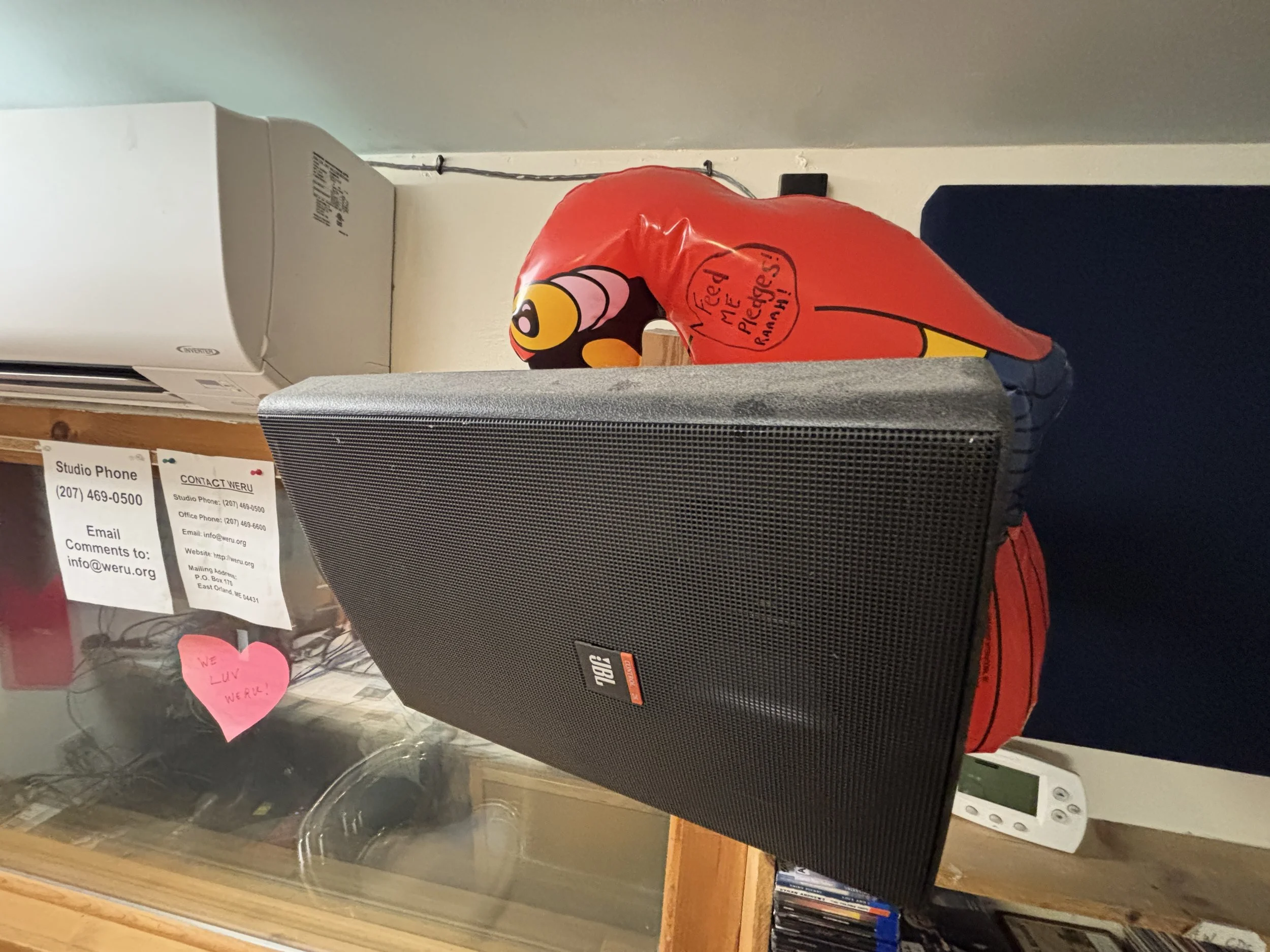
An inflatable parrot perched on a speaker is just one of the myriad eclectic pieces of memorabilia at the station. Photo by John Boit.
What will you miss the least about the job?
There’s always something that breaks. Or someone can’t make their show. Or I get a call at three in the morning when I’m on vacation. So what I’ll miss the least is worrying about things breaking, people leaving, and not enough money being raised.
What will you miss the most?
The people. Being among people who are so passionate about our mission. The camaraderie is so strong.
Got a favorite funny WERU moment?
One of them is a small thing but it cracks me up and I use it in training a lot. We always train people that the first thing you do when you are finished talking is to turn the mic down. So a volunteer played some music and then suddenly there was silence and he said on air, “What have I done?” And then there was more dead air. The charm of mistakes is part of the charm of the station. I’ve made plenty of mistakes. You have to laugh them off and move on.
How does over‑the‑air radio compete with Spotify, podcasts, and streaming?
All those streaming services, we crush them. Our programming is picked by human beings who love curating it and sharing it. If you want an algorithm to pick your music, that’s great. But for the people who want a real human being you can call up during the show and say, “Hey could you play this for me?” Spotify can’t do that. Really we crush them. I’m being a little facetious, but honestly, they can’t do that.
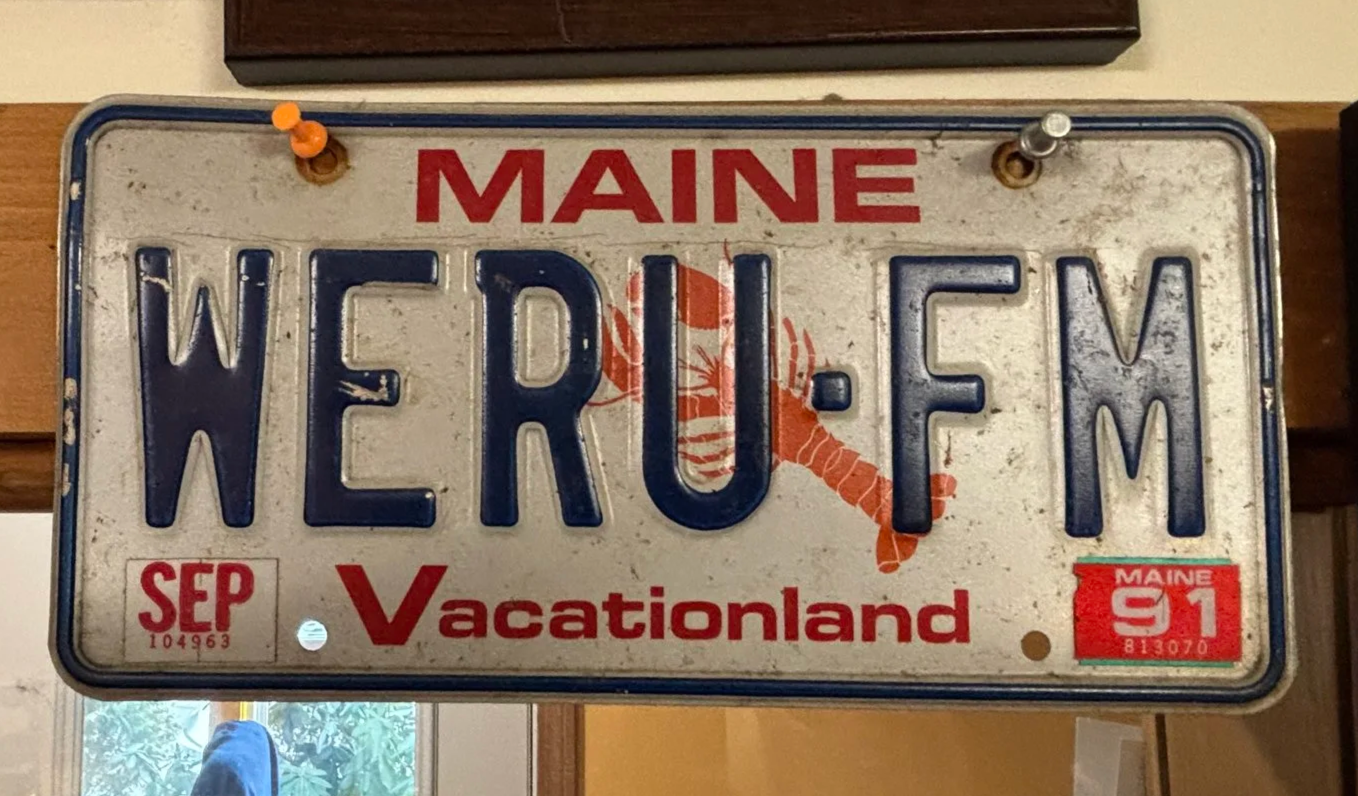
An old license plate hangs in the main studio. Photo by John Boit.
How should WERU evolve in the next decade, and what advice do you have for the next general manager?
Well, venerate your predecessor, of course, right? In the Henhouse, there was a bust of Archbishop Oscar Romero, the martyred theologian from El Salvador. And often it would have different hats on it–a ballcap, a beret. It wouldn't be bad to have a bust of me in the lobby with hats on it. But seriously, one thing is to keep reaching out to young people to keep the station multigenerational. Really concentrate on letting the programming evolve with the mission.
