

Blue Hill woman takes command of 101st Air Refueling Wing in Bangor
Sarah Clapp, a colonel and pilot, now leads the U.S. military’s easternmost airfield
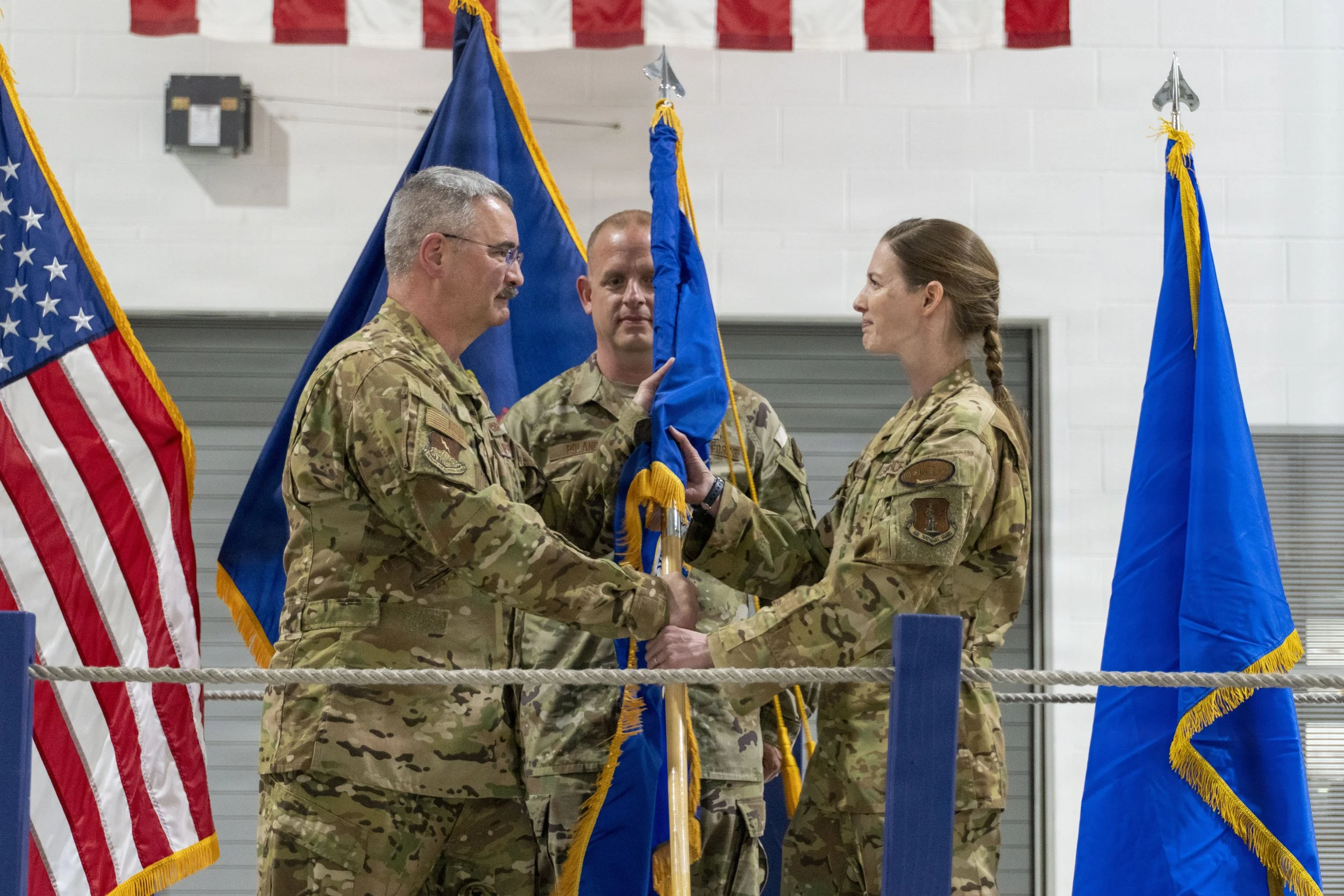
Blue Hill resident Sarah Clapp, right, is the new commander of the 101st Air Refueling Wing in Bangor. All photos courtesy of Sarah Clapp.
June 17, 2026
By John Epstein
BANGOR-When Sarah Clapp of Blue Hill was pursuing a master’s degree, she co-wrote a paper titled, “When the Boss is a Woman.”
Now she’s the boss.
On June 1, Clapp, a graduate of George Stevens Academy and the United States Air Force Academy, assumed leadership of the Air National Guard base in Bangor as Commander of the 101st Air Refueling Wing, known as “the MAINEiacs.” Clapp, who holds the rank of colonel, is the first woman to hold the position.

Clapp was a three-season athlete at George Stevens Academy, playing softball, soccer and basketball.
A decorated Air Force pilot and flight instructor, Clapp, 42, will oversee 1,150 personnel and a fleet of 10 Stratotankers, a mid-air refueling aircraft.
Clapp’s family goes back 10 generations in Maine, with at least seven of those in Blue Hill. Her grandfather and then her father have been operating Clapp’s Tree Farm on Hinckley Ridge Road for decades. Her great grandfather was the head of school of George Stevens Academy.
Clapp’s time at GSA foreshadowed leadership positions for her later in life. An outstanding scholar, she was also a top athlete, and was recently inducted into the school’s Athletic Hall of Fame by virtue of being captain of GSA’s soccer, basketball and softball teams.
“There were certainly better athletes than me that went to George Stevens,” Clapp said in an interview with The Rising Tide at the air base in Bangor, “but I played on some very good teams in five different championship games across three different sports.”
Nominated in 2002 to attend the U.S. Air Force Academy in Colorado Springs, she was a behavioral science major who thought she would teach.
“I went to the Air Force Academy having no intention to fly at all,” Clapp said.
But mid-way through her junior year, she had a discussion with a dean, who was her mentor and doing what Clapp thought she wanted to do -- teach behavioral science. The dean told Clapp that “she loved her career ‘but if I could have been a pilot, I would have been, and you have to understand this is an opportunity that most people never have and you will never have again.’”
Clapp also listened to what her father, Rob Clapp, said.
“He had no military background, but he observed that the pilots really run things in the Air Force,” she said.
So, Clapp decided she’d give flying a try even though she thought it was “not something to dabble in” and meant for people for whom “flying was their life-long dream.”
The training
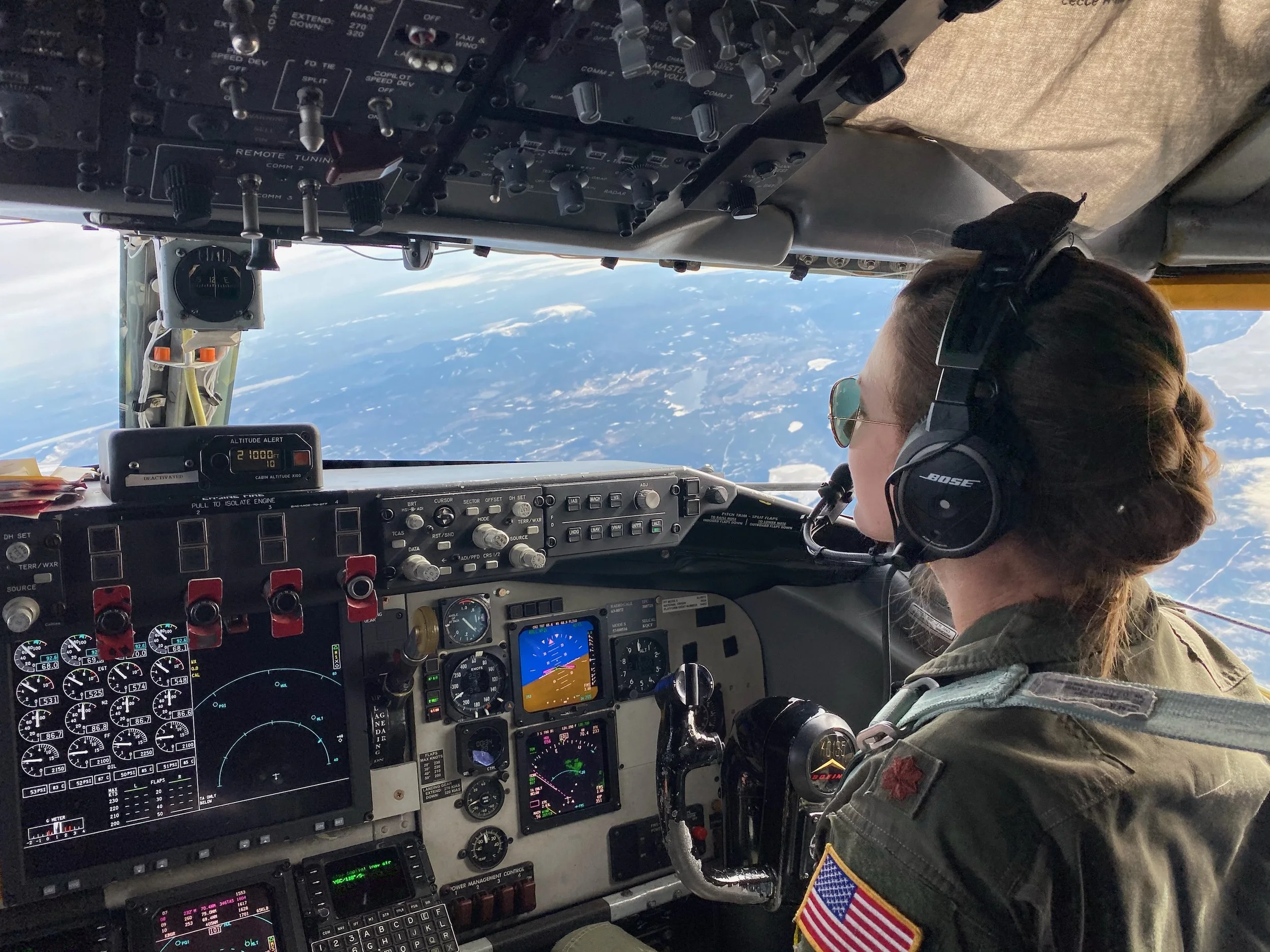
Clapp at the cockpit controls.
Although she grew up on a tree farm, Clapp had no real experience with machinery. Her experience operating complicated equipment came in Air Force pilot training in 2007, right after she obtained a master’s degree in behavioral science from Connecticut College
“When I went to my introductory flight screening program where you learn basic things about aircraft systems and engines, it was a very challenging crash course because I had no prior mechanical inclination,” Clapp explained.
And then there was the air sickness.
“Before I entered pilot training, I had a six-week long introduction to flight – a screening course to see if you have the aptitude to make it through pilot training,” Clapp said. “That was the very first time that I flew and I was very airsick, and almost failed out of that screening program because it’s so quick,” she continued. “You have about 20 hours before you are soloing, and the first 10 hours of it, I didn’t even land the plane because I was throwing up,” she added.
But she made it through screening and then trained for 150 to 200 hours on a T6, a small jet air craft, before moving on to operate the KC-135, a powerful, four-engine plane called the Stratotanker, which refuels fighter jets in mid-air.
“I never considered quitting, but I had a lot of flights where I was very sick,” Clapp said.
But then while piloting a cross-country flight, Clapp received permission to land her plane on the Space Shuttle runway in Florida.
“It was the first time I thought this was a cool job and actually fun,” she said.
Deployments to war zones
Clapp is also a veteran of several combat operations in the Middle East, including Enduring Freedom in Afghanistan and Iraqi Freedom. Her missions involved flying her tanker jet at a high altitude near a combat operation and being on the ready to refuel planes.
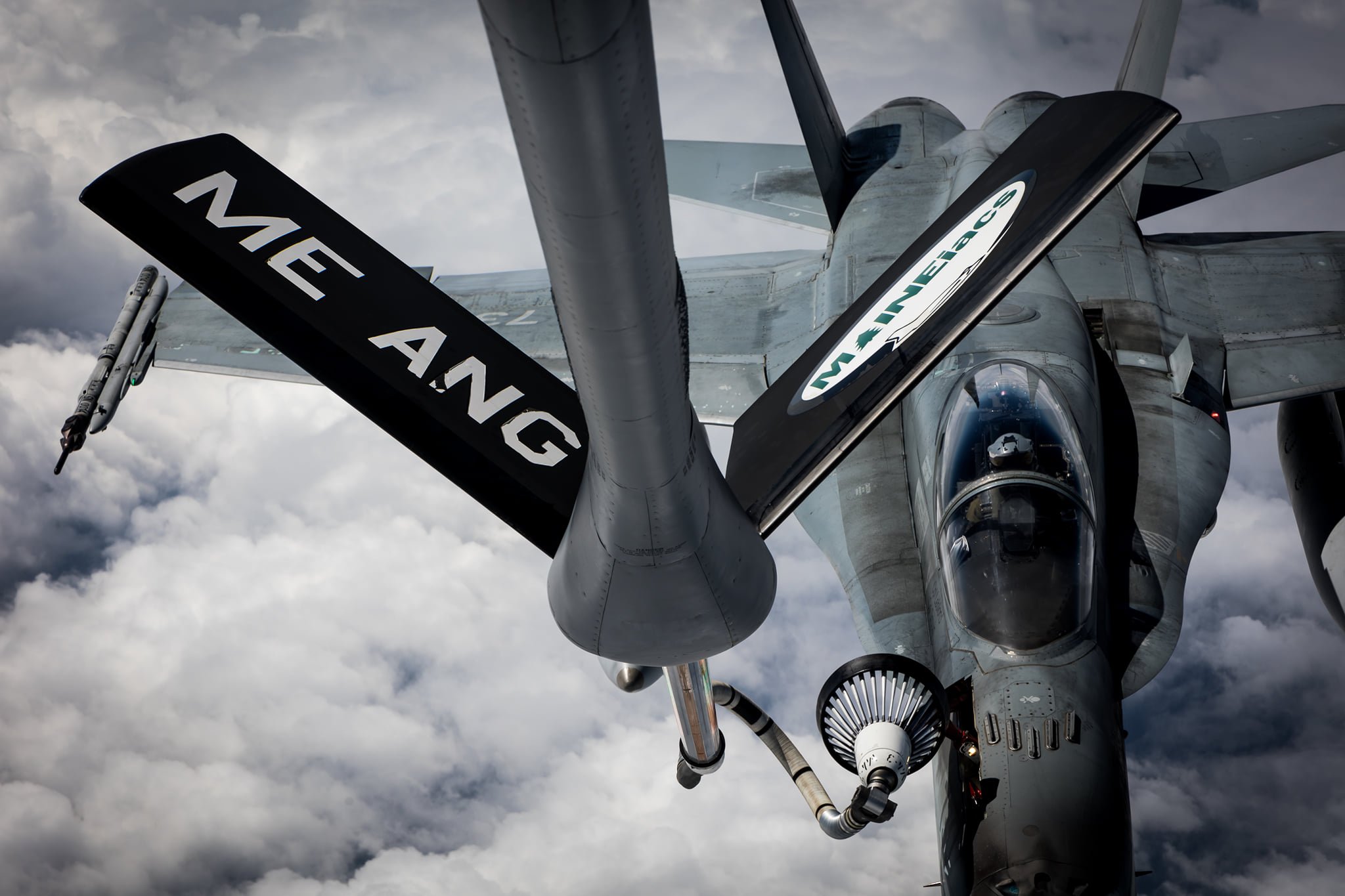
Clapp commands the air wing known as “The MAINEiacs,” which refuel fighter jets like this one mid-air for long missions.
“We would fly usually anywhere from 4 to 11 hours and a lot of flights might be pretty boring,” Clapp said.
The Stratotanker she flew has a three-person crew: a pilot, co-pilot, and a boom operator. The boom operator later takes a prone position at the stern of the aircraft and guides a boom that can extend 48 feet containing the fuel line. That apparatus is then connected with the combat aircraft that approaches the tanker from behind while flying 375 miles an hour.
“Our job is to provide a really stable platform,” said Clapp.
Challenging as that can be, other scenarios proved more dangerous.
Stationed with the Air Force in Japan, Clapp experienced a close call while flying in Thailand and working with a Thai air traffic controller. A miscommunication from the ground during stormy weather resulted in the controller directing her toward a mountain. Her plane’s back-up alert system told Clapp she was heading towards a mountain. She throttled up, climbed quickly, and cleared the mountain.
Ultimately, Clapp flew more than 3,100 hours of flight missions with 1,500 hours in combat.
From Air Force to Maine Air National Guard
After seven years in the Air Force, Clapp stepped away from military service for a few years to start a family with her husband, Lieutenant Colonel David Gribbin, who is also stationed at the Bangor air base. They are the parents of two girls and a boy: Vera, 11; Genevieve 9; and Roark, 5. The family lives in Blue Hill in a house beside Clapp’s Tree Farm.
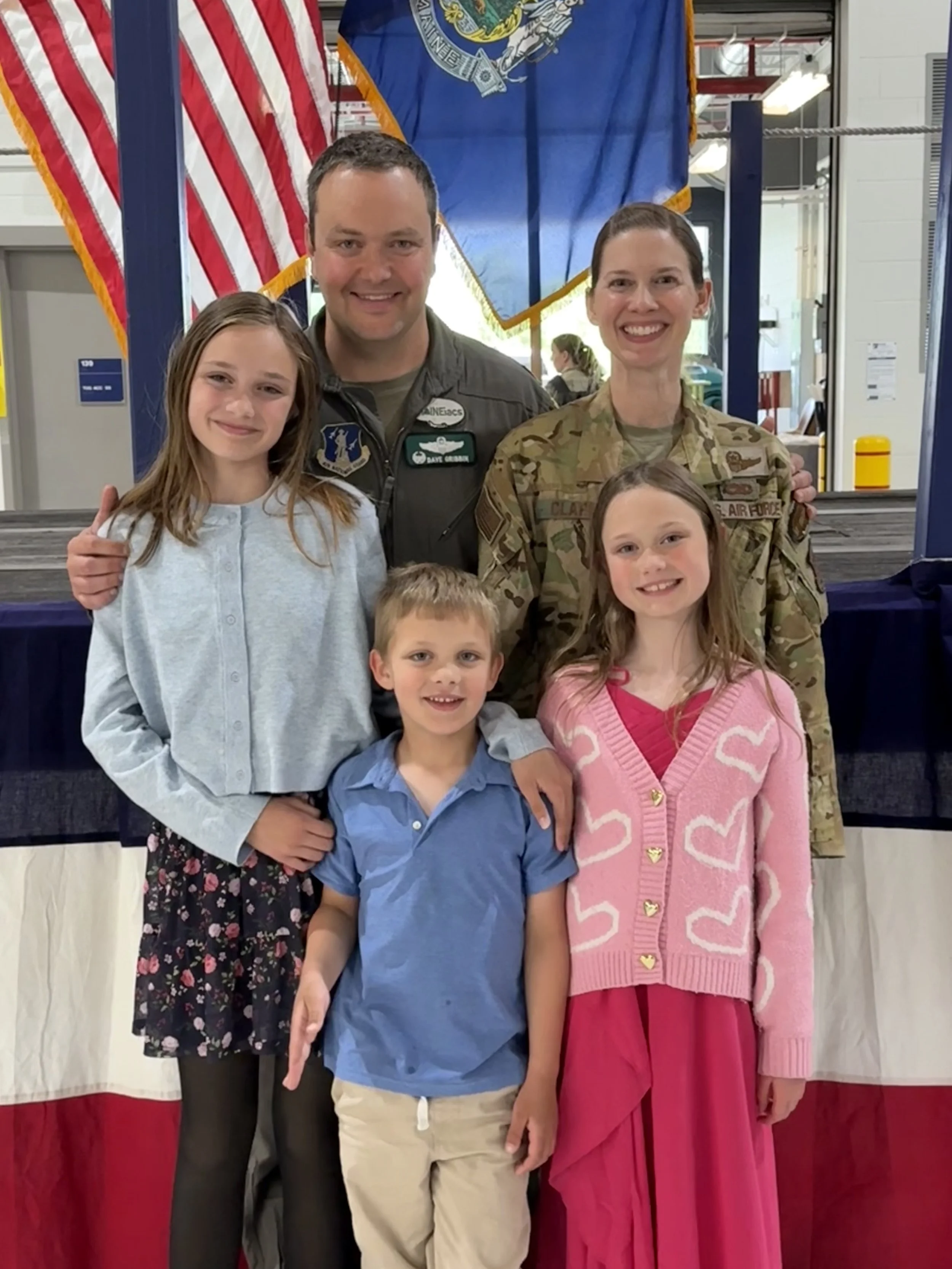
Clapp with her husband, Lieutenant Colonel David Gribbin, and their three children: Vera, Roark and Genevieve.
In October 2021, Clapp took a part-time position with the 101st Air Refueling Wing (or “ARW”) of the Maine Air National Guard in Bangor, nicknamed “the MAINEiacs.”
The base is the easternmost military airfield in the United States and is available for use by all branches of the U.S. military, as well as the nation’s allies. The base also has been called upon by the governor to assist during emergencies.
“We had people that responded throughout the state during Covid and we have hurricane response duties,” Clapp said.
The base’s firefighting unit provides all of the support for the adjacent Bangor International Airport. During the January private jet crash that killed several people at the commercial airport, Clapp said “our firefighters were the first on the scene in less than a minute.”
Clapp served as a commander of the aircraft maintenance squadron part-time for six months and then full-time for two years. In 2024, Clapp was appointed Deputy Commander of the mission support group. Later that year she was made Deputy Commander of the Air Refueling Wing. Throughout this period, she also served as a flight instructor, until June of this year when she was named Commander of the ARW.
Clapp now leads a group of 1,100 air men and women, including her husband, who currently serves under her as a squadron commander. Clapp says he will be transitioning out to avoid a conflict of interest.
The commander of the ARW must be a pilot, but Clapp noted that her experience commanding the various squadrons has given her a great overall understanding of how the base works.
When she was offered the leadership position by the Adjutant General’s Office at Maine National Guard headquarters in Augusta, Clapp said there was no discussion of gender at all. “They just said this position is open. We’d like you to take it, to go for it.”
‘When the Boss is a Woman’
Perhaps presciently, while obtaining a master’s degree in social psychology at Connecticut College, Clapp co-wrote an academic paper titled “When the Boss is a Woman,” with a subtitle of “The Psychology of Women at Work: Challenges and Solutions for our Female Workforce.”
“The big takeaway that I have, that really has stayed with me throughout my whole career, was understanding that men and women lead differently and have access to different tools because of different expectations throughout society,” Clapp said.
She said her research gave her an understanding of the different styles of leadership.
Col. Clapp, who had never flown on a plane before flight school, shares with The Rising Tide her challenges—and overcoming those obstacles—on a career path that has led her to becoming the commander of the 101st Air Refueling Wing in Bangor, known as “The MAINEiacs.” Video by John Epstein.
“It was very important for me to understand that men and women can be equally successful in leadership, but they just have access to different tool sets,” she said.
In the military, she said, direct communication and assertiveness is valued, something that can be “incongruent with the way people see the role of women generally, stereotypically, where people expect women to be softer, more relational, less direct, less ambitious.”
“Women often find themselves in leadership situations where they can choose either to be seen as competent or being a good woman conforming to the stereotypical gender role. And that’s a conflict there for women that isn’t there for men. So that’s a challenge,” she said.
“The other really important piece for me was recognizing that while gender bias exists in many different circumstances throughout society, and sometimes I’ve encountered it throughout my career, the average person doesn’t intentionally hold me back. The average person isn’t wishing me to fail or wishing me ill.”
