

Surry voters nix causeway funding, GSA tuition request
Voters approve road improvements, emergency services, and administrative costs
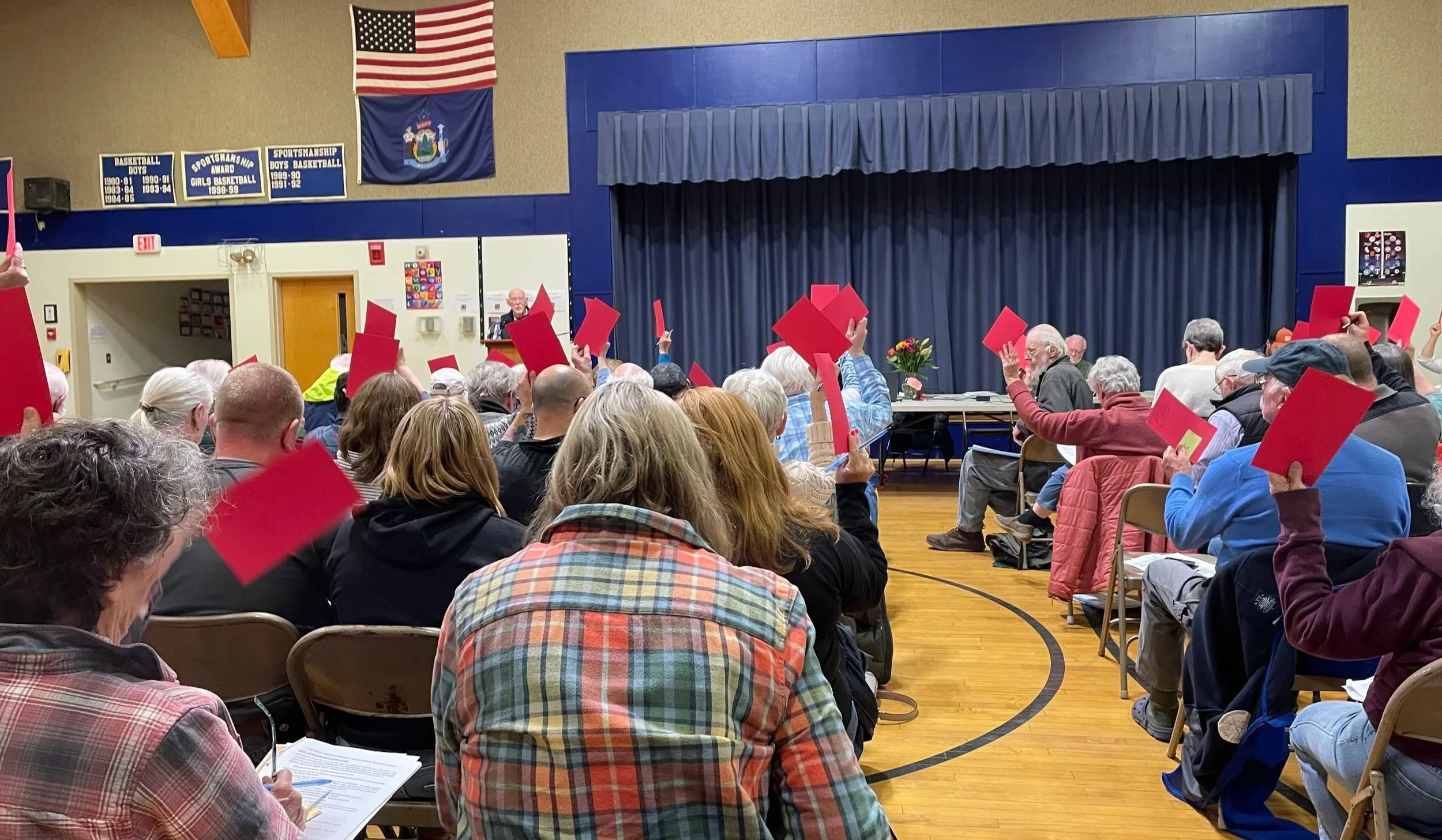
Voters hold up red cards to approve a warrant article at Surry's annual town meeting at the Surry Elementary School on April 13. More than 100 residents attended the annual meeting, which followed municipal elections on April 10. Photo by Tricia Thomas.
April 14, 2026
By Tricia Thomas
SURRY—Voters in Surry’s municipal election on April 10 rejected a plan to raise a portion of Newbury Neck Road to protect it from future flooding and nixed a request for supplemental tuition from George Stevens Academy. More than 100 Surry voters again convened for an annual town meeting on April 13, approving $3.8 million in school costs and more than $2 million in municipal funding for the year.
Residents voted 240 to 178 to eschew $2.9 million in pending federal funding for the Newbury Neck Peninsula Storm Evacuation Project, and told the town select board, by a vote of 237 to 178, that it should not commit to a 25-percent match of the funding. A third vote on the project, which would have authorized the town to seek construction bids, was rejected 250 to 163.
The project, designed by Sevee & Maher Engineers and estimated to cost a total of nearly $3.7 million, would have raised the roadway near Carrying Place Beach from nearly 9 to 15 feet above sea level to protect it from flooding. Historically vulnerable to flooding, the area was hit hard by winter storms in 2023 and 2024, which submerged the road and cut off 140 homes south of the beach from the narrow peninsula’s only evacuation route.
At public hearings before the vote, Surry firefighters told residents that raising the roadway would protect both residents and first responders. Some residents, including a handful who live south of the beach on the 10-mile road, objected to the plan at those meetings, citing the high cost and aesthetic impacts of the raised roadway and required guardrails.
Voters on April 10 also turned down a request from George Stevens Academy to pay a total of $32,130—or $1,530 per student for 21 students—in supplemental tuition to cover enrollment and budget shortfalls. This is the seventh consecutive year that GSA has made the request of sending towns, and the first year that Surry voters have rejected it. Surry’s select board and finance committee had recommended that voters pass the request, while Surry’s school board had recommended a “no” vote.
Former school board member Nicholas Noddin was elected to a seat on the three-member select board on April 10, defeating William Booth by a vote of 261 to 116. Noddin will fill a seat formerly held by outgoing select board chair Mary Allen. In addition, Jared Benner and Patrick Shepard were elected to two open seats on the school board.
Allen, who was thanked for her service with flowers and applause at the start of the April 13 town meeting, reported the results of the election to residents at the town hall meeting, but did not comment on voters’ decisions.
During the two-hour meeting, more than 100 residents approved, with little discussion, a total of 15 warrant articles that comprise Surry’s $4 million school budget for the 2026-2027 fiscal year. Superintendent Derek Perkins told meeting attendees that the biggest increases over last year’s budget were in salaries and benefits.
“This was a contract year for teachers, so new salaries were put into place that will go into effect next year, as bargained by the MEA [Maine Education Association] and the school committee. That’s one factor. [For] health insurance, we predicted for this budget a 12-percent increase and, hopefully, we’re under that amount,” Perkins said.
Perkins also attributed the budget increase to a spike in the number of Surry students attending high school and rising costs of that secondary education. While 13 Surry students will graduate high school this June, 19 will enter high school as freshmen in September, Perkins said.
“The big driver is, we had a $192,000 increase in secondary ed tuition,” he said. “We have 19 eighth-graders that are going to be going off to high school. Most of those kids are going to Ellsworth [High School]. Ellsworth’s tuition is just under $16,000 a year. They’re one of the most expensive. At least in Hancock County, for a public high school, they’re one of the more expensive tuitions.”
“I have absolutely no control over what they charge and neither, believe it or not, does Ellsworth High School or the Ellsworth school department. The State of Maine sets tuition,” Perkins added.
When asked how the GSA vote would affect Surry students, Perkins said he was unsure, but surmised that Surry students would not be barred from attending the private, Blue Hill school. Penobscot voters also recently scuttled the request, and GSA has said it will seek donations to cover the cost of Penobscot’s share of the supplemental tuition.
“George Stevens is going to take the kids. That’s not an issue. They need to figure out, for their budget, how they’re going to make up for that lost amount of money. That’s not anything that I can decide for them,” Perkins said of GSA response to the Penobscot vote. “But, what they have shared…is they’re going to try to get donors to try to make up that difference. They’re not going to put that on parents. That’s what they said about Penobscot.”
“Things have changed, obviously, [with the vote in Surry],” Perkins continued. “I haven’t had an opportunity to talk with anyone directly from George Stevens, but they’ve been pretty clear—they want our kids still. They’re just trying to figure out a budget with less funds than they were hoping to have.”
A GSA spokesperson did not respond to emailed questions on the matter.
After voting on education costs, residents at the town meeting approved, by shows of hands and little discussion, a spate of articles to fund town operations. Approved expenditures included $615,937 in town administration costs—$387,047 of which will be raised through taxes, and $572,707 for road improvements—with only $13,707 of that to be raised through taxes. Additional warrant articles okayed at the meeting include spending $202,550 for emergency services, $161,897 toward long-term debt, and $164,000 for town’s match—with only $4,000 coming from taxes—toward the planned purchase of a new fire truck.
Finally, voters overwhelmingly approved the repeal of a 1972 ordinance that outlawed certain type of public events—namely large music festivals. According to resident Mark Baldwin, who rose to provide a brief history of the ordinance before its repeal, the now-outdated law was put into place over fears that Surry could be forced into “another Woodstock.”
Select board member Chris Stark told the audience that the repeal of the old ordinance gives Surry a chance to create a new, more updated one in the future.
