

See how peninsula towns voted in Tuesday’s races, from U.S. Senate to sheriff to state rep
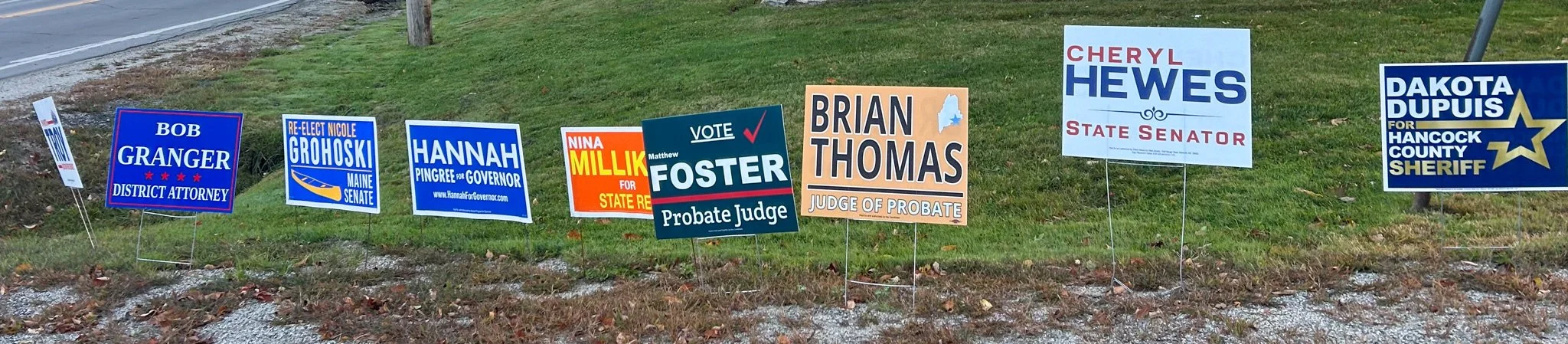
Political endorsement signs will soon begin to fade from roadsides. Photo by Maizy Weirich.
Nov. 4, 2026
By Maizy Weirch, John Epstein, Hank Austin and Steele Hays
The Rising Tide compiled the voting tallies of each town in our coverage area from Tuesday’s election, including Blue Hill, Brooklin, Brooksville, Bucksport, Castine, Deer Isle, Penobscot, Sedgwick, Stonington, Surry and Orland.
Maine voters have elected Troy Jackson for Senate and Hannah Pingree for Governor, while the seat for the next U.S. representative of Maine’s 2nd Congressional District is still up in the air. Some votes across the county and state have yet to be counted, but The Rising Tide has all the information on how those across the Blue Hill Peninsula cast their ballot.
Be sure to also check out what was on voters’ minds on election day.
Here are quick snapshots of key races.
Across the entire state, Jackson received 53.6 percent of the votes compared to Susan Collin’s 46.3 percent, according to NPR. The Blue Hill Peninsula shared a similar outcome, with only two of the towns, Bucksport and Orland, voting for Collins as the majority. Here, Jackson received 57.8 percent of votes.
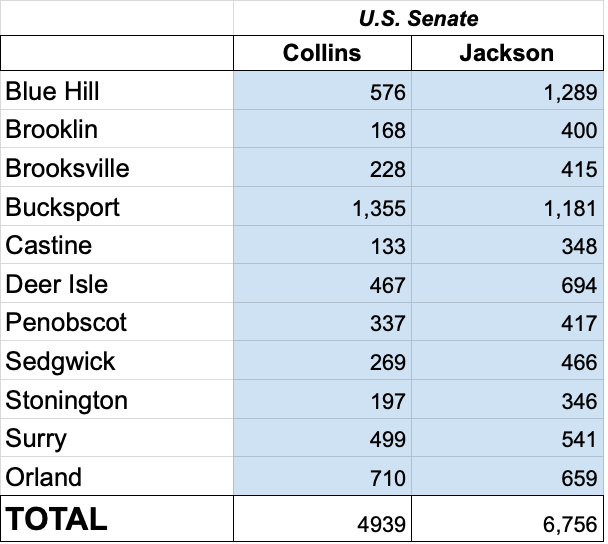
Total votes for the Senate on the Blue Hill Peninsula. Graphic by The Rising Tide.
The winner of Maine’s 2nd Congressional District is yet to be determined. Paul LePage, a Republican, and Matt Dunlap, a Democrat, are in a close race, but results are in on the Blue Hill Peninsula: LePage received roughly 36 percent of the votes, while Dunlap received 64 percent. Each town on the peninsula heavily favored Dunlap, although Dunlap had a close race in Orland, where he won by just 69 votes.
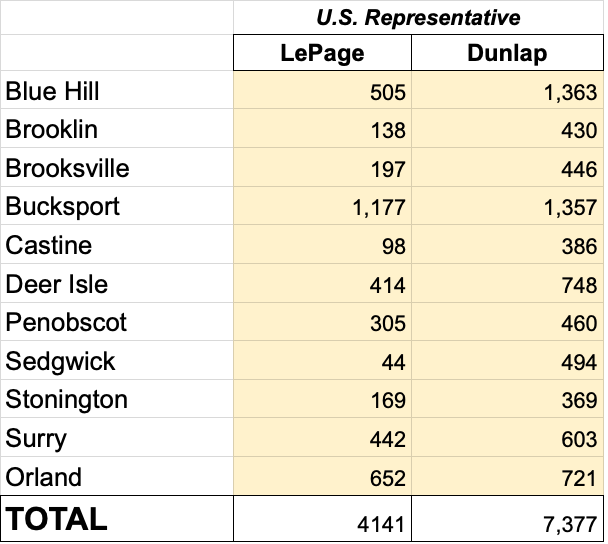
Total votes for the U.S. Representative on the Blue Hill Peninsula. Graphic by The Rising Tide.
Democratic candidate Hannah Pingree defeated Republican Bobby Charles and independent Rick Bennett to win Maine’s governor’s race with 55.2 percent of the statewide vote. On the peninsula, Pingree held a strong majority in all towns, receiving 59.7 percent of total votes.
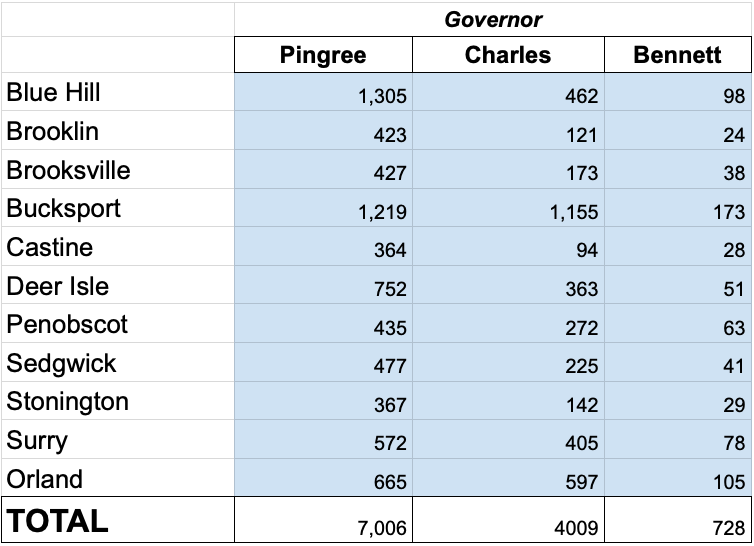
Total votes for Governor on the Blue Hill Peninsula. Graphic by The Rising Tide.
Corey Bagley, currently a detective with the Ellsworth Police Department and the Republican candidate for sheriff in Hancock County, has defeated his Democratic opponent, Dakota Dupuis, a lieutenant in the Hancock County Sheriff’s Office.
In a telephone interview with The Rising Tide on Wednesday morning, Bagley said, “I’m honored and humbled by the overwhelming support I received from voters. Dakota reached out to me last night to congratulate me, and we agreed to meet and talk about the future. I told him that we need to put the past behind us, get to work, and move forward for what is best for Hancock County.”
According to the Bangor Daily News, Bagley had close to a 3,000-vote margin on Dupuis. The race on the peninsula, however, was much narrower. Bagley received 50.55 percent of the vote, while Dupuis recieved 49.45 percent of the vote.
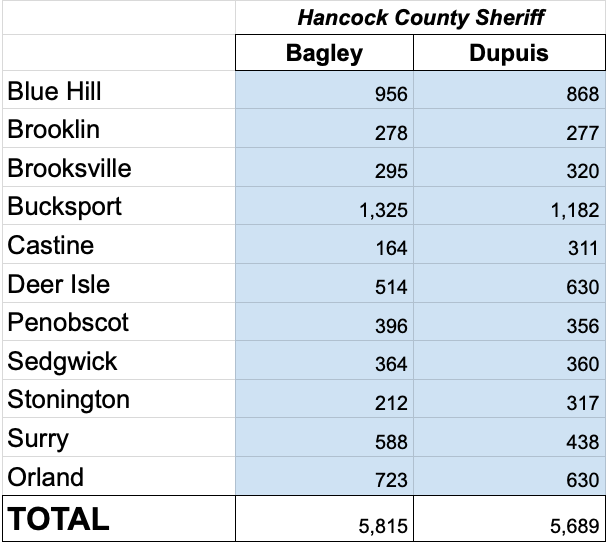
Total votes for the Hancock County Sheriff on the Blue Hill Peninsula. Graphic by The Rising Tide.
Incumbent Bob Granger has been reelected to serve as Washington and Hancock County’s District Attorney, winning handily over opponent Steven Juskewitch. According to the BDN, “Granger had 22,806 [unofficial] votes to Juskewitch’s 7,283 as of 11 a.m.” The gap was even larger here on the peninsula, with Juskewitch receiving only 20 percent of the votes.
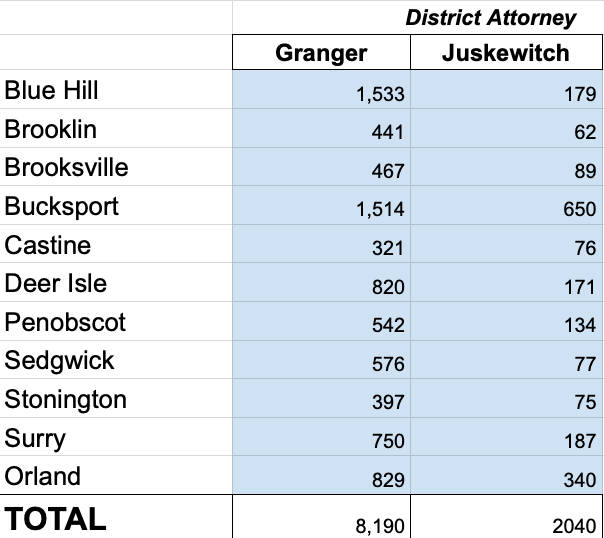
Total votes for the District Attorney on the Blue Hill Peninsula. Graphic by The Rising Tide.
A winner in the race for Hancock County’s Probate Judge has still not officially been announced; however, Brian Thomas, a Democrat, is leading former District Attorney Matthew Foster, a Republican, by 3,000 votes according to the BDN, with 34 of 37 towns having reported their results. Thomas had a strong lead within the Peninsula, securing 57.3 percent of the votes over Foster.
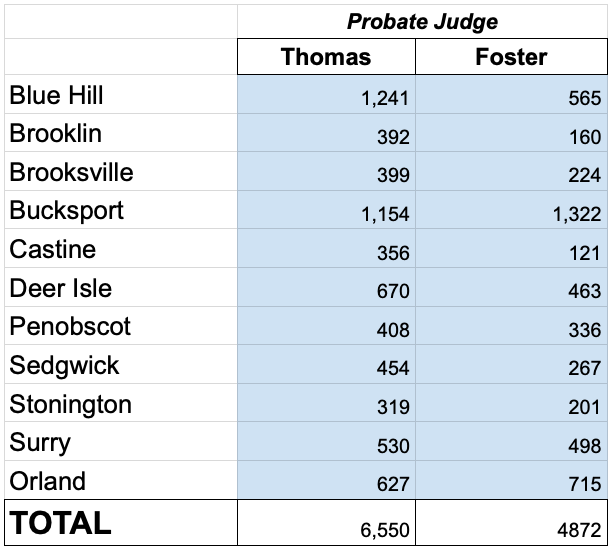
Total votes for the Hancock County’s Probate Judge on the Blue Hill Peninsula. Graphic by The Rising Tide.
Incumbent Nicole Grohoski was reelected as State Senator for District 7, defeating opponent Cheryl Hewes with a vote of 14,382 to 7,912 across all of Hancock County, according to The Ellsworth American. Within the Blue Hill Peninsula, Grohoski won 64.4 percent of the votes, compared to Hewes’ 35.6 percent.
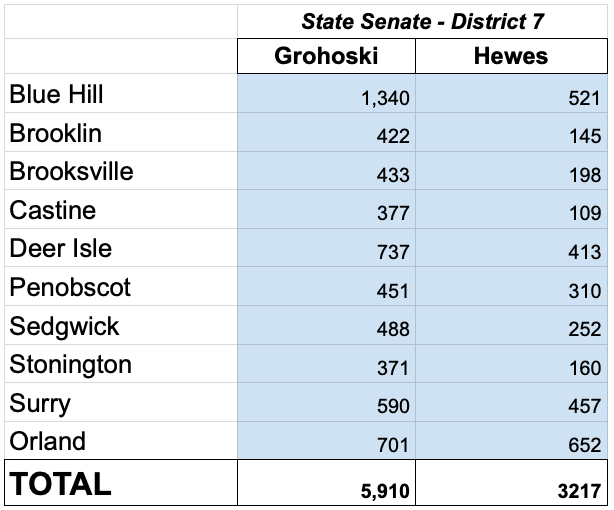
Total votes for the State Senate, District 7, on the Blue Hill Peninsula. Graphic by The Rising Tide.
Incumbent Holly Eaton has been reelected as State Representative for District 15. Eaton received 78 percent of the votes on the Blue Hill Peninsula against opponent Clifford Noyes.
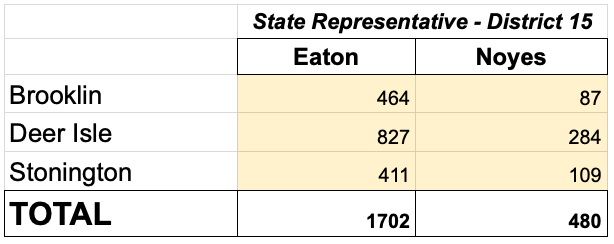
Total votes for the State Representative, District 15, on the Blue Hill Peninsula. Graphic by The Rising Tide.
Nina Milliken won against opponent Eric White for State Representative for District 16. Milliken received 67.5 percent of the votes on the Blue Hill Peninsula.
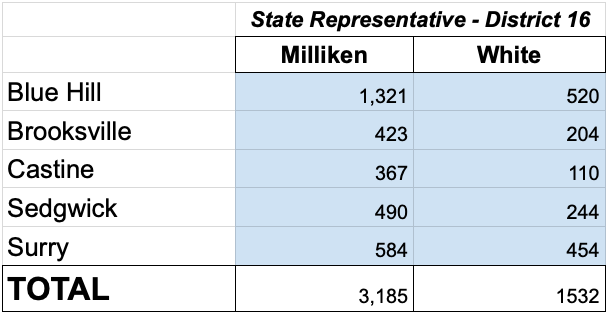
Total votes for the State Representative, District 16, on the Blue Hill Peninsula. Graphic by The Rising Tide.
Steve Bishop hung onto his seat as state representative against Ron Russell in a race decided by about 100 votes.
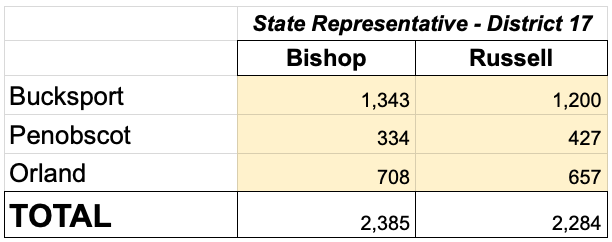
Total votes for the State Representative, District 17, on the Blue Hill Peninsula. Graphic by The Rising Tide.
Nothing marks the end of a pivotal midterm election like the end of campaign advertisements.
Local U.S. Postal Service employees said they breathed a sigh of relief that the election was over and said they expected the torrent of paid political advertising mail to slow to a trickle.
"All the carriers are happy and all the customers have been saying how happy they are that it's over," said USPS employee Tony Henriquez of the Blue Hill Post Office. "This was my second election and this year was significantly heavier than two years ago."
On several recent days, the station's three recycling bins have been overflowing by the end of the day after postal customers have discarded their political flyers and brochures before leaving the post office. The volume was so heavy that the USPS processing plant in Hampden reached its maximum capacity and officials directed local postmasters to hold their recycling for several days and not transport it to the plant, Henriquez said.
