

Still ‘burnin’ rubbah’ after all these years
Catching up with the Deer Isle man who became famous for his tire-burning prowess 20 years ago

Chug Proper, featured in Tire Tracks, still works on and fixes up cars. His newest ‘burning machine’ is undergoing repairs using parts from his old green Chevy Malibu. Photo by Maizy Weirich.
Sept. 2, 2026
By Maizy Weirich
Twenty years ago, a local documentary film, Tire Tracks, highlighted a controversial yet common pastime among some Deer Isle-Stonington residents.
It was all about “burnin rubbah.”
The film documented several residents who enjoyed laying down patches of burnt rubber from squealing tires along roads, and gave voice to local culture on the island. It also reflected a class and social divide in the community because of opposition, often from seasonal residents, to burning rubber.
The main subject of the film was Chug Proper, a Deer Isle resident who lives on Greenlaw District Road. Proper is seen throughout the film burning rubber in a cloud of smoke with his “burning machine,” a 1984 white Chevy van with flames on the side.
“I had a green Malibu that I burned rubber with all over the island, real wicked,” Proper said. “I retired that a few years ago and I started building a van, and that’s my future rubber vehicle, I’m hoping.”
The Rising Tide caught up with Proper and several other people who helped create the film 20 years ago.
Proper became an even larger local star after the film's release, and made the front page of the sports section of The New York Times.
“My friend from Philadelphia, he called me. He said, ‘Chug, you made the New York Times.’’ I said ‘f - - - you, Marty’... I went and bought a New York Times and there on the front page of the sports section was my old flaming van and a big write-up,” Proper said.
Today, Proper is 75, “lucky to be alive,” and is still amused by and an active part of the rubber-burning community of Deer Isle-Stonington. Proper has five children, 13 grandchildren, and a four-legged best friend named Blaze. He is happily married and settled down with his third wife, Melissa, whom he “gets along with like peanut butter and jelly.”
“After I got with the third wife, I finally calmed down. I think I found the right person and things flow really well. When we first got together, she always cut my food up. To this day, she still cuts my food up and brings it in for me… I am spoiled rotten. And all my friends know it. I told her I could never replace her.”
Proper still burns rubber, but his new “burning machine,” a 1949 Chevy 3100, is currently under construction. So, on a recent summer day, he invited his friend, Lucas, to burn rubber on the road in front of his house instead.
Listen below to what squealing rubber sounds like at the hands of an experienced burner.
Lucas burned new tire tracks into the already heavily marked-up road. Rubber smoke lingered minutes after the car drove off. Proper’s 13-year-old grandson, Chase Larrabee, went to the road and scooped up his first-ever rubber ball from the remnants of the burning tires.
Despite hearing the glee in Proper’s laugh after Lucas burned rubber, not everyone has always been a fan of the practice.

Chug Proper with his best four-legged friend, Blaze, on his lap. Photo by Maizy Weirich.
“Summer people or rich people, they’re the ones who do most of the complaining,” Proper said. “They don’t like the noise, and they don’t like the smell.”
Linda Nelson, who was the founding executive director of Opera House Arts in Stonington, as well as the news editor at the Island Ad-Vantages newspaper at the time of the film, said Tire Tracks came about because, “we started to get complaints and wanted to follow up on a news story about people complaining about downtown, and complaining about kids downtown.”
Some Deer Isle-Stonington residents were unhappy when the film came to be.
“I had some donors say they would never give me money again,” Nelson said after she continued to screen the film.
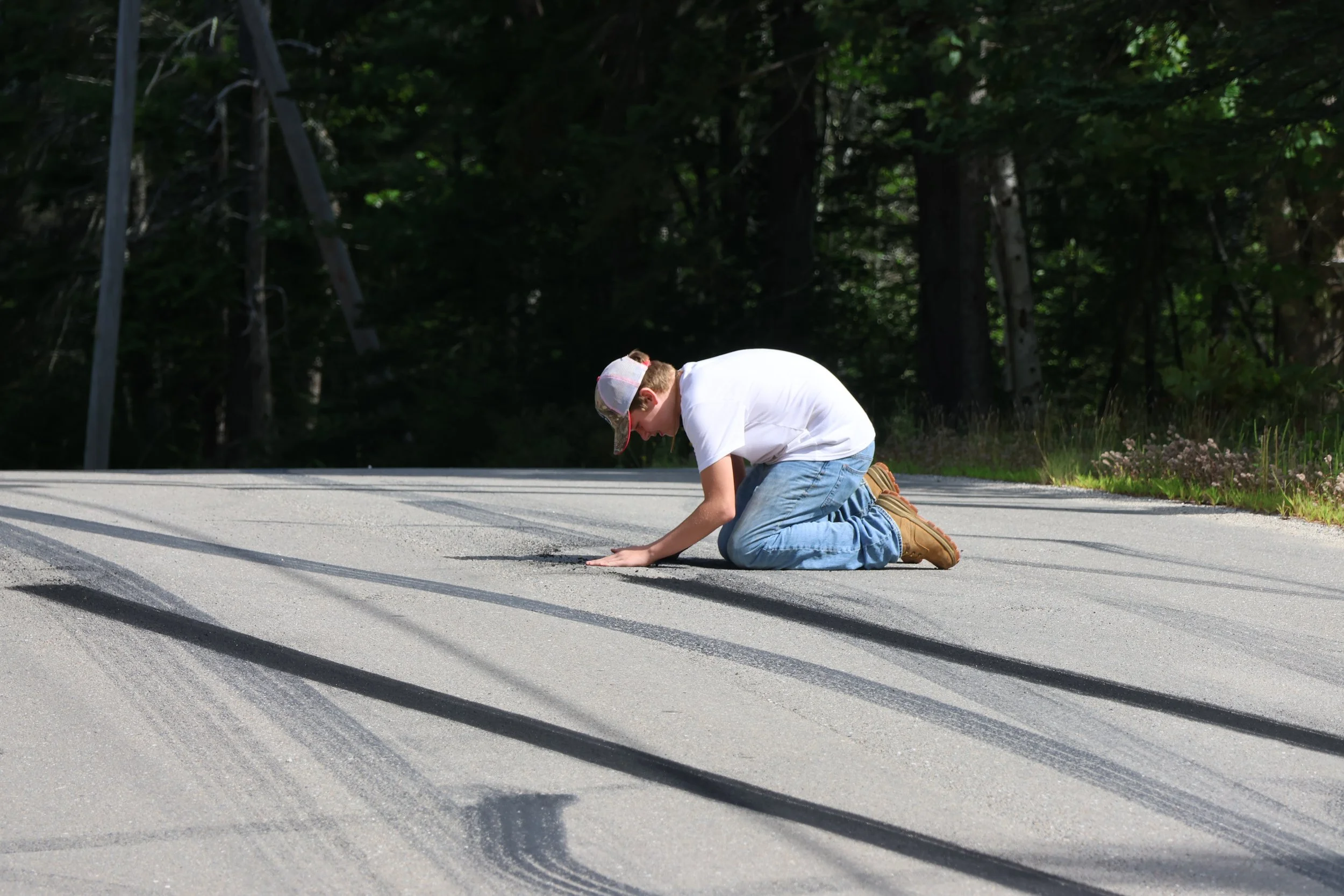
Chase Larrabee collecting burnt rubber on Greenlaw District Road. Photo by Maizy Weirich.
“I do think that standing up for people in a working community who make noise and grit when there are newer people moving in who do not want that grit, is, you know, standing up to gentrification in some way,” Nelson said.
Today, Nelson is a freelance writer and consultant, and serves as the economic and community development director for the town of Stonington. She emphasized to The Rising Tide that her comments about the film do not reflect any official position of the town.
“In Stonington, we’re particularly trying to sustain our year-round fishing community. That's really important to us. So we certainly need the income from seasonality and from seasonal residents. We just have to be careful not to cross a tipping point,” Nelson said.

Linda Nelson, co-creator of Tire Tracks, in front of the Stonington Town Hall. Photo by Maizy Weirich.
The film was directed by John Steed, a freelance reporter with whom Nelson worked at the newspaper. Before the film was even a concept, Steed interviewed several youths who burned rubber, which led to a yearlong film project through Opera House Arts and its digital media studio, where people could rent recording equipment to document local stories.
Today, Steed, who divides his time between Stonington and Belfast, has pursued a different professional path as a lawyer dealing with consumer protection litigation, trials, and bankruptcy cases. He said that filmmaking and the law have similarities.
“A lot of advocacy is storytelling. Thinking about where people are coming from and then being able to ask a good question,” Steed said.
Shortly after the film debuted, Steed moved to Philadelphia, where he studied law. He has been back in Maine for the past decade.

John Steed, director of Tire Tracks, will be available for a talkback after the screening on Sept. 19. Photo by Maizy Weirich.
Even though Tire Tracks is 20 years old, it is still relevant to the people of Deer Isle-Stonington. And in celebration of the anniversary, the Stonington Opera House is screening the film on Sept. 19 at 7 p.m.
Two decades later, it’s a film that still helps bridge a cultural divide between locals and seasonal residents.
Steed said the film is important because it “gives something for people to work with and arrive at their own conclusions, which is a very different way of making changes in people’s minds and in society.”
The film provided a window into a practice that was not well understood by many residents.
“I think when they watched the movie, they understood it’s just us,” Proper said.
He also said that burning rubber actually increased after the film was released.
“We are who we are,” Proper said.
In celebration of the 20th anniversary of Tire Tracks, the Stonington Opera House will screen the film on Sept. 19 at 7 p.m.
