Early feedback on school cell phone ban
Some students are now dancing in the lunchroom, others say there needs to be a ‘better middle ground’
Sept. 16, 2026
By Jessi Hardy
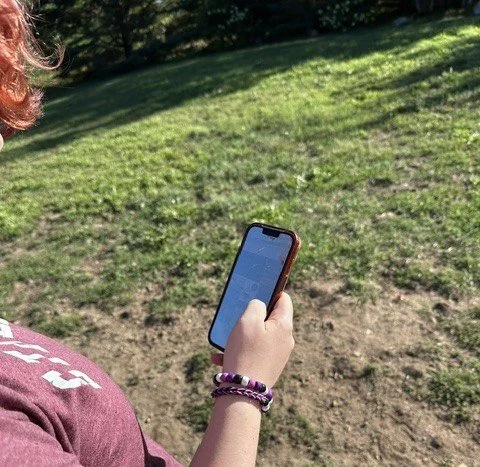
Students still have mixed reviews on the ‘bell-to-bell’ cell phone ban. Photo by Jessi Hardy.
A few weeks of school have passed since Maine implemented the “Bell to Bell” cell phone ban created this year by Gov. Janet Mills. Both Deer Isle-Stonington High School and George Stevens Academy are reporting generally positive developments from the ban, although there are still mixed reviews from students.
Deer Isle-Stonington High School Principal Rebecca Gratz said that the transition into the new policy has been smooth.
“The students have been really cooperative about turning their phones in, and we have had no issues so far. We also haven't gotten any pushback from parents about the rules, which is great,” Gratz said in an email to The Rising Tide.
GSA’s Head of School Shelly Schildroth noted in her weekly update to the community that she was happy the policy is working.
“They [students] understand that phones should be in the locker by the time their first class starts at 8:05 a.m. and that we are ending classes at 2:25 p.m. to allow them time to retrieve their phones from their lockers in plenty of time to catch the bus,” Schildroth said.
Both schools report that lunch and other breaks between classes are spent communicating with others instead of using cell phones.
“I think our students are interacting more during breaks and lunch... It has definitely cut down on drama during the school day,” Gratz said. “We had five seniors making up a dance at lunch today. It was really fun to watch them laughing and dancing together.”
“The best news here is that our lunch times and passing times [in between classes] are spent talking with others. I’ve even heard of a few board games being played during downtime,” Schildroth said.
Perspectives among students remain mixed as they adjust to the new rules.
Emma Weed, a Deer Isle-Stonington High School junior, said, “Having your phone taken away all day can feel frustrating, especially when you’re used to having it there for things like checking the time, communicating with your parents, or just having it during free time.”
Weed has concerns about safety within the classroom while not having access to a personal phone.
“I don’t really think schools are safe enough to completely take away our phones. If there was an emergency or something happened, I’d want to be able to contact my parents or get help,” Weed said. “At the same time, I think the policy has helped people pay more attention in class and actually talk to each other more. So overall, I wouldn’t say it completely sucks, but I definitely think there needs to be a better middle ground.”
Mara Black, a GSA junior, said, “Although I understand why the policy was put in place, I feel that it jeopardizes my safety… I feel that I should be able to text my mom or my sister to come pick me up if I feel sick or am in pain… I shouldn't have to email my friend who's home sick to check on them.”
Black says the ban also shows a lack of trust toward the student body.
“Most importantly, I should be trusted as a high school student. The people who abuse their phones should be talked to individually, not as a whole,” Black said.
For others, the transition to the ban was minimal.
Michael Parady, a Deer Isle-Stonington senior, said, “I don't mind the no cell phones in school. It was easy for me to give up. I like the no cell phones in school because it forces people to go back to how it was when I was a kid, when everyone actually talked to each other.”