

Shah vows to expand programs for Maine’s aging population
Democrat also says ‘a stronger Maine starts in our classrooms,’ placing education as a priority economic driver
EDITOR’S NOTE: The Rising Tide has asked all gubernatorial candidates to complete the following questionnaire. The Rising Tide will publish responses of candidates when received. These profiles are not paid advertisements. They are offered purely as a voter education tool. The Rising Tide does not endorse candidates for any office.
Below are responses from Democrat candidate Nirav Shah. The primary is June 9.
June 5, 2026
1. Background
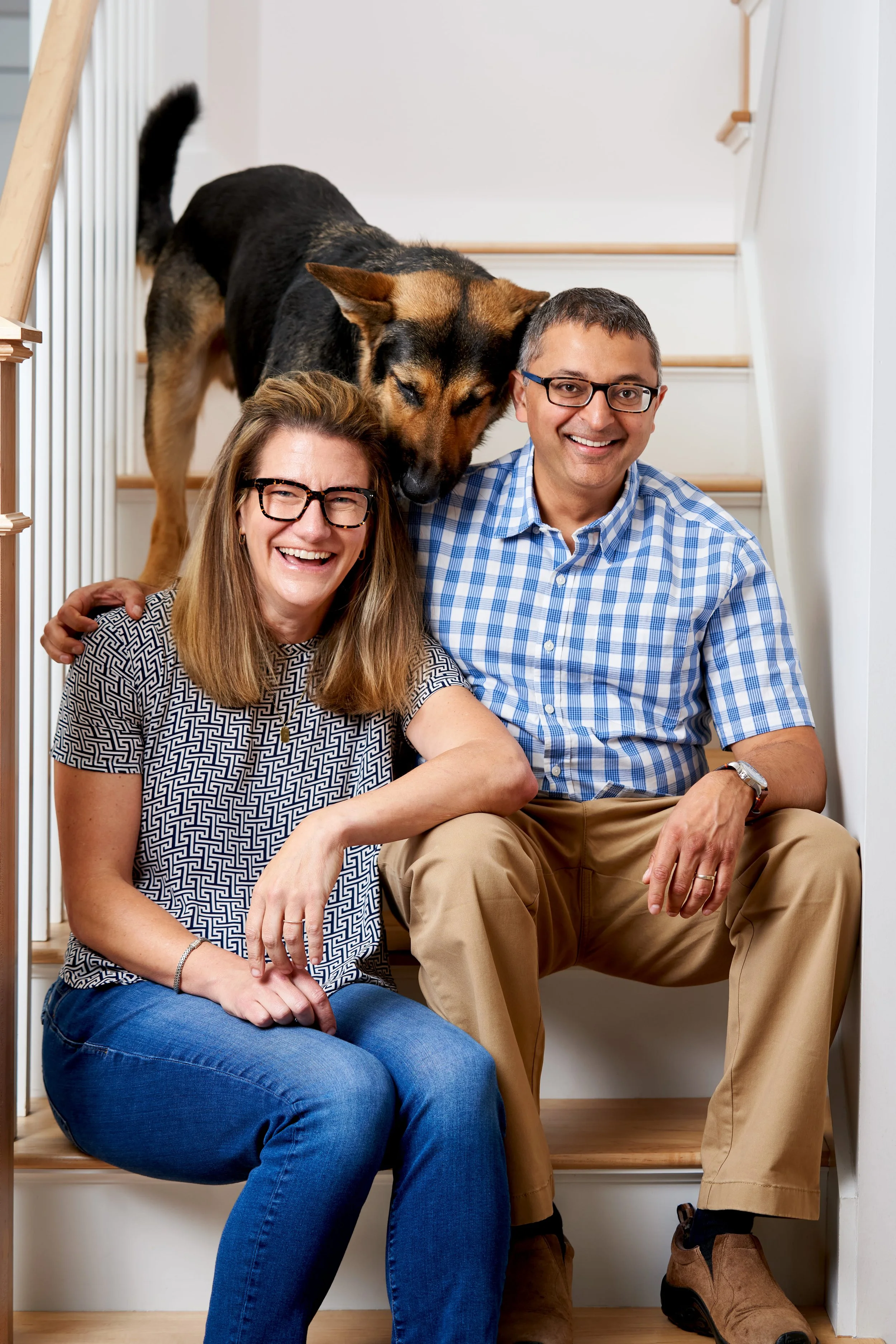
Nirav Shah with his wife Kara and their dog, Fritz. Courtesy photo.
Tell us about your background: Where did you grow up and where did you go to school? Tell us about your career (or careers). Why do you want to be governor, and how have your past experiences prepared you for this role?
I am the son of immigrants — my father came to this country in 1970 as a mango farmer who worked as a busboy in Chicago while my mother babysat neighborhood kids, and they eventually settled in a small rural town in northern Wisconsin, searching for a better life. That background shaped everything about who I am: a medical school graduate by education, an attorney by profession, and a public health guy by passion.
After leading the Illinois Department of Public Health, Governor Mills appointed me Director of the Maine CDC, and it was during those years – through one of the hardest stretches this state has ever faced – that Maine became home for me and my family. The Biden Administration later asked me to serve as Principal Deputy Director of the U.S. CDC, but I came back, because this is where I want to build something lasting.
I'm running for governor because Maine families deserve a leader who will feed kids, fix housing, fund health care, and fuel our economy – and fight back against the Trump Administration. I've done this work before, and I'm ready to do it again.
2. Housing and Affordability
Maine faces rising housing costs, increasing property taxes and a shortage of workforce housing. What specific policies would you pursue in your first two years to make Maine more affordable for working families, young people and seniors?
Maine is facing a genuine affordability crisis, and I've heard it firsthand at dozens of campaign events across this state – parents juggling child care and mortgage payments, seniors stretching fixed incomes to cover heating bills, small business owners who can't recruit workers because people simply can't afford to live here. In my first two years, I will set a clear statewide housing production target, create a Housing Fast-Track for affordable and workforce projects, and expand MaineHousing's capacity – because we need an estimated 84,000 new homes by 2030 and we simply are not building them fast enough. I supported a targeted millionaire’s tax, dedicated to property tax relief, with revenues directed to municipalities to reduce the burden on homeowners and renters (happy to see the Legislature pass this), and I'll expand the Homestead Exemption for all permanent, year-round Maine residents.
For seniors who want to stay in their homes and communities as they age, I will create Aging-in-Place Innovation Grants to expand adult day programs, in-home services, and community-based supports – because people deserve the dignity of remaining where they've built their lives. I'll also launch the Maine Caregiver Corps to recruit and train the next generation of caregivers, so that families don't face impossible waitlists when a loved one needs help.
Making Maine affordable isn't one policy – it's a coordinated commitment to housing, property tax relief, and supporting people at every stage of life.
3. Rural Maine
Many rural communities are struggling with aging populations, school enrollment declines, workforce shortages and limited access to health care. What is your long-term vision for rural Maine, and how would your administration help small towns remain economically and socially viable? What specifically will you do for rural Maine?
Rural Maine is not a problem to be managed. It's a strength to be invested in, and my long-term vision is a Maine where small towns remain vibrant, economically resilient, and full of opportunity. Clean energy is one of the most powerful economic tools we have for rural communities: Maine already generates roughly two-thirds of its electricity from renewables, and clean energy jobs are growing three times faster than overall employment, with rural counties benefiting most. I will accelerate that by modernizing our grid, building out offshore wind infrastructure, and making sure Maine workers, including union workers, lead that buildout. I'm committed to ending childhood hunger in our rural communities, where one in five Maine children lives in a food-insecure household, which is the highest rate in New England, by expanding farm-to-school programs, mobile meal sites, and emergency investments from Maine's rainy day fund. Our public schools are the heart of rural community life, and I will expand wraparound services and provide additional annual pay for teachers in rural and hard-to-staff schools.
I also believe deeply in what sociologists call "third places" – the coffee shops, diners, libraries, and community gathering spaces that hold towns together – and I will create a Community Gathering Places Grant Program to help towns invest in those spaces, because people don't just choose a job, they choose a community. Every rural town in Maine deserves a governor who sees them, fights for them, and understands that their vitality is Maine's vitality.
4. Education and Workforce Development
Maine has slipped dramatically in delivery of quality education, and now ranks in the bottom 10 states in the nation. What is your plan to reverse this trend?
Let me be direct: the data is unacceptable, and I won't sugarcoat it — only 33% of Maine fourth graders are proficient in math and just 26% in reading, both below the national average, and in some areas Maine saw larger declines than any other state in the country. That is not the Maine we want, and reversing this trend starts with bold investment. I will expand high-quality pre-K, strengthen early literacy through evidence-based reading instruction, mandate universal reading screeners, and ensure schools and teachers have access to the highest-quality instructional materials – because we know the earlier we identify challenges, the better the outcomes.
Maine teachers are among the lowest-paid in New England, and I will work to make those salaries competitive and provide additional pay for educators in rural and hard-to-staff schools, because we cannot ask great people to do the most important work in our state while paying them less than they deserve. I'll invest in wraparound services like school-based food pantries, mental health support, and community partnerships because students cannot learn if their basic needs are unmet, and right now one in five Maine children is food-insecure.
I will also make the first two years of community college permanently tuition-free, expand career and technical education pathways in every high school, and align workforce training with the jobs Maine needs filled in health care, clean energy, and the building trades. A stronger Maine starts in our classrooms, and as governor, I will treat education as the economic and moral priority it truly is.
5. Energy
Maine has some of the highest electricity rates in the nation. What is your plan to reduce electricity rates, and will you promise to lower it by a certain amount?
Maine families are paying too much for electricity, and I won't pretend there's a magic switch that fixes it overnight. But there is a clear path forward, and I'm committed to following it with urgency. In the short term, I will work with lawmakers and regulators to fix the rules that determine how utilities earn profits, ensuring ratepayers come first and families aren't footing the bill for unnecessary utility spending, and I'll expand energy assistance and efficiency programs to bring immediate relief to households. At the same time, I'll advocate regionally for better winter fuel planning, because New England's heavy reliance on natural gas for electricity means that when gas prices spike, Maine families pay dearly – and that can't keep happening.
For lasting price stability, the answer is clean energy: renewable sources like wind have near-zero marginal cost once built, meaning after the initial investment, prices stay stable and families are protected from fuel market volatility. I will make strategic investments to modernize Maine's electric grid, accelerate the transition to clean energy, and position Maine as a leader in offshore wind infrastructure — ensuring Maine workers lead that buildout and benefit from those jobs. Maine's commercial electricity rates are 64% above the national average, and states like New York offer economic development rate discounts of 30–35% for businesses. Maine should have an equivalent program, and as governor, I'll pursue one. I'm committed to putting us on a clear downward trajectory on energy costs, and I will hold my administration accountable to making measurable progress on that promise.
6. Economy.
Maine has always struggled with a year-round economy. But seasonal states like Florida are booming, thanks to economic development plans that are business friendly and aim to lower income and property taxes. What’s your plan to spur economic development? Do you have any outside-the-box ideas you’d like to propose?
Maine doesn't need to invent an economy from scratch. We need to remove the barriers holding back the one we already have, and invest boldly in the sectors where we have a genuine competitive advantage. Right now Maine is one of the hardest states in the country to start a
business: in 2026, we are the only state where you cannot form a business online, and that's simply embarrassing. As governor, I'll create a unified one-stop digital business portal, set firm permit review timelines with a money-back guarantee if the state doesn't perform, and make the first hire easier for every small business owner turning their side hustle into something real. I'll also invest in "third places" – the coffee shops, libraries, diners, and community gathering spaces that hold towns together – the National Bureau of Economic Research shows that neighborhoods with vibrant third places see nearly 12% more new business startups, and every workforce recruiter will tell you: people don't just choose a job, they choose a community.
Clean energy is an enormous economic opportunity: Maine already has more than 16,000 clean energy workers growing three times faster than overall employment, and 3.2 million Americans have already relocated as climate migrants, with millions more projected. Maine's position as a climate haven should be a powerful economic recruitment tool, and I will lean into it. I'll also fund a Maine Employee Ownership Center to help the nearly 13,000 Maine businesses owned by baby boomers approaching retirement transition to local ownership rather than simply closing, and I'll build on our extraordinary outdoor recreation economy, which is now worth $3.9 billion and nearly doubled since 2012, by giving the Maine Office of Outdoor Recreation a clear economic mandate and real resources to match. Maine has everything it takes to thrive year-round; what we've lacked is a state government willing to match the grit of our people.
7. Trust in Government and Civic Life.
Americans increasingly distrust institutions, including government and the media. What would you do as governor to improve transparency, restore public trust and encourage more civil political dialogue in Maine?
Trust isn't given — it's earned, and earning it requires showing up consistently, being honest even when the news isn't good, and making government actually work for the people it serves.
The only promise I have made, throughout this entire campaign, is to host two town halls every single month as governor, so that Mainers across this state — in communities like Blue Hill, in Washington County, in Aroostook — have direct access to their governor.
