

Town meeting then, town meeting now
How much have municipal meetings changed since 1939?
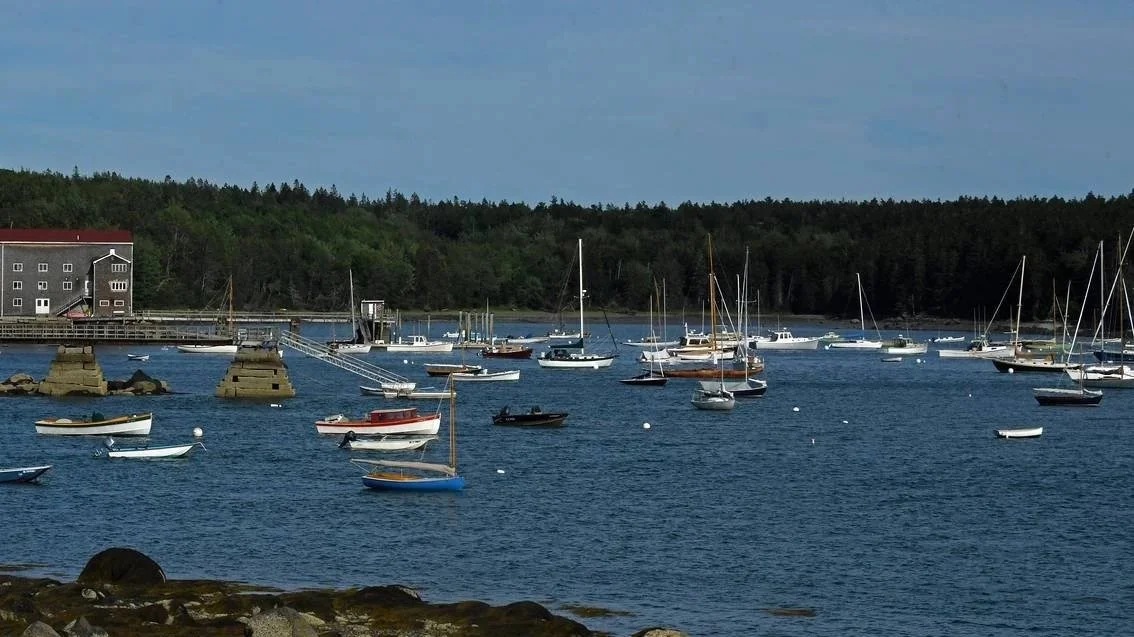
E.B. White’s ‘One Man’s Meat’ offers observations about life in rural Maine, including the annual Town Meeting. Photo courtesy of the Town of Brooklin.
May 4, 2026
By Margery Irvine
BROOKLIN—When you live in Brooklin, it’s hard not to see E.B. White lurking around every curve in the road. Even if you don’t pass the house where he used to live, even if you don’t come upon his and his wife’s stones in the cemetery, even if you don’t sit on a bench in their memorial garden at the library–even so, when you read the essays he wrote for Harper’s Magazine in the 1930’s, that’s when you sense his presence everywhere.
He wrote about the schools, the townspeople, the dogs, his own saltwater farm. And about the annual town meeting.
Having just attended our most recent town meeting, I’ve turned the pages of my copy of One Man’s Meat to re-read “Report,” about the previous year’s (1938) town report; and to read again “Town Meeting,” about the 1939 meeting.
I’m guessing that, even though it was March when White attended and April when we did, the weather really wasn’t very different: As Robert Frost describes it in “Two Tramps in Mud Time,”
When the sun is out and the wind is still,
You're one month on in the middle of May.
But if you so much as dare to speak,
A cloud comes over the sunlit arch,
A wind comes off a frozen peak,
And you're two months back in the middle of March.
The place was different. We met in the school auditorium, some of us in folding chairs, others on the bleachers. But White sat “in the old town hall next to the church and across from the cemetery” in a “Victorian mistake.”
In 1939, town meeting was followed by lunch prepared by Brooklin’s ladies; on April 23, 2026, the eighth graders had laid out a pre-meeting spread of coffee, tea, cinnamon rolls, coffee cake, and quiche. The first row of seats 87 years ago was occupied by Brooklin’s high school seniors, “come to observe government processes in a free country.” This year, the eighth graders sat on the floor for much the same reason.
White describes a “spectacle the townsfolk had walked miles for […] the air heavy with distilled venom.” His neighbor, White tells us, turned to him and whispered, “‘I get so excited here it makes me sick. I’ll commence to shake by and by.’”
I can’t say I shook, but we did have a tense moment or two, primarily concerning an easement to one of the town’s waterfronts. The one thing, if mutterings can be relied upon, that everyone seemed to agree on was that lawyers, sooner or later, screw everything up.
If you get to town meeting early enough, and if you haven’t gotten your Annual Report ahead of time, you can sit and read through last year’s report, letters from local officers, letters from non-profits asking for funding, and–here’s where the fun starts–the page-and-a-half of Outstanding Taxes and the 22 pages of Real Estate and Personal Property Taxes. Even on a cold April day, you can work up some heat wondering why your neighbor is paying less than you.
White’s observation about property taxes seems both quaint (“The average citizen pays an annual tax on his property of about twenty-five dollars”) and also remarkably clear-sighted: “the [land and buildings of the] summer visitors are valued at a greater sum than the land and buildings of the residents.”
So: weather the same; setting similar; population almost identical (798 then, 869 now). And then we get to income and expenditures.
[I’ve used my inflation calculator to convert dollars of the late-1930’s to dollars today; those amounts are in parentheses, preceded by AFI–Adjusted for Inflation.]
On the income side, White puts the amount raised by taxes at $25,000 (AFI $576,000). That amount last year in Brooklin was $3,606,000, accounting for 77% of the town’s total revenue.
Then and now, expenses went something like this:
In 1938, all administrative expenses, $2100 (AFI $48,000); in Brooklin last year, that amount was approximately $616,000 (this figure is a bit hard to come up with, because we pay for many services that White’s fellow residents didn’t).
White noted that “It costs a good deal more to repair roads and bridges than it does to pay the public servants”; total, $3650 (AFI $84,000). And for the previous fiscal year in Brooklin, $375,000.
In 1938, Brooklin had three one-room schools, one two-room school, and a combination junior high and high school. The town voted to fund all education expenses with $7400 (AFI $170,000), and the state contributed another $1500 (AFI $35,000). Last year, in Brooklin, that figure was $2,478,000, with subsidies amounting to $298,000.
Harper’s published “Town Meeting” in March, 1940, Hitler marching across Europe and the United States less than a year away from sending arms and soldiers to the east and to the west. We have today our own alarums and excursions. And yet we, like the Brooklin residents of nearly 90 years ago, meet to vote and gossip and demonstrate how democracy works in our own very small corner of the world.
—Irvine lives and writes in Brooklin.