

Blue Hill author’s new book reveals the ‘sonic horror’ of Stephen King
After a year of unprecedented access to the master of horror’s archives, Caroline Bicks says King’s genius is rooted not in gore, but in sound
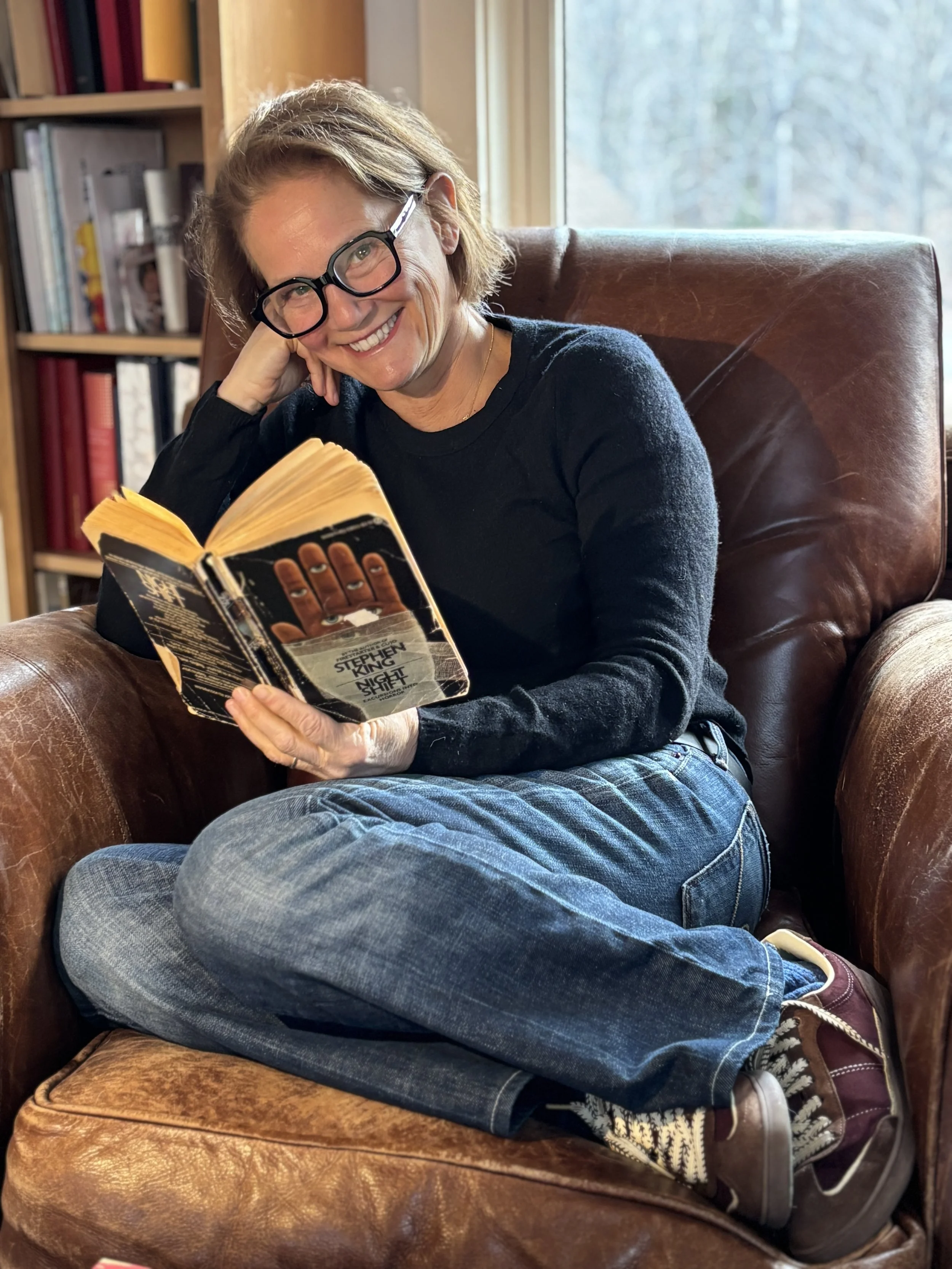
Blue Hill author Caroline Bicks with a copy of the first Stephen King book of short stories she ever read. Photo by John Boit.
April 8, 2026
By John Boit
BLUE HILL–When Caroline Bicks was seven, she ran after her brother and sister and crashed through a plate-glass door while on summer vacation in Castine. The accident, which required dozens of stitches, left a long scar on her hand and wrist, and a vivid memory of terror.
“I was absolutely convinced I was going to die,” Bicks said of the wound that required dozens of stitches and weeks of bandages.
Five years later, when she was 12, Bicks found herself at Witherle Memorial Library in Castine, staring at a paperback copy of Stephen King’s collection of short stories “Night Shift.” Staring back at her from the book cover was a bandaged hand with eyes on its fingers.
“It was just a shock when I saw it because it reminded me of what for me was very traumatic,” Bicks said. “It was my first experience of a book hitting what Stephen King calls the ‘fear bone.’”
Now Bicks understands King’s concept of the “fear bone” better than anyone, after a year of unprecedented, extended access to King’s archives and the imminent publishing of her new book, “Monsters in the Archives: My Year of Fear with Stephen King.”
The book examines King’s writing style and editing process, studies word choice, reveals alternate endings, and takes a deep dive into the question: Why exactly is his writing so scary?
The answer, Bicks says, is not that King paints gruesome scenes for readers–he does–but rather that he pays extremely close attention to the actual sounds of words. It is in the imagining of a scene–and its sounds–that we become truly terrified.
Bicks has a phrase for it: “Sonic horror.”
Intentional craftsman
Long after her hand healed, long after she read her first Stephen King novel, and long after she graduated from Harvard, Bicks eventually landed a job–and then tenure–as a professor of Shakespeare at Boston College. She was settled, and admits she almost could have stayed there her whole life.
But in 2017, plans changed.
The University of Maine had just created the Stephen E. King Chair in Literature, a position endowed by the Harold Alfond Foundation. Bicks applied for the job and became the inaugural chair of the prestigious appointment, with one caveat: The university issued strict guidance that she was not to initiate contact with Maine’s reclusive legend of horror.
So she taught her classes. There was a lot of Shakespeare, her favorite.
Four years passed.
Until one day, when there was a phone call at Bicks’ Blue Hill home.
“Caroline, it’s Steve King,” said the voice on the other end. It was time they finally met, he said.
King visited Bicks at the UMaine campus, meeting her students over two days. Saying goodbye at the end of the second day, King said, “Bring it in,” and gave her a bear hug.
“I couldn’t believe it. The man responsible for terrifying generations of readers—including me—was so…nice,” Bicks writes in her book.
Six months later, Bicks was about to start a sabbatical to research Shakespeare, her academic specialty. But now she had a new idea. She wanted to find out why King’s writing is so frightening.
“I just knew I wanted to spend my year reading all those early drafts of those books that scared me so much when I was a teenager, and trying to figure out how he crafted these stories, how they got stuck in my head and why they were still there.”
King and his wife, Tabitha, also a writer, had recently turned their famed Victorian house in Bangor into an archive for their writing. The couple now live in western Maine.
Bicks pitched the idea. The Kings accepted. And suddenly Bicks found herself with unprecedented access to the archives of a writer who has sold more than 350 million books.
“I just knew I wanted to spend my year reading all those early drafts of those books that scared me so much when I was a teenager, and trying to figure out how he crafted these stories, how they got stuck in my head and why they were still there,” Bicks said.
She pored over original manuscripts and studied back and forth revisions between King and editors.
It was while reading earlier drafts of Pet Sematary that she realized sound was key to the sense of dread King created.
What she found was a writer far more deliberate than many casual readers—and some literary critics—may assume.
Clitter vs. clatter
[Spoiler alert: If you don’t want to know the ending to Pet Sematary, skip to the next section of this article.]
In the end of Pet Sematary, a husband, distraught over losing his wife, puts her body in a sacred burial ground where dead things come back to life–but never the same as they once were.
In the final sentences, the husband is sitting alone playing solitaire. He hears his wife, fresh from the grave, approach from behind. She puts her hand on his shoulder and says one word that is “grating, full of dirt.”
“Darling.”
It’s the kind of ending that still raises a shiver even decades after first reading the book, Bicks said.
“He doesn’t describe her — you don’t see her,” Bicks said. “You only hear her.”
That, she said, is part of what made Pet Sematary so important to her understanding of King’s method.
“That book for me was about sound. Sonic horror,” she said.
There are more such instances. In the same book, King writes of a pile of bones that begin moving. His original manuscript wrote, “Fingerbones clittered.”
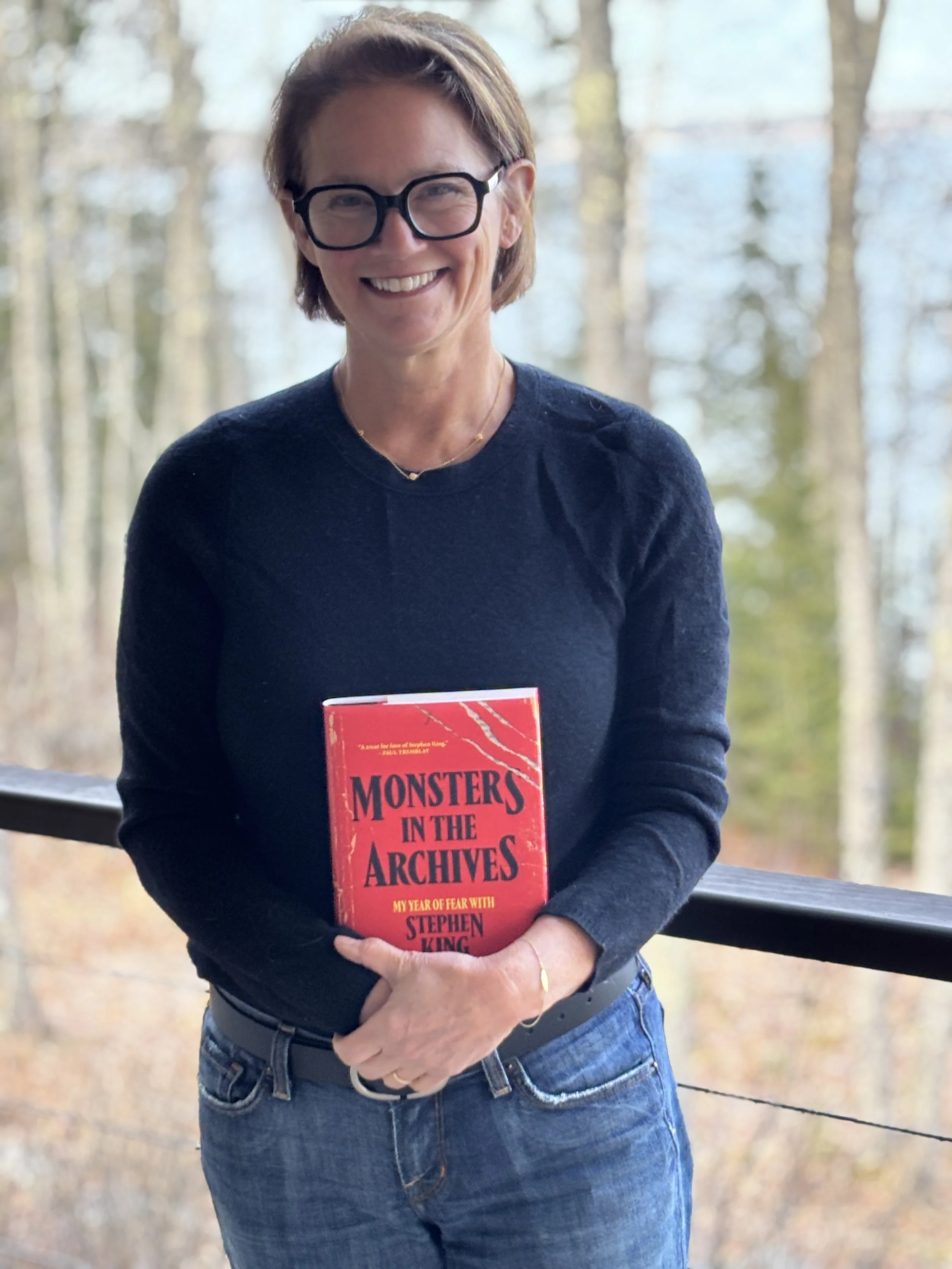
Bicks at her Blue Hill home with a copy of her new book about Stephen King, due out later this month. Photo by John Boit.
But a copy editor questioned the word choice. “Word OK?”
“Word OK,” wrote King in the notes. “A clitter is a very soft, ghostly clatter.”
Bicks encourages anyone to see the difference for themselves by repeating the words out loud. The clatter, clatter, clatter sound of bones is loud and clumsy. But clitter, clitter, clitter sounds insidious. Unstoppable. Creepy-crawly.
“When I was talking to him about the book,” Bicks said, “I said, ‘Do you remember why you did these things?’”
King’s answer stayed with her.
“He said, ‘Absolutely. When I’m writing, I always think about word sound. I am always thinking about how the word’s going to clang on the reader’s ear,’” Bicks said.
Bicks hopes her book helps push back against some literary circles who dismiss King’s writing skill.
“I want people to just appreciate that Stephen King is an intentional craftsman,” she said. “That he thinks about the words on the page. He’s thinking about how it’s sounding to the reader’s ear. He’s not just spewing out pages.”
King, for his part, says Bicks’ nails it when explaining his writing.
“[T]his is the best book about my process that I have ever read,” King wrote recently on social media. That accolade is all the more stunning considering it comes from a man who wrote On Writing – a book about the craft of writing and his own creative process.
Writing in an age of AI
Bicks said the idea of intentional word choice – selected by humans, for humans – feels especially important at a moment when AI-generated writing is being embraced across so many facets of life.
“Books created by humans do something that a machine can’t,” Bicks said, “because they’re connected to human experience and human emotions and human ingenuity.”
That, she said, is the larger lesson she hopes readers take not only from her book, but from King’s work itself: that language is not just information, and that great writing is not just a technically competent assembly of words.
“Words mobilize emotions,” she said. “Words connect to experiences.”
And that connection, she said, is something we must protect.
“If we lose touch with that,” Bicks said, “then I’m scared.”
Bicks will be speaking about Monsters in the Archives: My Year of Fear with Stephen King at the Blue Hill Library on June 25 at 7 p.m.
