

My Wild Neighbors: The secret lives of snappers
Despite their pugnacious reputation, the last thing snapping turtles are looking for is a fight
Sept. 8, 2026
By Kimberly Ridley
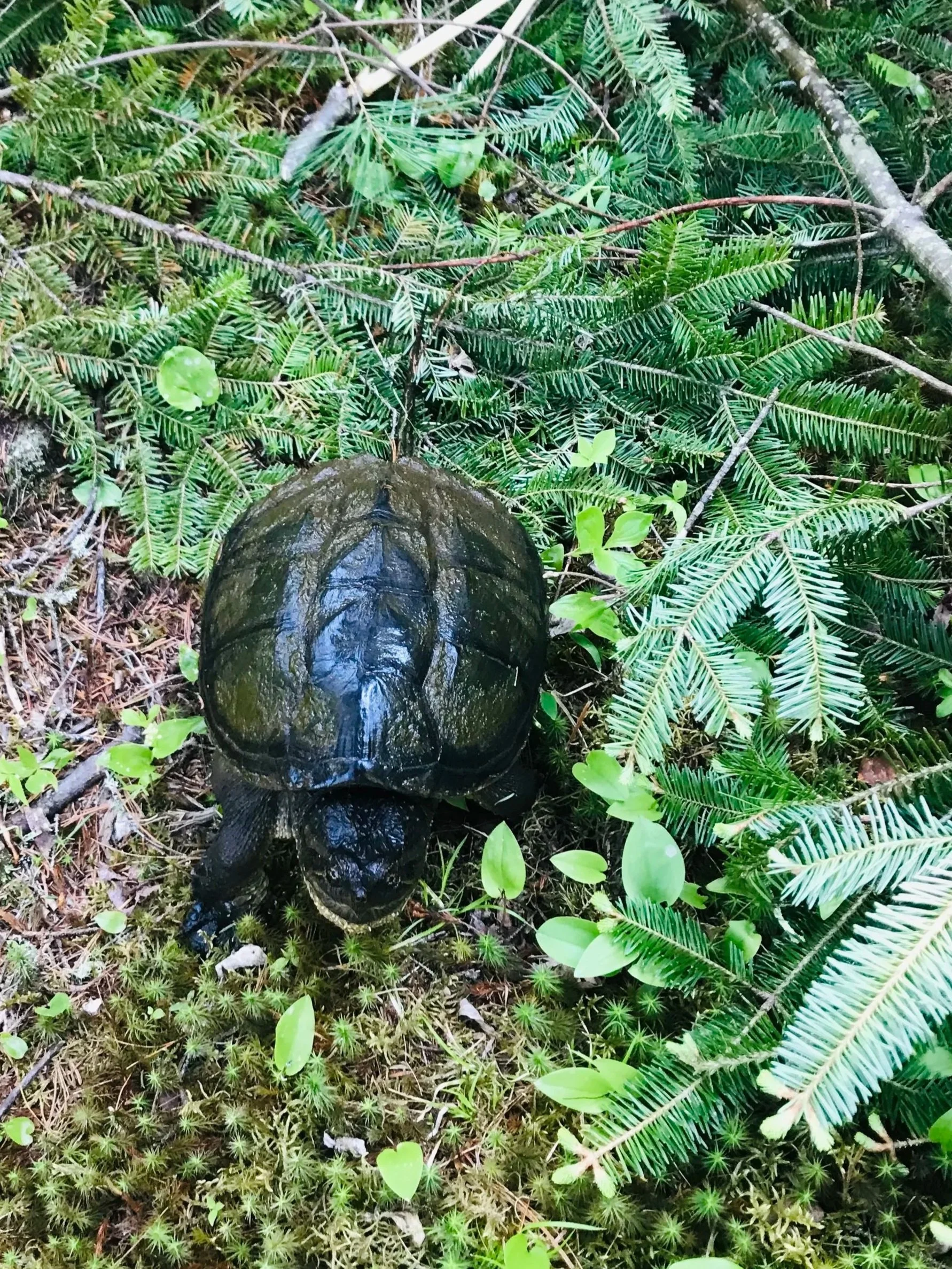
A snapper turtle. Their eggs often hatch in September after incubating for several summer months. Photo by Kimberly Ridley
Driving by a marshy stream one late spring afternoon, I noticed a large black rock by the side of the road. It seemed out of place. I pulled over and grabbed my binoculars to discover the “rock” was a snapping turtle the size of a small serving platter.
The snapper heaved up on fleshy legs and rocked up and down like a low rider in slow motion. As I watched from a few yards away, the turtle squeezed out an egg about the size of a ping-pong ball. It was the color of skim milk.
With a hind foot, she guided the egg into a hole she’d dug in sand, inches from the asphalt. Slowly, the snapper laid egg after egg. Her dark brown carapace, saw-toothed on the back end, glistened with algae. Her gold-rimmed eyes gleamed. My phone rang, breaking the spell. Time to go. Glancing back in the rearview mirror as I drove away, I wished her well and hoped her eggs would stay safe: About 90 percent of turtle nests are raided by skunks, raccoons, crows and other predators.
Snapping turtle eggs typically hatch in September after incubating underground for two to three months. I was fascinated to learn that incubation temperature determines the sex of snappers and most other freshwater turtles, as well as all sea turtles. Warmer incubation temperatures early in development produce female turtles, and cooler temperatures produce males.
With bumpy shells barely larger than a quarter, snapper hatchlings scramble to the nearest body of water to shelter in the shallows. It’s a precarious time. They’re basically the popcorn of the pond, snapped up by herons and crows, along with otters, mink, and other mammals. Survivors spend their lives in ponds, lakes, and streams, leaving only to lay eggs or search out a new spot if their home becomes uninhabitable.

Snappers and painted turtles, Maine’s other common freshwater species, have remarkable adaptations to weather winter. They go into a kind of torpor called brumation. When the water temperature drops below 50 degrees, they head to the deepest, calmest area of their home waters, where winter temperatures will hover just above freezing. The increasing cold slows the turtles’ metabolisms and heart rates down by 99 percent. Their hearts beat only once every few minutes. They stop breathing all winter long and instead absorb oxygen through their cloaca (in some circles, this is called “butt breathing ”). If oxygen levels drop too low, snappers and painted turtles can briefly enter an anaerobic state. This causes lactic acid to build up, which triggers muscle cramps and can lead to death. But turtles address this by drawing calcium out of their shells to neutralize the acid. In a way, it’s somewhat like taking an antacid for heartburn.
Unlike hibernating mammals, who sleep through the winter, brumating turtles are technically awake. Scientists have found that they’re aware of their surroundings and occasionally move about. Snappers and painted turtles have been observed swimming under ice in the middle of winter.
Fear not if you spot a snapper while you’re swimming, as I have several times over the years. They won’t bite off your toes or even nibble them, despite what your older siblings may have told you when you were a kid. Surprisingly, snapping turtles have a “shy and retiring nature when in water,” as herpetologist Malcolm Coulter said in Maine Amphibians and Reptiles. If they see you coming, they’ll head in the opposite direction as fast as possible.
It’s a different story on land. Most snappers you’ll encounter on terra firma are females looking for a sandy or gravelly spot to dig a nest. They have good reason to get snarly if anyone gets in their face. Unlike most turtles, snappers can’t fully pull their limbs and heads into their shells. Their plastrons (bottom shells) are much smaller than those of painted turtles and other species. Consequently, they defend themselves by lunging and biting with sharp, powerful jaws when they feel threatened or harassed. Riled snappers have stunningly fast reflexes and can extend their necks snake-like up to two-thirds the length of their shells.
Which raises the conundrum of how to move a snapping turtle out of the road. If it’s safe to stop, pull over and flick on the hazard lights. Experts advise approaching the snapper from behind, and picking it up by the back of the shell with two hands and then setting it down off the road in the direction it was heading. Never pick up a snapper by its tail, which can injure its spine. Likewise, never grab a snapper on the sides of the shell because these creatures can reach around and bite. Other techniques include the platter hold, placing one hand on the back of the shell and another under the back of the plastron for support. If the snapper is too big to pick up, experts advise gently dragging it backwards by the carapace onto a car mat. Drag the mat backwards across the road in the direction the turtle is heading and then rotate the mat so the turtle is facing the direction in which it was going. I’ve read that some people keep a large snow shovel in the car during turtle nesting season to move snappers. Here’s a video demonstrating how to move a snapper.
Video from Canadian Wildlife Federation.
Despite their pugnacious reputations, snapping turtles exude a gnarly charm. They aren’t looking for a fight. They’re just trying to live their best lives like the rest of us. Watching that mama snapper gave me a new and deeper respect for these ancient beings, who evolved 60 to 100 million years ago and can live upwards of 50 years. I think about her every time I drive by that marshy stream. Come September, I scan the roadside for hatchlings. No luck yet, but I keep hoping.
Maine native Kimberly Ridley is the award-winning author of six creative nonfiction books about the natural world for children and adults, including The Secret Pool and Wild Design: Nature’s Architects. Her essays and articles have appeared in numerous publications including Down East Magazine, The Christian Science Monitor, and The Boston Globe. She lives in Brooklin with the painter Tom Curry and their cat Andy. www.kimberlyridley.org
