

New infrared sauna opens in Orland
And, more science behind the self-service infrared sauna
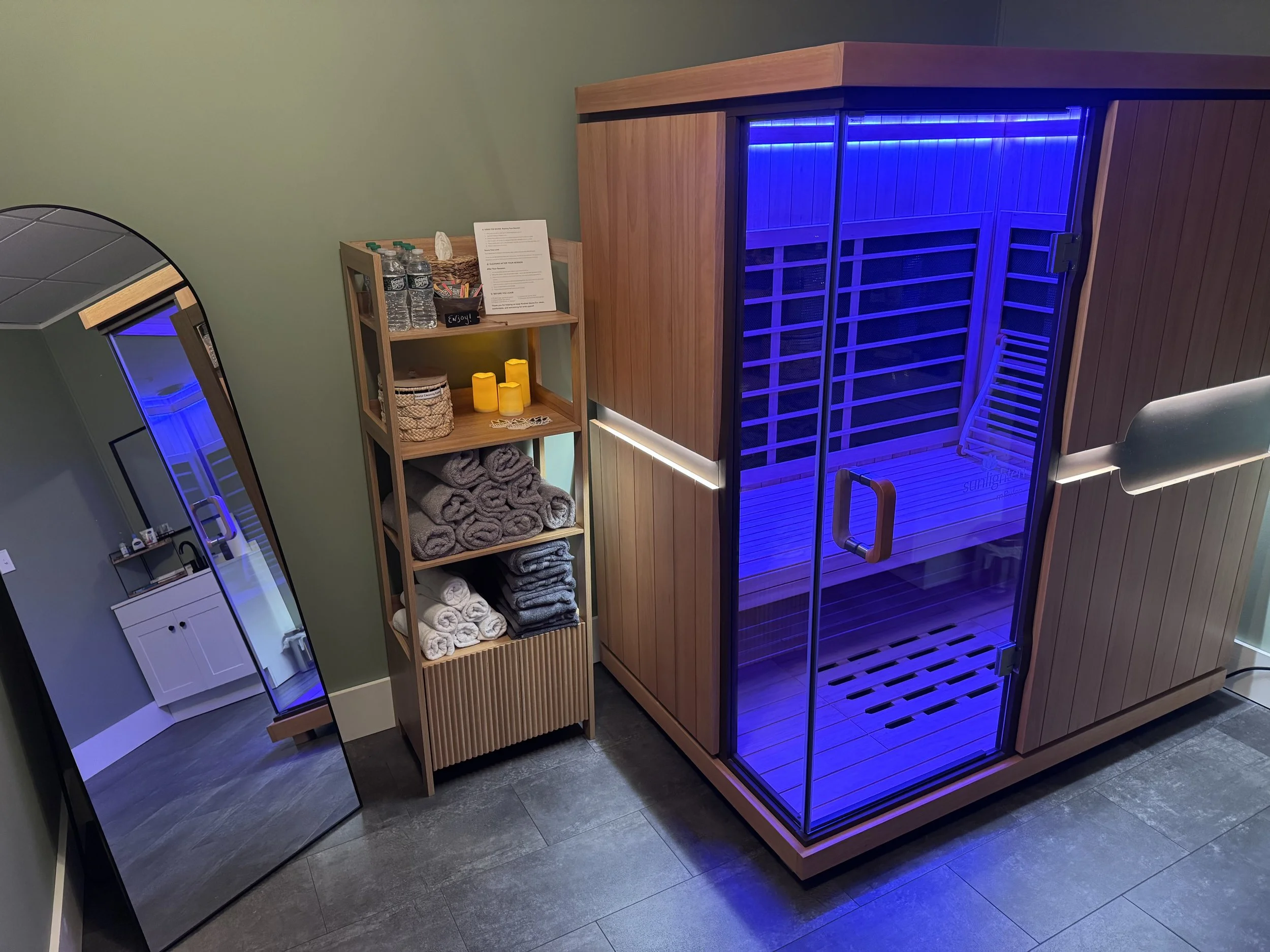
This infrared sauna in the Orland Community Center uses lower temperatures as opposed to a traditional, wood-fired sauna. Photo courtesy of Kindred Sauna.
Sept. 2, 2026
By Annie Means
ORLAND—A new infrared self-service sauna has just opened at the Orland Community Center, founded by longtime friends Danielle Reardon and Kim Burgess, who first met as coworkers 13 years ago.
“Our bond started around health and wellness,” Burgess said.
Not only did that shared interest spark a friendship, but it eventually inspired their company name, Kindred Sauna.
“We were looking for a name that spoke to our relationship with each other,” Burgess said. The phrase “kindred spirits” quickly came to mind.
The idea to bring a sauna to Orland came after the pair saw saunas in other locations.
“About six months ago, we saw a self-service sauna and thought, wouldn't this be great at the Orland Community Center?” Burgess said.
She said the idea made sense: The center is already home to a range of health-centric offerings, including fitness classes, a gym, and medical care.
Saunas are commonly pictured as wood-fired, the kind that conjures images of Scandinavians enjoying a long sweat followed by a cold plunge. These traditional saunas rely on convection: The air inside the sauna box heats up first, and that ambient warmth is what raises the body’s internal temperature.
Infrared saunas also differ from traditional saunas in terms of their heat source. They use infrared heaters to emit infrared light, which warms bodies directly through radiant heat.
“We also personally prefer infrared, as it gives the benefits of heat in a gentle, lower-temperature environment,” Reardon said, “and it’s easy to incorporate into a wellness or recovery routine.”
Infrared light is a type of electromagnetic radiation that sits just beyond the visible spectrum, meaning it cannot be seen, but can be felt as heat. In a sauna, special heaters emit these wavelengths directly at the body, and the energy is absorbed by the skin, which gently raises tissue temperature from the outside in. This is the same kind of warmth felt from sunlight on skin, even on a cool day.
Because the light itself does the work of heating the body rather than warming the surrounding air first, infrared saunas can produce a deep, penetrating heat at much lower ambient temperatures than traditional saunas require. Infrared saunas run at 110°F to 135°F, while traditional saunas run at 150°F to 195°F, allowing users to stay inside infrared saunas for a longer period of time.
Given the location, an infrared sauna also makes more sense for Kindred Sauna as opposed to a traditional one. The pair needed technology that made it accessible for self-service customers, without relying on outside upkeep or personnel. A wood-fired sauna, for example, would require constant stoking.
Burgess and Reardon say that people could use their space for a multitude of reasons.
“My hope would be that people give it a try to see the impact on their well-being,” Burgess said. “Sometimes people look at a sauna as pampering, but really, it’s taking care of your body.”
For the self-service experience, Kindred Sauna’s online booking platform lets users reserve a session for a set time, after which they receive an email with a unique door code to enter the sauna space and begin their session.
For a single 60-minute booking, prices start at $40. For more information on prices and membership options, visit Kindred Sauna’s Facebook page.
