

‘Journey towards the earth’ at an off-grid school in Blue Hill
Way of the Earth School offers four-month immersion program in how to ‘live with the land’
Sept. 30, 2026
By Maizy Weirich
BLUE HILL – Tucked away in the woods and at the end of a dirt road in Blue Hill, one couple has spent the last decade learning how to live in a reciprocal relationship with nature–and teaching it to others.
Way of the Earth School, located on a 50-acre plot of land at the end of Jay Carter Road and co-founded by Hannah Rhea and Colby Smith, teaches nature-based living skills. The couple aims to live in a balanced way with the earth, participating in and yielding to nature’s systems, rather than against it, the couple said.
The school hosts workshops using materials from the local landscape, such as turning rawhides into pouches, making acorns edible, and even offering a homeschool program for children ages 7 to 12 teaching “earth living skills, wild awareness activities, and land-based crafts,” according to the school’s website.
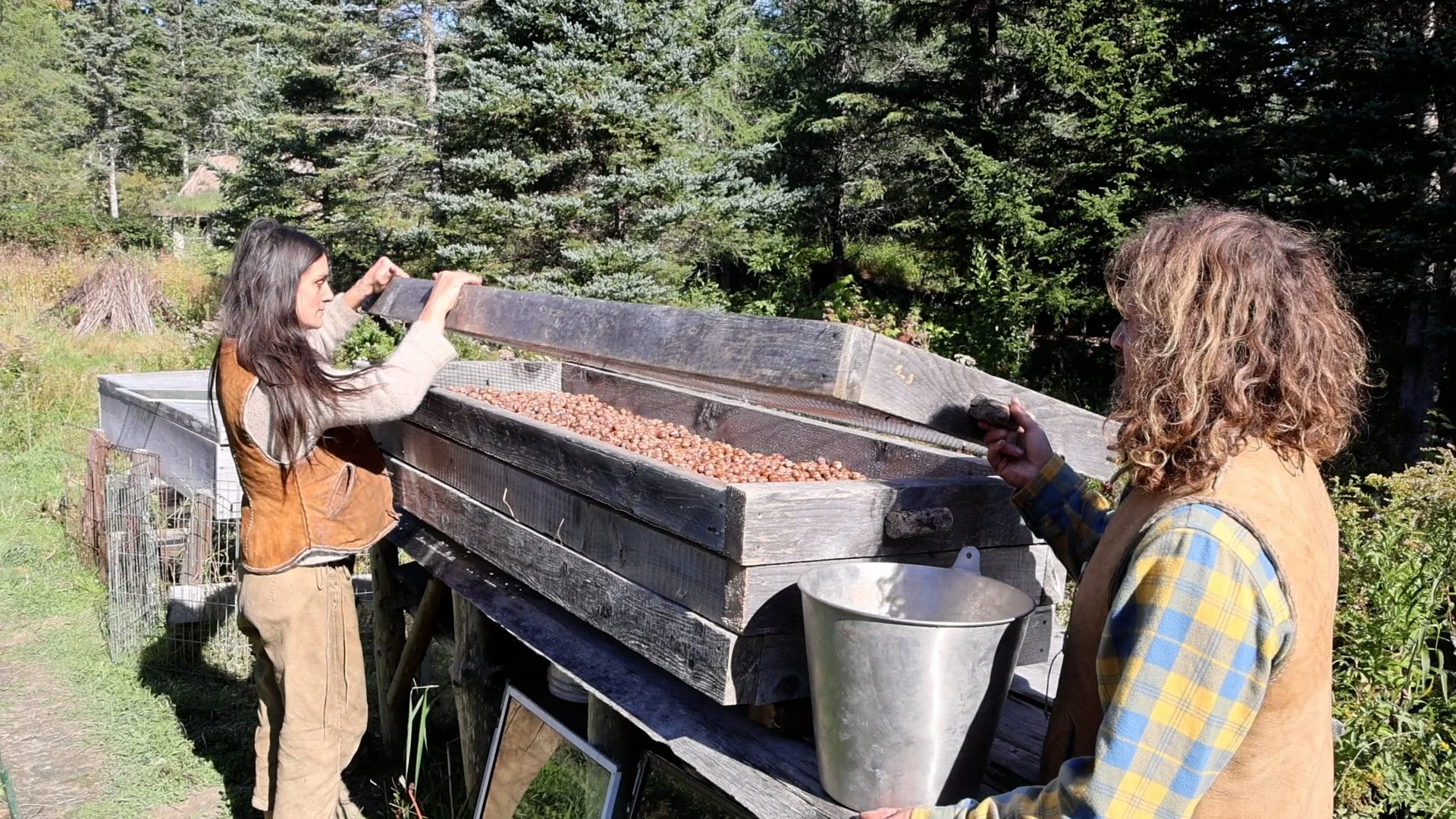
Co-founders of Way of the Earth School, Hannah Rhea and Colby Smith, with drying acorns they foraged. Photo by Maizy Weirich.
Their most involved offering is a four-month immersion program each summer, where up to eight students become completely immersed in the wilderness and landscape.
Members bathe in streams, sleep in home-made shelters, tents, or occasionally the “earth lodge – sleeping quarters made from wood, clay and straw, known as cob – and cook exclusively over an open fire and a rocket stove. During their stay, members learn a long list of “physical” and “internal skills” about using earth’s material and connecting with the land and oneself, among other things.
The program's cost is a sliding scale of $4,500 to $7,500.
Social media is one way the couple promotes their programs. The Way of the Earth School’s Instagram has over 22,000 followers.
Tour of the woodland campus
On an early autumn day, Smith, 42, and Rhea, 34, wore handmade leather vests fashioned from animal hides. Much of their wardrobe is derived from felting, hide tanning, and weaving. They procure deer hides from a local game processor, and sheep wool and goat skins from a butcher.
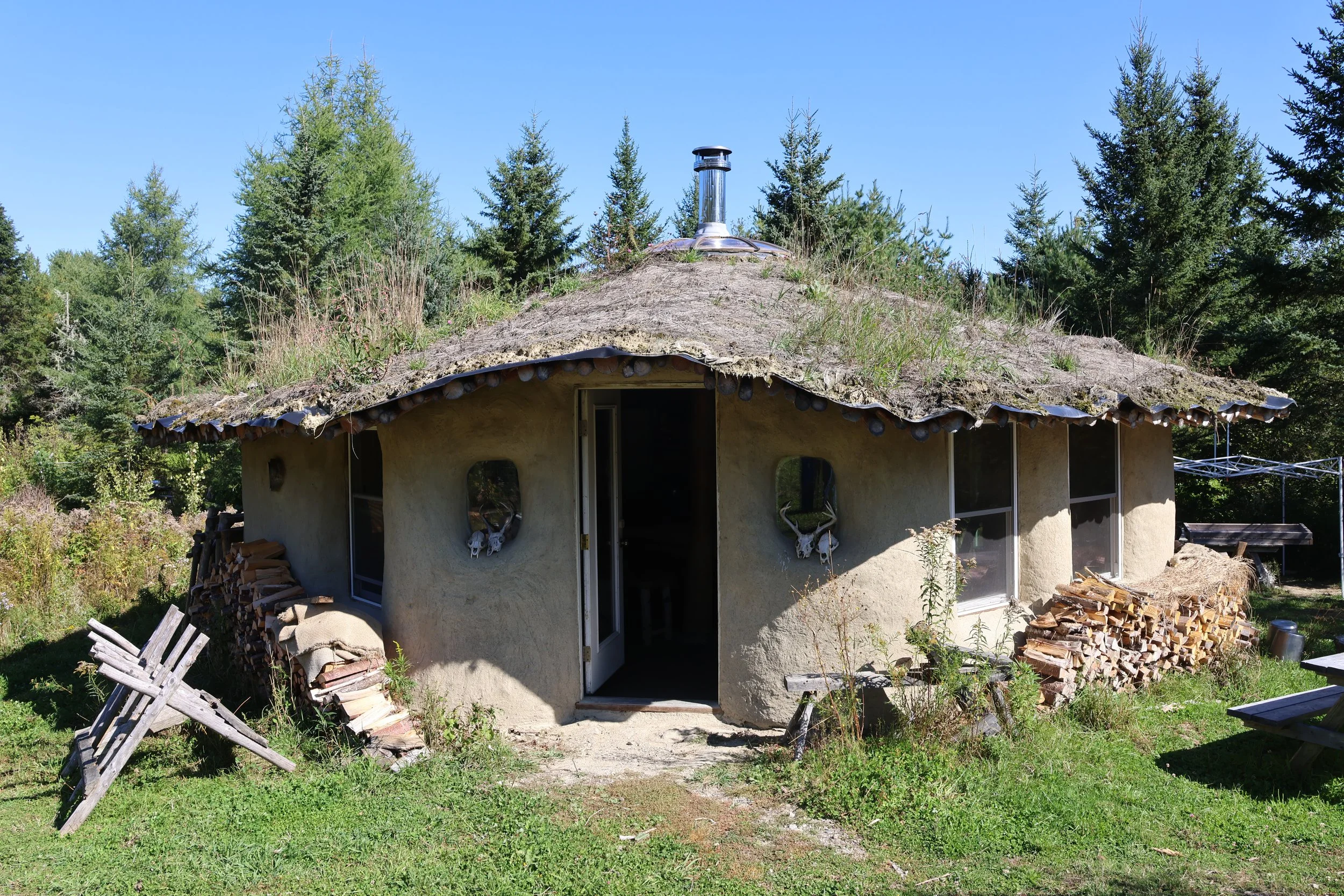
The classroom and community space for the school. It often hosts workshops and homeschool lessons. Photo by Maizy Weirich.
Down a path and through a field is the school’s classroom and community space.
The classroom is a yurt-style building with wooden poles for roof rafters. Smith and Rhea built the structure with natural materials from the landscape, using cob and trees from the land.
“We just kinda made it up. The materials available kind of dictate what you can make,” Smith said.
It wasn’t exactly a structure built from a handbook or design plans, they said.
“This style of building is very intuitive and relational. It’s not based so much on measurements,” Rhea said.
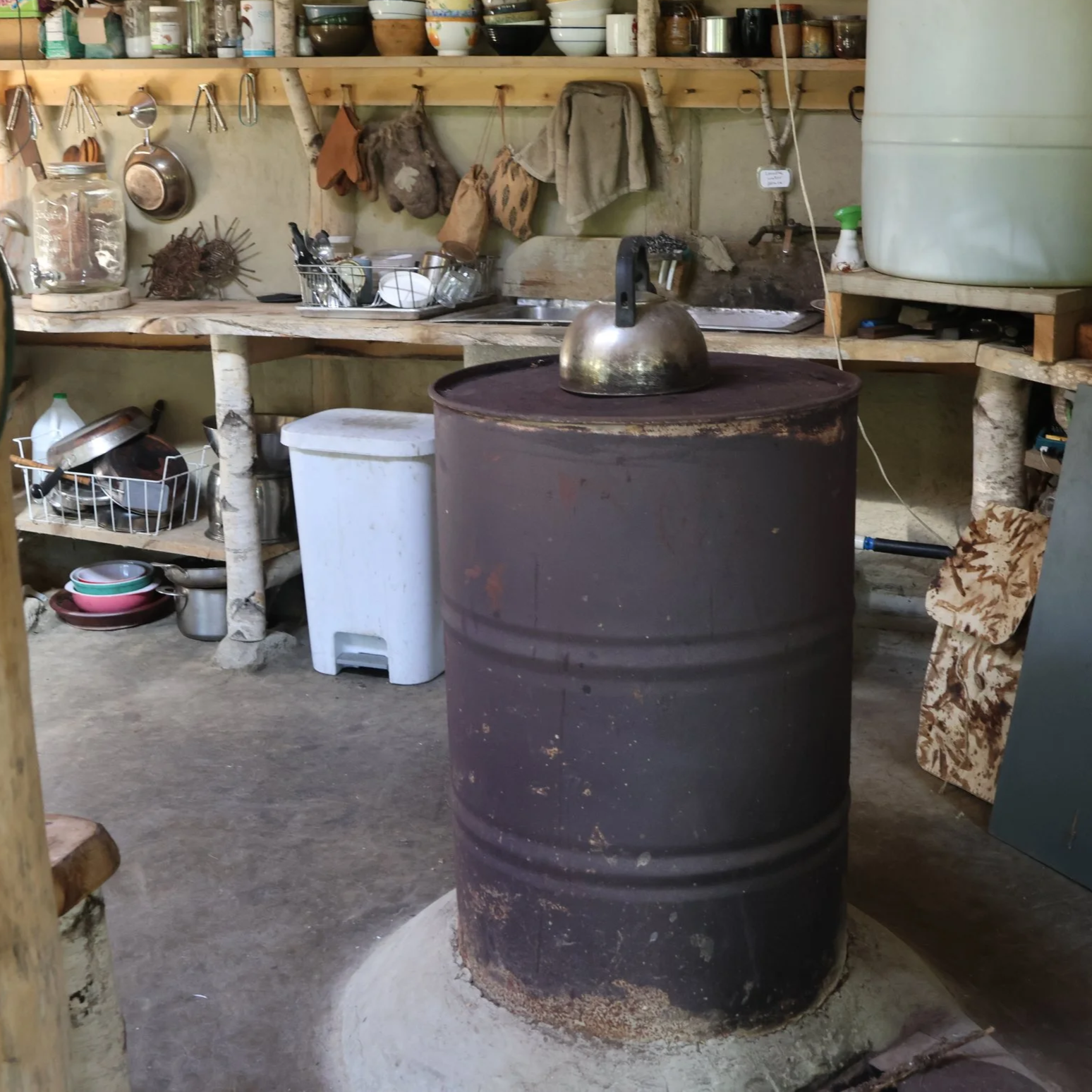
Exterior of rocket stove. Photo by Maizy Weirich.
The classroom is heated by one of several rocket stoves on the property. The cylindrical body of the stove creates a draft from fed wood, which then flushes and traps the heat underneath the ground of the structure, creating a radiant floor. The smoke travels through a stove pipe rising through the middle of the room and out through the roof.
“It loses all of its heat into the floor,” Smith said. “It's a lot more efficient way to burn than a woodstove.”
Rhea agreed: “It’s like 80 to 90 percent more efficient, so we don’t burn very much wood.”
Rhea said that their building knowledge was mainly acquired from the land, as well as from Ray Reitze, founder of Earthways Guide Service in Canaan, Maine, who taught them how to make their earth lodge.
The earth lodge is the couple’s home base, where they sleep and spend most of their time in the winter. The impressive structure is made of poles leaned against each other, as well as an industrial pond liner that acts as a moisture barrier.
Past the classroom and near the edge of the woods is the homestead’s living area, with an outdoor kitchen used in the warmer months. The outdoor space has a strong smell of spices and counters lined with jarred ingredients. The centerpiece of the kitchen is another rocket stove, but this time designed for cooking.
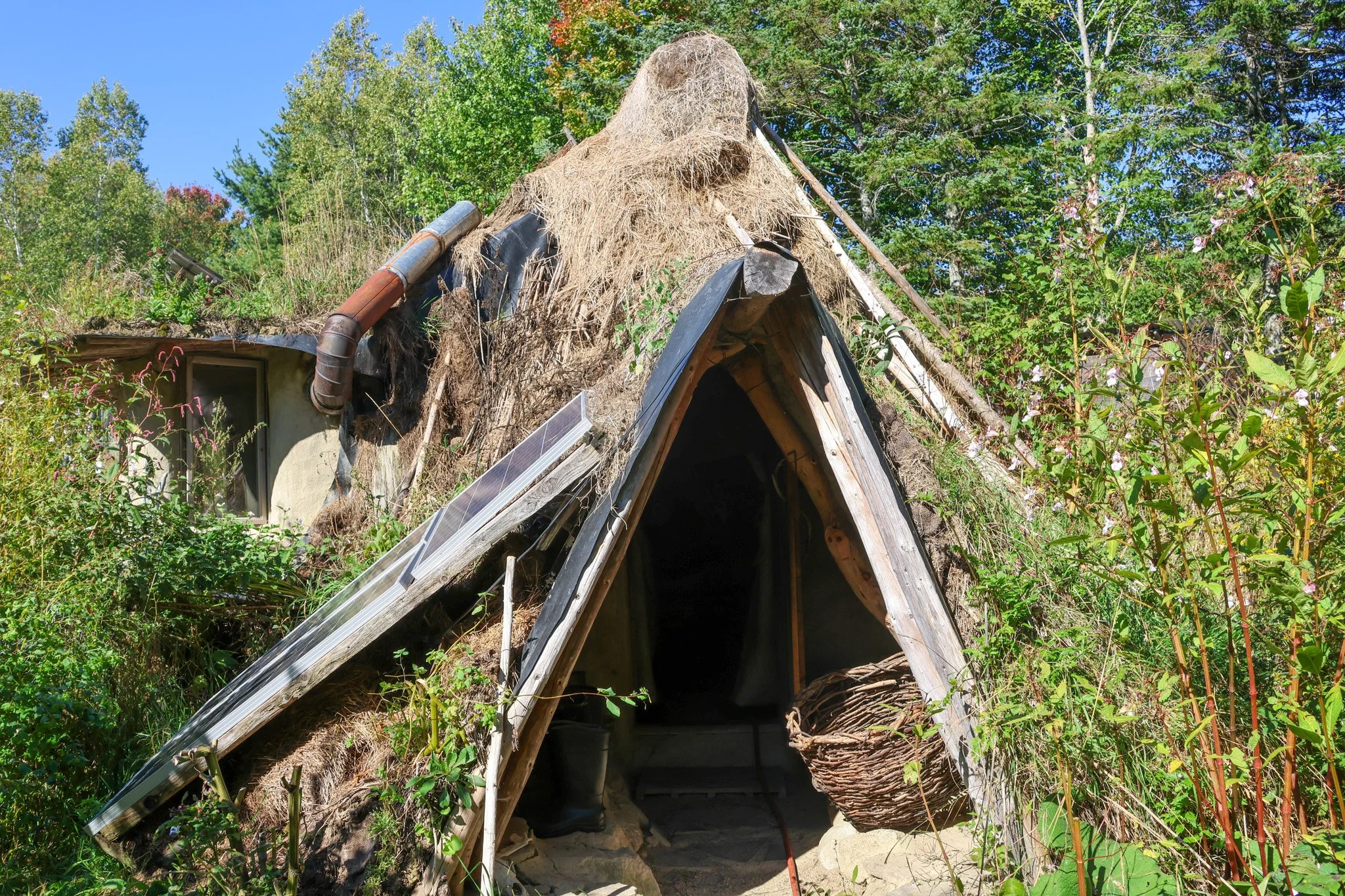
The Way of the Earth School’s earth lodge, composed mainly of cob and wooden poles, is heated with a rocket stove. Photo by Maizy Weirich.
Much of the food consumed at Way of the Earth is homegrown or foraged, such as acorns and wild tubers – sometimes stored in their root cellar – or from livestock, like their Nigora goats and Angora rabbits.
“We really focus on native wild foods here, and increasing the diversity and abundance of those species. So, as more of those get more mature, or the patches spread, they get more integrated into our diet,” Rhea said.
But there are some things that require a trip to the Blue Hill Co-op, she said.
“Like dairy and chocolate,” Rhea said. “You can’t not have chocolate.”
The couple retrieve water from an outdoor spring. The spring also fills a water tank nearby, enclosed within a smaller structure next to their root cellar, where some of the vegetables are stored.
In a larger field on the property, the couple tends a mix of garden beds, berries, and wild fruit and nut trees. Each year, they rotate a few fenced-in areas between their ducks and gardens.
The couple practices self-reliance when it comes to repairs. Rather than hiring a plumber or carpenter to fix an issue, Smith said, they just figure it out themselves, accepting the trade-off in time as opposed to money.
“When we build a building, it may take several months or a year or more. But it only costs, like, a few grand for the whole building,” Rhea said.
‘What if you actually have enough?’
While growing up in southern Maine, Rhea and Smith said they both had rather “normal” childhoods, they said. But in high school they both became interested in what they call “earth living skills” and in having an increased reciprocal relationship with nature. They moved to Blue Hill almost a decade ago.
They stress that they are not “sticklers” or “purists” for their lifestyle, but they do what they can.
“It’s more about the journey towards the earth. The more that we can participate in meeting our needs directly from the earth, the less isolated we are from that connection,” Rhea said. “It’s just our value system. I think living in integrity with your values is one of the most important things as a human.”
The couple's lifestyle is a constant learning process about themselves, as well as about what the natural world around them needs to thrive, too, they said. Rhea describes her connection of reciprocity and participation with the natural world as “belonging.”
“I have a really deep kind of fulfillment and contentment,” Rhea said.
Rhea also emphasized a spiritual relationship they have found with their lifestyle.
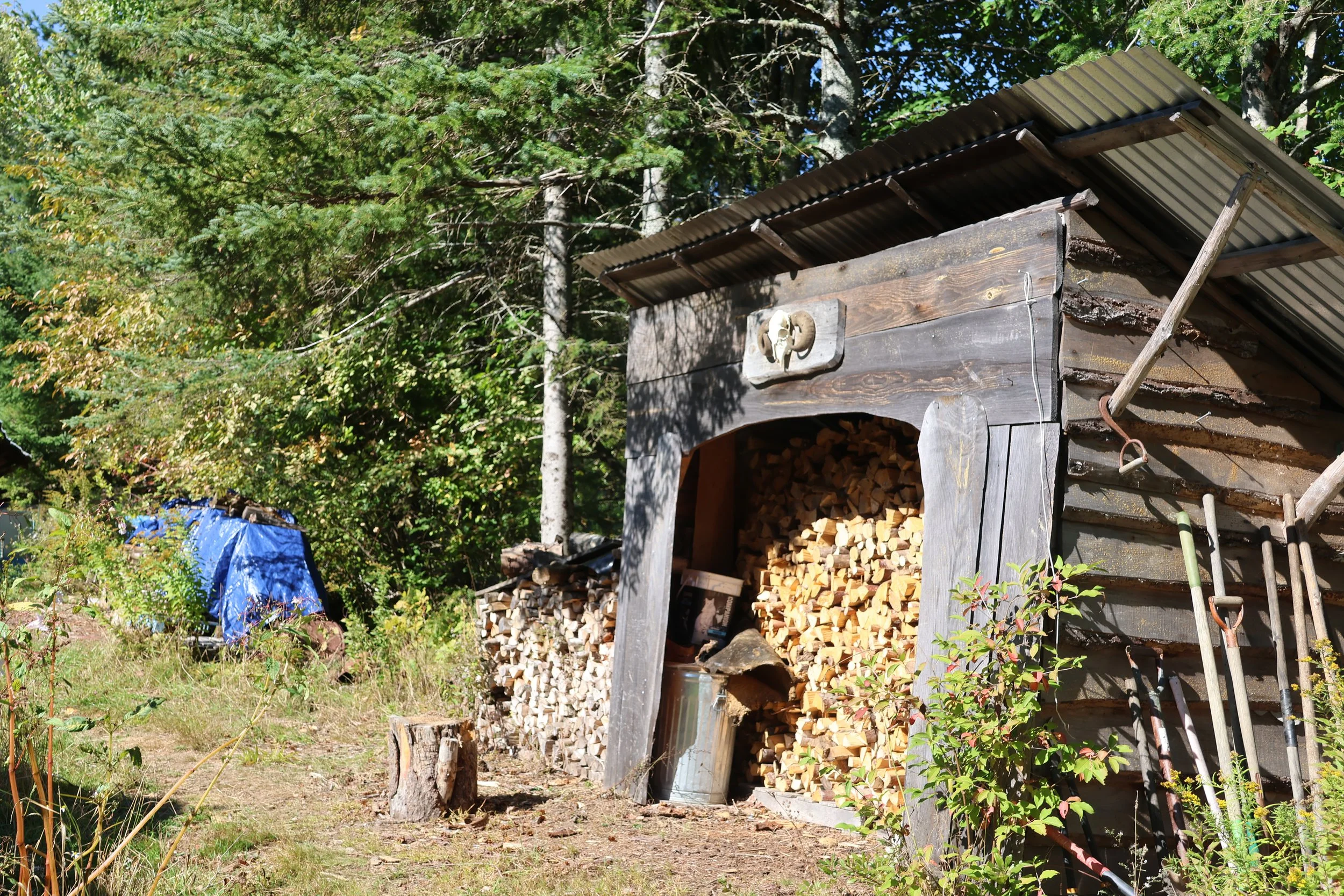
The couple’s wood shed. Photo by Maizy Weirich.
“I feel like the way we live physically really mirrors our spiritual relationship to the land,” Rhea said. "Because when you’re living very close to the land, you’re hyper-aware that everything is very alive.”
The couple believes there is an increasing interest in this way of life.
“I think we’re learning as a culture that the survival shows we watch aren’t the only reality of what it means to live close to the earth. There’s actually a way to be more in alignment, and to live, thrive, and not just focus on this ‘hardcore survival,’" Rhea said.
Although the summer is busier with the school’s four-month immersion program with six to eight other members on the land, the couple stays in Blue Hill throughout the more isolated winter months, often alone.
“We do feel that community is a really important skill, but it is sometimes hard to find people who are as in-depth at this as we are, and want to do it to the level of intensity we are,” Smith said.
Despite these challenges, they have had a couple of residents who have lived on the land for over a year, as well as a student who extended their stay from the immersion program. The couple is hopeful to have more community members settle on the land in the future.
While the Way of the Earth School is off-grid, Smith and Rhea still utilize some technology, such as a pickup truck and a cell phone. But before introducing technology into their lives, Rhea said they ask themselves: “What are you sacrificing for this technology? and “What are you going to replace that with?”
“We [society] create more and more things that have more and more needs, and make it more and more complex, mostly so that we’ll spend more and more money,” Smith said.
Rhea added: “It’s always just like ‘more, more,’ but what if you actually have enough?”
Facing the oncoming winter, the couple will slow down, match the ebb and flow of the seasons, and continue their constant “journey towards the earth,” Rhea said.
“I find this extremely comfortable,” Rhea said.
