

WHEEL WATCH: Newfoundland—the Island 60 years ago
A trip up the Canadian coast leads to fond memories of Stonington—and a call on a public phone to a departed older brother
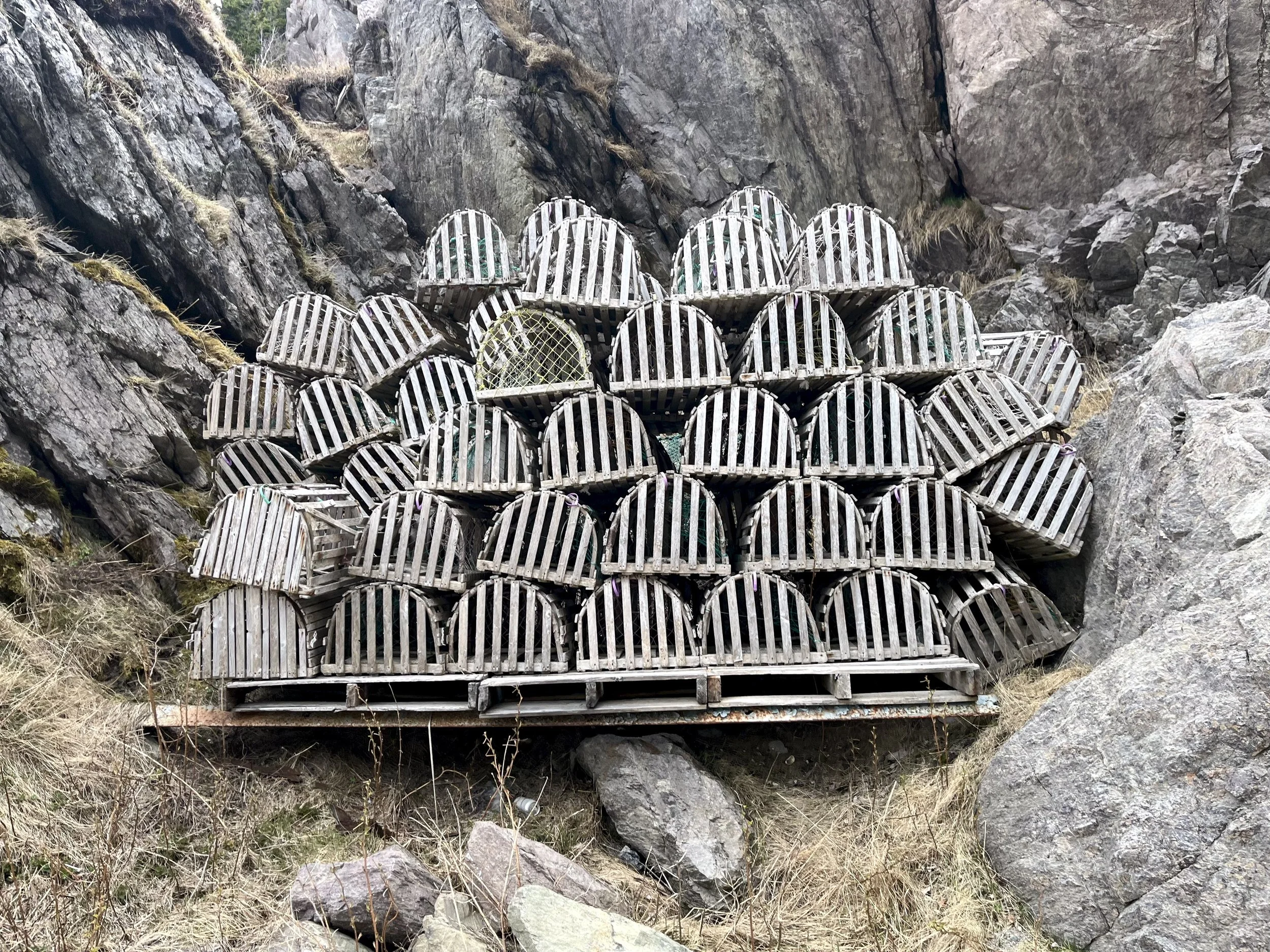
Although wire lobster traps have found their way to Newfoundland, some still fish wooden gear. All photos by Brian Robbins.
May 4, 2026
By Brian Robbins
When it comes to electricity, salt water is a conductor.
But when it comes to slowing time down, salt water is actually a great insulator.
Combine it with enough distance, bold coastlines, and weather that challenges more often than it coddles, and you have a place that time and progress are slow to get to – in the best of ways.
Like Newfoundland, Canada.
My wife and I just got back from Newfoundland – our third trip so far. I say “so far” because we both hope there’ll be more.
Ask me what we like about Newfoundland and if there’s a limit on time, I’ll most likely tell you, “It reminds me of the Island when I was a kid.” And that pretty much tells you all you need to know.
If we have time to sit and talk about it, I’ll tell you more.
Like that moment at sunrise of our very first morning on our initial visit to Newfoundland.
After ominous warnings to “Look out for the moose” during the ferry ride from North Sydney on Cape Breton to Port aux Basques, Newfoundland, we were hesitant to drive very far from the ferry terminal in the fog-swathed pre-dawn, unable to see much more than a car-length (or a moose-length) ahead of us. We’d eased just a little ways up the road from the terminal and hauled over to doze and wait for a little bit of light in the sky.
It wasn’t until things began to brighten that I realized we were parked just a few feet away from a stack of half-round wooden lobster traps – the kind of gear that I grew up with (the only halfway-presentable thing I ever learned to build out of wood and nails, truth be told).

Tigger, the author’s wife.
“Tigger, I think this place has been waiting for us,” I said to my wife.
Or maybe I’ll tell you about the fish weir we saw on our first kayak paddle that trip. We hadn’t much more than launched from the shore of the Codroy River when a familiar sight from long ago caught our eyes: a fish weir – two, actually. As we paddled by, we could see a fellow in an outboard working on one of them. I was transported back to my childhood, when Pa and Uncle James spent their summers looking for herring.
They always went stop-twining, shutting off coves to trap the fish, pursing them up in a pocket of twine to load into the bellies of the sardine carriers that used to travel the coast. But I also remember a weir they had, as well, off the shore in Sunset, I believe it was. By the time I got old enough to really work and be a part of things, the seining years were over for Pa and Uncle James. But as a kid, I got to hang around when they had shutoffs, and spent the occasional overnight aboard the old seiner Lucky Star, learning to quietly maneuver the outboard with Pa up in the bow, silently guiding me with a lean this way or the other.
Or how about the scrunchions we had – what I knew as “pork scraps” when I was growing up – during our first sit-down dinner in Newfoundland? “Scrunchions” were offered as an option with codfish and potatoes on the menu. I had to ask to find out what they were.
When I was little, Marm made the best fish and potatoes, the highlight being the fried-out pork scraps and their juices ladled over top of the steaming heap of boiled potatoes and fish. To be good, pork scraps must be fried to the point of being crunchy – darkish brown, but never burnt. Marm’s were always perfect.
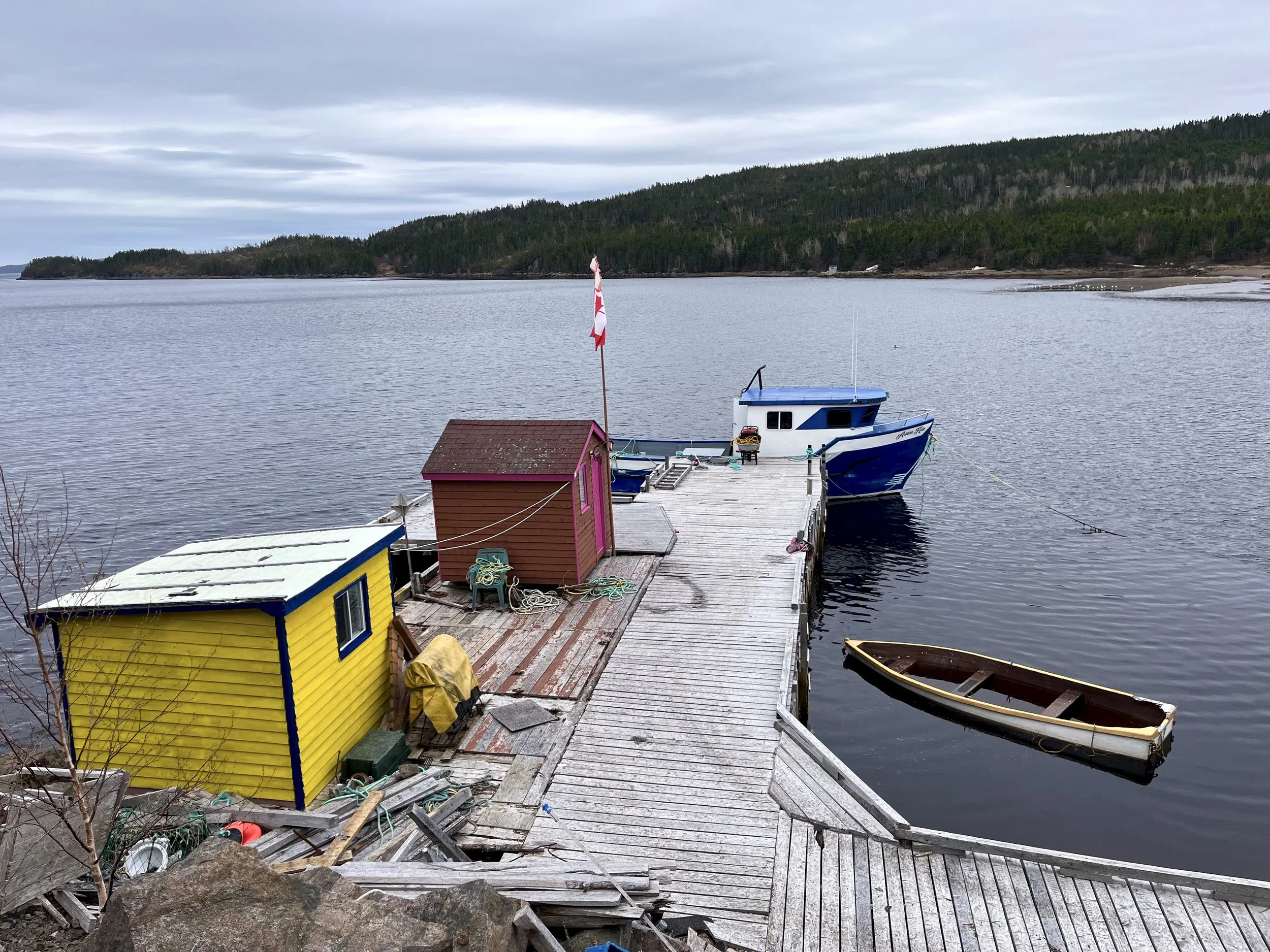
A Newfoundland “stage.”
I hadn’t had pork scraps for a long, long time. But we did that night. They might have been “scrunchions” on the menu, but they were pork scraps in my book.
And then there was the moment during our second trip up there that we realized when a Newfoundlander referred to a “stage,” they were talking about their small shop and wharf down on the harbor.
We were staying in the village of Southport, where our presence in town bumped the population up to 33. Not 3,300. Thirty-three.
Herb Avery, a veteran fisherman who still worked out of an outboard, lived with his wife Frances on the hill just above the house we were renting. Once Herb found out I’d brought my acoustic guitar with me, he was on us to “Come down to the stage on Friday night, b’y. They’ll be music and eating and everything.”
I wasn’t sure just what and where the “stage” was Herb was referring to, until maybe Thursday of that week when he reminded us of the get-together the following evening and pointed down to his little wooden building on the wharf at the head of the cove in Southport – dark green with red trim and a big painting of a codfish fastened up high on one side.
“Wait, Herb – that’s the stage you’re talking about?”
“Uh huh. Right down there, b’y. It’ll be a good time.”
Come Friday evening, we kept an eye out for the gathering on the wharf, and sure enough: Right around 6, we started to hear a little music and voices drifting up our way.
When you’re invited to sit in with a bunch of folks playing music, the best thing you can do is lay back a little and let them set the tone. I figured it would be a night of traditional Newfoundland tunes – and there were a few – but there were also some good ol’ outlaw country songs: George Jones, Merle Haggard, Waylon Jennings. For some reason, when it came around to me to pick a tune, I took a chance on Creedence Clearwater Revival – and “Lookin’ Out My Back Door” touched off plenty of foot stomping and hollering on the choruses.
At some point, Tigger gave me the high sign and dashed up to our house. When she returned, sliding the big wooden door open with one foot while balancing a bottle of store-bought screech and two cups of ginger ale, one of the young fellas in the crowd nodded and said, “Now there’s a real woman, right there.”
I can vouch for that.
There was a tall, wiry guy leaning against one of the posts. He’d barely said anything except to tell me he used to play a little guitar, but his hands “didn’t work so good” anymore.
He leaned down to me: “You like that there Creedence?”
He took a sip of the clear liquid he’d brought in a glass jar (definitely screech; definitely not store-bought), closed his eyes, and let loose:
“Put a candle … in the window …”
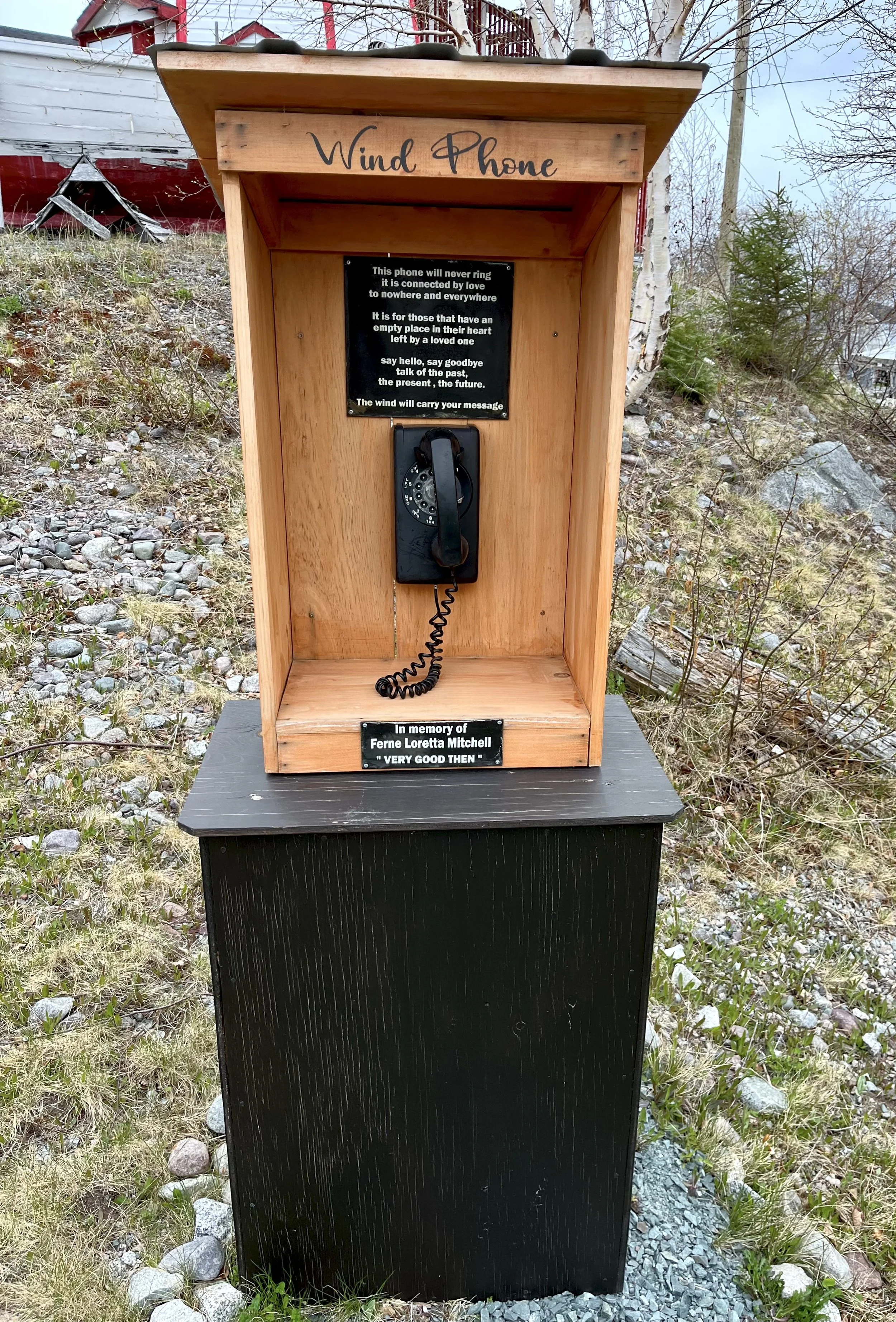
The “Wind Phone” in Burlington, Newfoundland.
Trust me: it was the best version of “Long As I Can See The Light” ever.
If you ever made it to one of the Sunday morning tunes at my brother Stevie’s workshop on Main Street in Stonington – music caulked in amongst the traps and rope – you have a sense of the scene. It was the kind of thing that happened a lot when I was young.
During our past trips to Newfoundland, I’d call my brother to tell him about something we’d seen or done, or some interesting character we’d met.
But Stevie’s gone. We’re coming up on six years since he passed.
So I was tickled during this most recent visit to discover the “Wind Phone” – an old rotary phone mounted in a wooden box on a post at the town landing in the village of Burlington.
“This phone will never ring,” read the sign above it. “It is connected by love to nowhere and everywhere. It is for those that have an empty place in their heart left by a loved one. Say hello, say goodbye. Talk of the past, the present, the future.
“The wind will carry your message.”
So I called my big brother.
And I’m pretty sure he heard me.
So ask me what it is we like about Newfoundland and I’ll tell you all those stories and more.
Or maybe I’ll just quote a line from an old Tom Waits song: “They say if you get far enough away, you’ll be on your way back home.”
—Robbins, who grew up in Stonington and now lives in Nobleboro, writes his monthly column “Wheel Watch” for The Rising Tide.