

LETTER: Effects of prolonged rockweed harvesting are not well studied
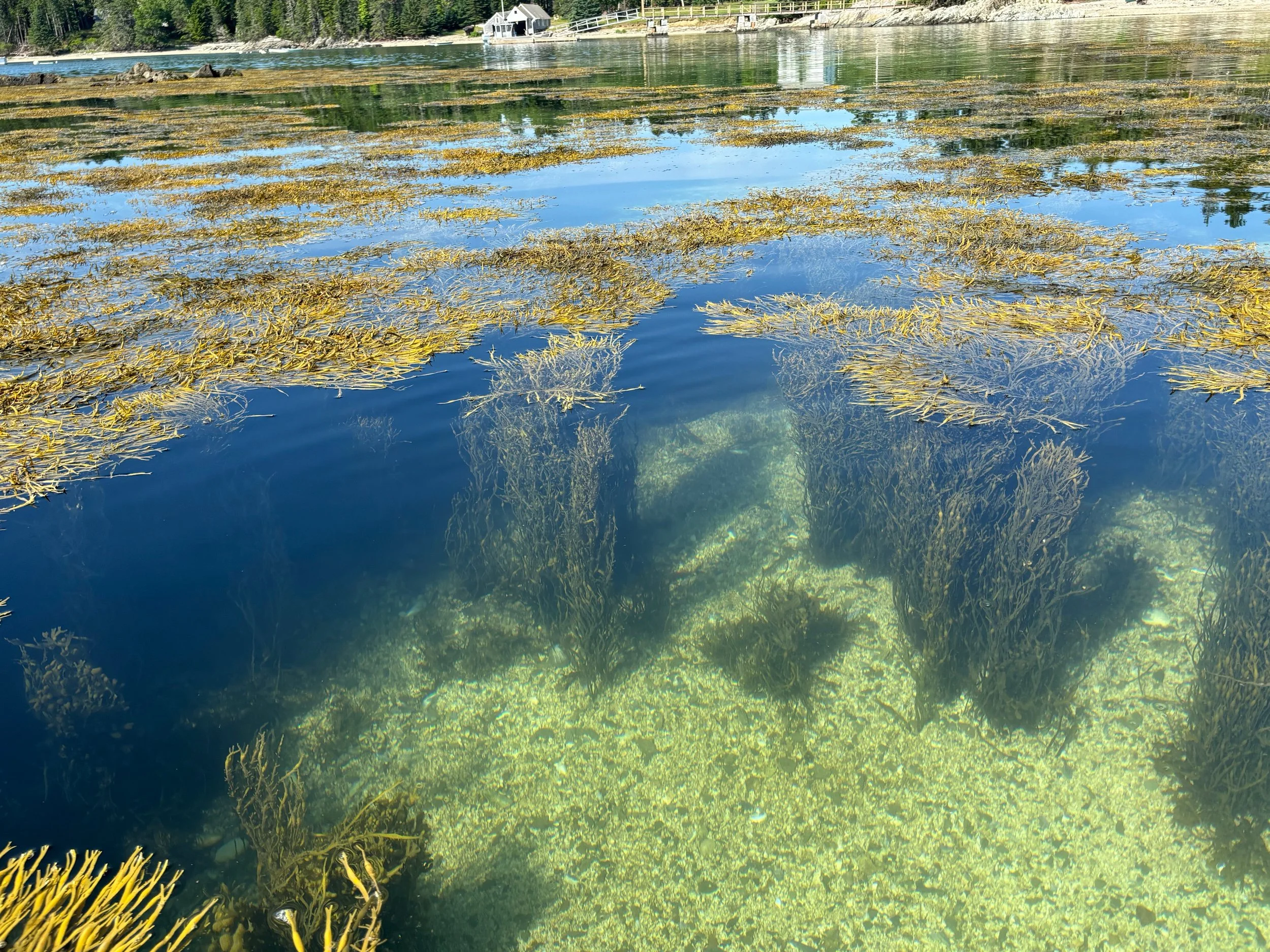
Rockweed harvesting has become more prevalent in recent years along the coast of Maine. Photo courtesy of David Porter.
By David Porter and Allison Snow
In a scientific review article published this month in the Journal of Marine Science and Engineering–and for which we were both among its co-authors–biologists working in Maine and Nova Scotia concluded that key experimental studies of rockweed’s recovery from harvesting often lacked scientific rigor and none have focused on the long-term effects of repeated harvesting.
Rockweed (Ascophyllum nodosum) is a slow-growing, perennial seaweed that flourishes on rocky shores of the Gulf of Maine. Ecologically, rockweed is considered a foundation species because it supports scores of invertebrate species, fish, shore birds, and other wildlife, forming an underwater forest at high tide and a moisturizing blanket over rocks and nearby mudflats at low tide. Decomposing rockweed drifts on the water’s surface as floating mats, washes up on beaches, and nourishes marine food webs. Many people are familiar with rockweed’s slippery brown fronds that are hard to traverse at low tide.
Rockweed also has great commercial value that supports industrial-scale harvesting. Each year, thousands of tons of rockweed are extracted from the Gulf of Maine and processed as soil conditioners, fertilizers, crop biostimulants, and other products. Rockweed is rarely killed by harvesting because the fronds are cut off above a sturdy basal holdfast that can sprout new shoots. A major research question, then, is how quickly can rockweed grow back and recover its natural biomass and three-to-six foot height after different intensities of harvesting?
The article, whose authors also include David Garbary and Herb Vandermeulen, both from St. Francis Xavier University in Nova Scotia, reviews the strengths and limitations of experimental studies published between 1981 and 2024. Because of important caveats in every study, we strongly recommend a more nuanced approach to citing these papers, especially when the results are used to discount possible negative effects of commercial-scale harvesting. In our review, we also suggest improved protocols for future research. We acknowledge that field experiments in rocky intertidal areas are inherently hard to carry out, and note that previous studies have contributed a great deal to our understanding of the ecology and resiliency of rockweed.
–Porter and Snow, both retired university professors, are co-founders of the Blue Hill Peninsula Rockweed Forum (rockweedforest.org), a volunteer conservation group that seeks to raise awareness about rockweed’s natural history and ecological services.
The Rising Tide welcomes letters and opinion pieces from a wide variety of viewpoints. Published pieces do not reflect the editorial stance of The Rising Tide and are not endorsements. To submit a piece to us, email info@risingtide.media. We ask that all submissions be original and exclusive to The Rising Tide.
