

Blue Hill voters elect Best to fourth term, approve $23M budget
Voters pass GSA supplemental tuition request by 2-1 margin

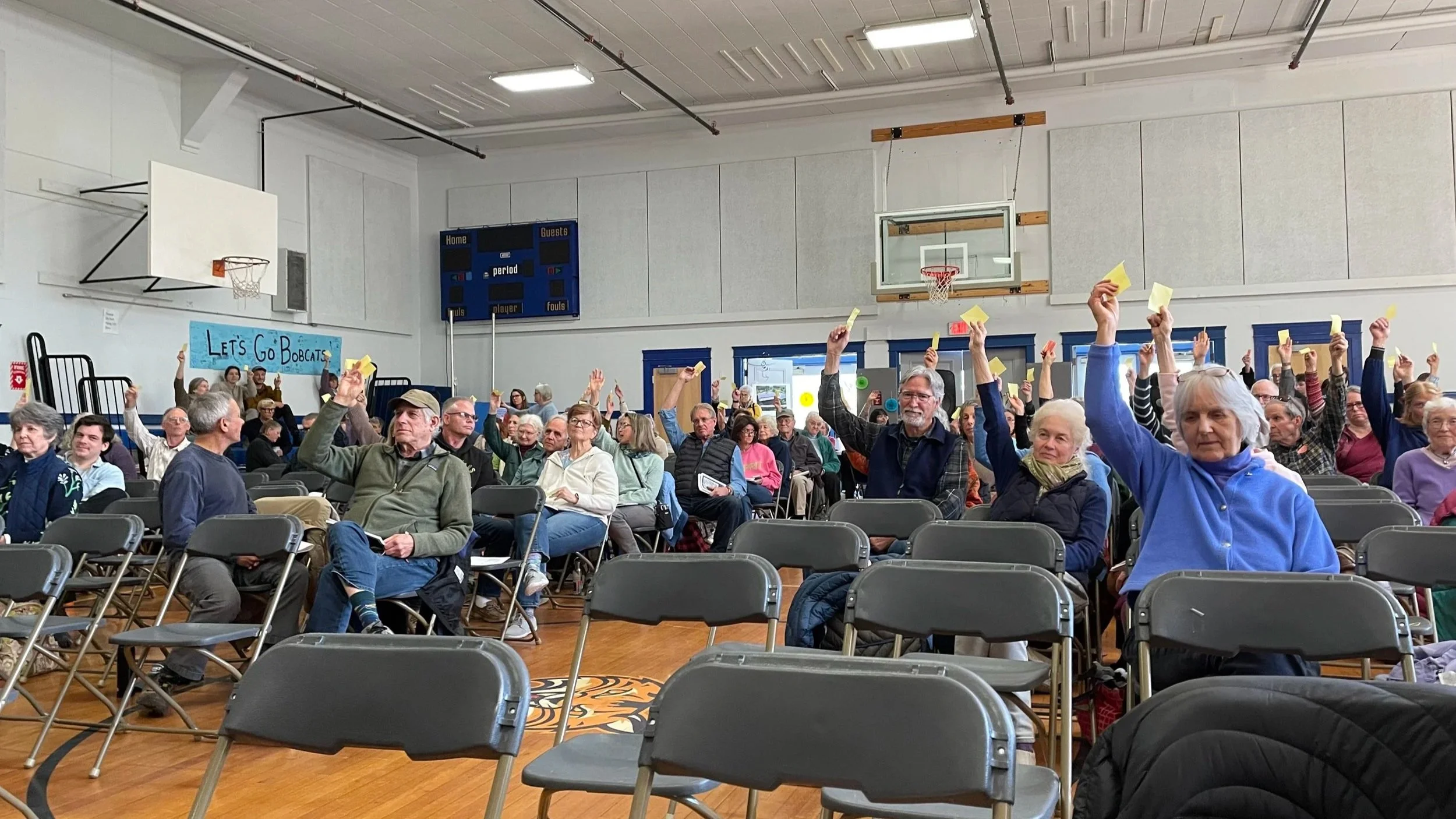
Voters decide by show of hands during the annual town meeting on April 3. Photo by Tricia Thomas.
April 7, 2026
By Tricia Thomas
BLUE HILL— Voters on April 3 reelected incumbent Ellen Best to a fourth, three-year term on the town’s select board, and approved by a two-to-one margin a request for supplemental tuition from George Stevens Academy. At Blue Hill’s annual town meeting the following day, voters also green-lighted a loan for a new public safety facility on Tenney Hill, and approved a $23-million budget that is expected to trigger a 9.7-percent tax increase this year.
Best, an attorney and select board chair, was re-elected over challenger Scott Cromwell by a vote of 238 to 203, the select board announced at the start of the town meeting. Voters also returned unopposed incumbents Marcia McKeague and Gavin Riggal to their seats on the planning board and re-elected unopposed incumbents Elaine Lawrence and Ben Wootten to the school board. A third candidate for the school board, newcomer Hannah Bates, also ran unopposed and was elected to her first, three-year term.
A request from GSA to pay $1,530 in supplemental tuition for each Blue Hill student who attends the school, totaling $116,280, was approved 302 to 149. This is the seventh consecutive year that GSA has asked sending towns to pay the supplemental tuition to cover budget shortfalls resulting from declining enrollment. This year’s request was $170 less per student than in previous years, and the school has committed to further reducing the ask in the years ahead as it works to balance its budget, increase enrollment and be more transparent.
So far, three of the seven towns that send students to GSA have approved the request, with the exception of Penobscot, which scuttled it by a vote of 94 to 92 on March 2. Voters in Surry will weigh the matter on April 10.
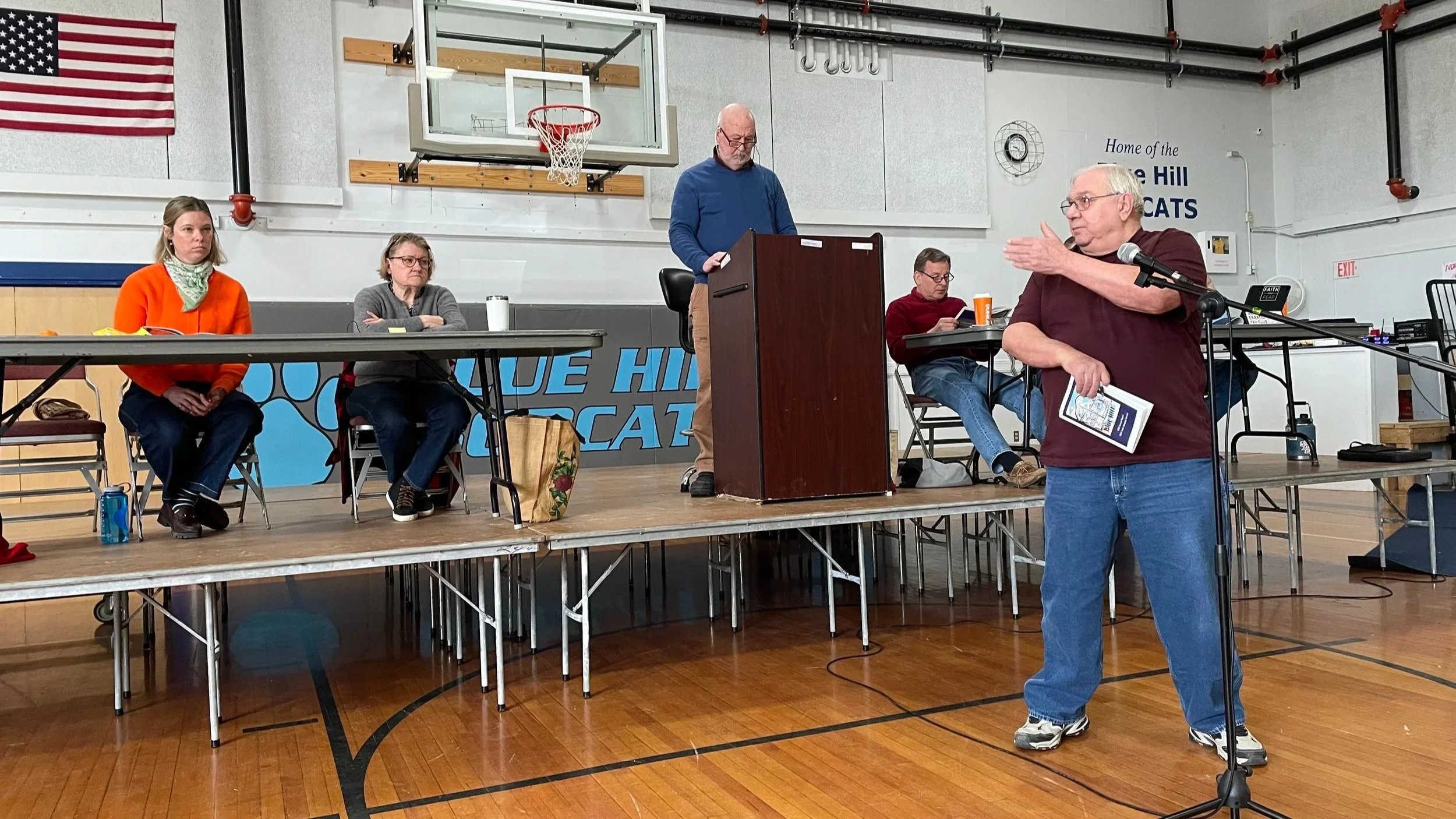
Resident Tim Horton asks questions about school budget. Photo by Tricia Thomas.
With only a smattering of questions and no vocal opposition, a majority of the more than 150 voters at the town meeting on April 4 approved—by voice vote, shows of hands and secret ballot—a series of warrant articles that made up the school district’s proposed $8.8 million budget for the 2026 fiscal year. The $8,865,479 school budget accounts for an estimated 40 percent of the town’s municipal budget. Regional school union 93 superintendent Derek Perkins, who attended and answered questions at the town meeting, has attributed the more than $1 million rise in this year’s budget to spikes in salaries, benefits and special education costs.
Nearly $878,000 was also approved during the four-hour meeting for town administration, including town staff. Before the vote, Best announced to the crowd that, due to the recent hiring of a second deputy clerk at town hall, office hours would be expanded from three to four days per week starting April 6. Bente Snow, hired as a full-time deputy clerk three weeks ago, brings the total number of public-facing town office employees to three, Best said. Snow joins full-time deputy clerk Ana Ruiz and full-time clerk Dana Goettler. Town treasurer Morgan Cousins and code enforcement officer Zavier Alvarez, both hired last year, also work in the town office but do not provide direct, counter-service to the public, Best said in an interview after the meeting.
The town reduced office hours last year after a spate of resignations. Starting on April 6, the town office now will be open from 8 a.m. to 5 p.m. on Mondays, and from 8 a.m. to 4 p.m. on Tuesdays, Thursdays and Fridays, Best told those gathered at the town meeting.
Select board member D. Scott Miller said that the town’s administrative costs also include a half-year’s salary for a new town administrator.
“This number includes a partial-year appropriation for a town administrator, if we find the right candidate,” Miller said.
The position has been vacant since former town administrator Julie Atwell resigned last summer. She was the town’s third administrator since the position was created in 2019. When Atwell resigned to take a job with School Union 93, the town said it would not immediately fill her position.
Voters were split and no decision was made on a select board proposal to reduce polling hours for next year’s municipal election. This year, polls were open from 10 a.m. to 8 p.m. Best called for a show of hands on reducing hours next year to 3 to 7 p.m.
“It looks like it’s about a tie, so we’ll see,” Best said after the vote.
The matter was further discussed at a select board meeting on April 6, with board member Amanda Woog expressing opposition to the proposed reduction, but no decision was made then either. If approved, any reduction in polling hours would only affect municipal elections. Mandated, 8 a.m.-to-8 p.m. polling hours for state and federal elections would remain in effect.
Voters at the town meeting on April 4 also readily sanctioned, by voice vote, a proposed $1.5-million loan and the use of $50,000 in unassigned funds to help pay for a new, $6.7-million public safety facility on Tenney Hill. When completed, the new facility will replace the aging fire and EMS station on Water Street. The town has applied for $3.4 million in federal grants to help pay for the project, and the $1,542,500 loan from the Maine Municipal Bond Bank will be used to match any federal funding received, town officials have said.
In addition, voters approved a $1.5-million loan, and appropriated another $1 million from previously granted funds, to replace a broken sewage outfall pipe emanating from the town’s harborside wastewater treatment plant. While the pipe, buried under Blue Hill Harbor, has been temporarily repaired since the break was discovered last year, it likely will need to be fully replaced, Miller said. The outfall pipe repair is separate from a long-planned wastewater treatment plant upgrade, which will begin this year.
The more than 150 voters who attended the town meeting also supported borrowing $1 million and appropriating another $600,000 in town funds for the reconstruction of Turkey Farm Road. The project is one of the last on a list of road improvement projects the town has been working through over the past several years, Miller said last month. Only $300,000 of the project’s cost will come from property taxes, Miller said. Reconstruction of Kingdom Road also was approved by voters, with $250,000 coming from taxes to pay for it.
A total of 13 warrant articles that proposed spending more than $106,000 in donations to local non-profits, including the newly formed Toddy Pond Watershed Management District, the Lawrence Family YMCA, and the Shaw Institute, generated much discussion near the close of the four-hour meeting.
After more than an hour of debate, voters approved all but one of the funding requests in their entirety. Only the Shaw Institute, making its first funding request to Blue Hill voters, had its ask reduced, from $50,000 to $3,000 for the year. Board member Amanda Woog told the crowd that she disagreed with the board’s recommendation that voters deny the institute’s request and pay it nothing.
“I was the one [select board] member who recommended $3,000 for the Shaw Institute. I think the general sense of the board was, in a tight budget year and with a first-time requester, $50,000 was a lot of money, and I agree with that.” Woog said. “But, I also think it’s a really important part of the community.”
Information on the school and municipal budgets approved at the meeting, along with the anticipated mill rate that will be set this summer, is available on the town’s website.
