

Deer Isle plans for $22M causeway upgrades
Work could start by late 2027 to raise both the Deer Isle and Little Deer Isle causeways

The Deer Isle Causeway will be raised more than four feet to weatherproof it in the face of storms like this one in early 2024 that flooded the roadway. Photo courtesy of the Deer Isle Fire Department.
June 15, 2026
By Jessi Hardy
DEER ISLE - A vital lifeline for the region, the Deer Isle Causeway is poised for a major transformation. After nearly a century of service connecting Little Deer Isle and Deer Isle, the aging causeway—originally built on a hard clay bar in the 1930s—is set to undergo a $22 million reconstruction to combat increasing erosion and ensure the road remains fully functional for decades to come.
The Maine Department of Transportation held a public meeting and presented the project for residents to view and comment. The meeting was held at the Deer Isle Town office on June 10 with a dozen residents in attendance. The project is due to start some time in 2027-2028 with a completion date of 2029-2030.
The two-year project is fully funded by Congressional Direct Spending – formerly known as federal “earmarks” – as well as state funds. There is no expected cost from the towns.
Reconstruction also includes upgrading the Little Deer Isle Causeway next to the Deer Isle bridge.
The reconstruction project is a collaborative effort involving the Maine Department of Transportation, the towns of Deer Isle and Stonington, and the Hancock County Emergency Management Agency (HCEMA). This project, which has been in development for nearly four years, was consistently identified as a top public safety priority in the HCEMA mitigation plan. The current momentum for this work accelerated following a 2022 tabletop exercise with local first responders, and was further underscored by severe erosion and flooding events experienced during 2023 and 2024.
Design and timeline
The project design is expected to remedy the issue of flooding, which became a critical concern after a winter storm in 2024 brought water levels 18 inches over the causeway.
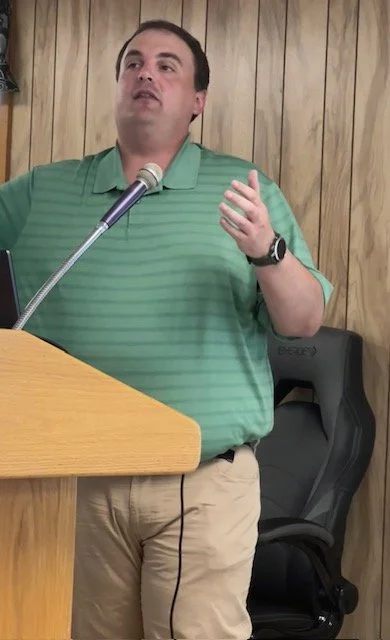
Project manager Paul Pottle from Stantec explains the Deer Isle Causeway Project to the public. Photo by Jessica Hardy.
The reconstruction is aimed at “making it more climate resilient hopefully for the next 75 years,” said Deer Isle town manager Jim Fisher, opening the presentation.
The new design will raise the causeway four and a half feet, from 9 feet to 13.3 feet of elevation. Each side of the causeway will be widened to provide a five-foot shoulder, will improve driveway access for more safety and visibility, and will have heavy stone rip-rap to help with future storms. Causeway Beach access will be reduced to one driveway instead of two with an area to turn around.
“The beauty of the way the causeways are, is all the approaching roadways into the causeway, are coming down. It made it really easy to raise the causeway and tie into the existing [road] relatively well,” said Paul Pottle, a project manager with Stantec, the engineering firm.
The project will be conducted in three phases. Phase one will focus on base layer construction while maintaining two-way traffic. The second and third phases will be completed one side at a time, limiting traffic to one lane with signals.
The project will be put out to bid in 2027 with the hope of starting late that year or early in 2028.
Community concerns
While the causeway is widely considered the best road on the island, the upcoming project has prompted some concerns among residents.
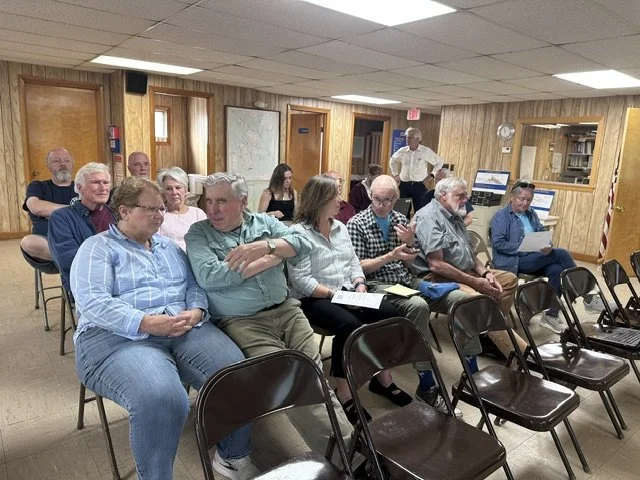
Residents from Deer Isle and Stonington attend the public meeting for the Deer Isle Causeway Project. Residents filtered in and the meeting became standing room only by the end of the meeting. Photo by Jessica Hardy.
Ray Weed asked about the small pond alongside the Little Deer Isle causeway, the driveway into his property, and any potential future flooding of the land. Eleven driveways will be affected by the new design.
Others asked about the noise from construction and whether the cost will change two years down the road.
One concern was first responders having the ability to get to an incident. Responders will be equipped with a preemptive device to activate the traffic signals, planners said.
“Basically, it’s a button you push as you’re approaching the signal. It tells that signal that you are now the primary. It stops traffic from coming the other way. You may have to wait for however long it takes to clear a path but it will immediately stop and have things go in the other direction,” Pottle said.
The public is able to view the project online until June 24 and may submit comments and questions until that time. Questions will be answered by MaineDOT staff.
For more information on the Deer Isle Causeway project visit the MaineDOT website. For any follow-up questions, please reach out to Senior Project Manager Laurie Rowe at 207-215-5072 or Laurie.Rowe@maine.gov.
