

Firefighters hold open house to showcase need for new station
Deer Isle’s fire station buildings plagued with challenges including black mold, cramped space, and lack of safety ventilation
Aug. 11, 2026
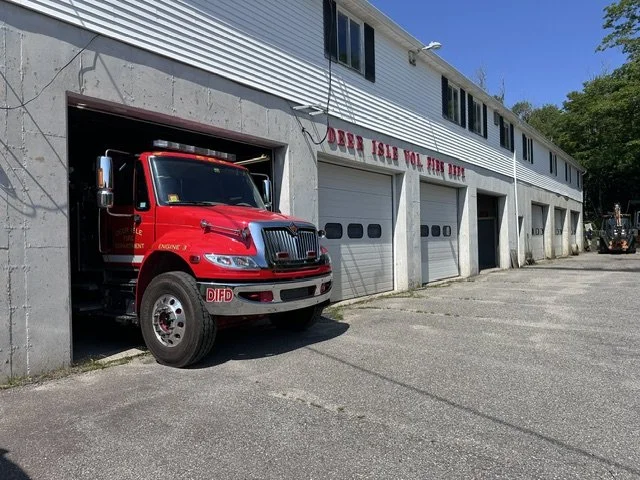
Working under the hood of a large fire truck often requires the vehicle to be parked half in and half out of its bay, Deer Isle firefighters say. Photo by Jessi Hardy.
By Jessi Hardy
The Deer Isle Volunteer Fire Department is sounding the alarm over the deteriorating state of its infrastructure, opening its doors to the public on Aug. 9 to showcase the conditions that firefighters say are threatening their health, safety, and the department's operational efficiency.
The department is seeking $7 million for the construction of a new, consolidated facility to replace its aging firehouse.
The volunteer crew, consisting of 21 members, opened their doors to the public to showcase that the issues are more than just cosmetic. Station One, built in 1974 and located beneath the Deer Isle Town Hall, has severe space constraints that prevent the installation of modern safety equipment.
"You can't work in the engine compartment of any of them without opening the door first," Deer Isle Fire Chief Brent Morey said.
Morey said fire trucks must often be parked only partially within the stations’ bays so their hoods can be opened for basic maintenance. Low ceilings make it impossible to install a diesel exhaust collection system to protect firefighters from carcinogens, he said. The tight spaces make it difficult for firefighters to maneuver within the building, he said.
The department's second location located in the old former elementary school built in 1952 is in equally poor condition. Firefighters have reported persistent black mold in training rooms, bays and bathrooms. The rubber roof leaks, leaving standing water on the floors after rain. Like the department’s other building, there is no exhaust ventilation system.
“We can't put a diesel exhaust collection system in, because the ceilings are too low, and we can't do any of this stuff, to make it safer for the firefighters,” Morey said “The place is full of stuff [equipment].”
Perhaps most critically, the department lacks a dedicated decontamination station.
Currently, firefighters risk bringing carcinogens and contaminants home to their families or back into their living spaces because there is no separate entrance or facility to properly wash gear and shower after a call.
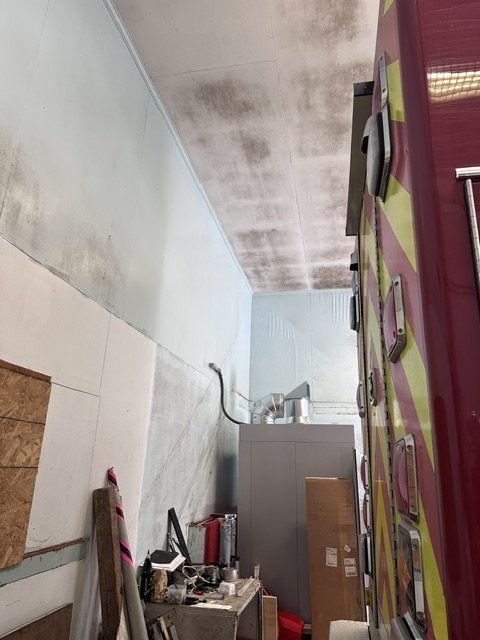
Black mold on the ceiling of the fire house is a serious health issue, firefighters say. Photo by Jessi Hardy.
“Black mold can lead to respiratory disease, kidney disease and autoimmune disorders,” said Dr. Timothy Cobb, a primary care physician who is a member of the fire department. “With a new station we’ll have a separate entrance,a decon station, and separate lockers where there is a fresh pair of clothes.”
Cobb said that a new building will help with firefighter health as well as volunteer recruitment.
“Our firefighters are aging, and the current environment—where we struggle to train—is a distraction. A new fire station will eliminate those hurdles, creating a space where we can focus on our community,” Cobb said.
The estimated cost for a new, consolidated facility is approximately $7 million. While the department has applied for various grants and congressional funding, they have yet to secure the necessary capital. The department is concerned delaying the project will only drive costs higher as material prices rise.
“We have solutions to problems. The next step is funding,” Ronnie Billings, a 40-year veteran of the department said.
Currently, a playground, ball field and community garden share the property. The new proposed building will use recycled material from the current site to build up the ground for a new playground, Morey said.
The proposed facility has been “designed by firefighters, for firefighters,” Cobb said.
The proposed design even accounts for future needs, including the inclusion of space for bunk rooms designed to accommodate a potential future transition from the current volunteer model to a hybrid or full-time staffing model, part of a plan to create a new home for the department that will last 50-75 years, Morey said.
