

New policies–and punishments–for students who use cell phones in class
Deer Isle-Stonington schools adopt policies for state’s new cell phone ban
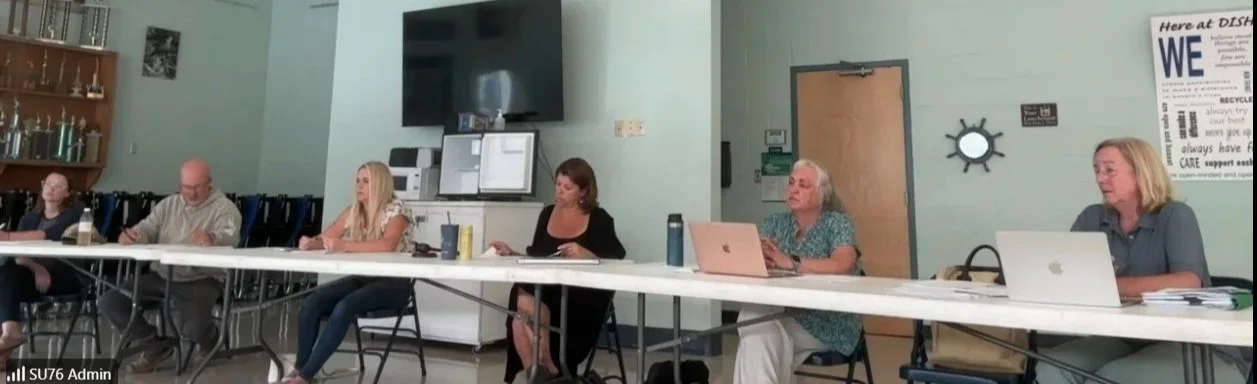
The Deer Isle-Stonington School Board at an Aug. 10 meeting to adopt a new policy on school cell phone use. From left are members Alison Billings (replacing Darian Gove), Darrell Williams, Chelsea Torrey, Genevieve McDonald, Lynn Witham and Superintendent Tara McKechnie. Photo by Jessi Hardy.
Aug. 11, 2026
By Jessi Hardy
When Deer Isle-Stonington students return to school at the end of August, they’ll have to abide by new rules on cell phone use.
The consequences for using a phone in school, which apply equally to students from kindergartners to high school seniors, range from lunch detention to out-of-school suspension.
The policy was created in response to the state of Maine’s new “Bell to Bell, No Cell” ban on cell phones in schools that was signed by Gov. Janet Mills earlier this year.
Deer Isle- Stonington High School Principal Rebecca Gratz attended the CSD 13 school board meeting on Aug. 10 to provide clarification of the policy the high school and elementary school is implementing.
The policies for the two schools were drafted this summer.
“I really appreciate the parents and the students and the teachers who took time this summer to work on them,” Gratz said.
According to the new policy for both schools, all students must hand in their cell phones and other “smart devices” in either their advisory, homeroom or main office.
The devices will be placed in a portable lock box and returned to the students at the end of the day. The board also noted that in case of evacuation, the lock boxes are portable and are able to be transported out of the building.
If a student claims they didn’t bring a device to school, their parents will have to confirm that to school officials.
The policy also lays out the penalty for possessing a phone during the school day. Gratz confirmed there will be no special circumstances or exemptions to the policy.
The punishments for having a phone in class are as follows, as stated by the policy:
First Offense: The device(s) will be confiscated by an administrator, a parent/guardian will be contacted, the student will serve a lunch detention with an administrator, and the incident will be logged for behavior tracking purposes.
Second Offense: The device(s) will be confiscated by an administrator, a parent/guardian will be contacted and will have to pick up the device, the student will serve a 30-minute after-school detention which will mean they cannot attend practice/games/rehearsal that day, and the incident will be logged for behavior tracking purposes.
Third Offense: The device(s) will be confiscated by an administrator, a parent/guardian will be contacted and will have to pick up the device, the student will serve up to one day in school suspension, which will mean they cannot attend practice/games/rehearsal that day, and the incident will be logged for behavior tracking purposes. The student may be subject to random bag checks/searches after the third offense.
Fourth Offense: The device(s) will be confiscated by an administrator, a parent/guardian will be contacted and will have to pick up the device, the student will serve up to one day out of school suspension, which will mean they cannot attend practice/games/rehearsal that day, and the incident will be logged for behavior tracking purposes. On the morning the student returns to school, a parent/guardian and the student will meet with an administrator. The student will be subject to random/regular bag checks/searches after the fourth offense.
Gratz said she’ll be curious to see how students navigate social situations without any smart devices at their fingertips.
“You also know what's going to be challenging for our kids is to learn how to talk to each other without having videos to share and things to show each other. So it'll be interesting to see how things are in the cafeteria,” Gratz said.
–John Boit contributed to this story.
